
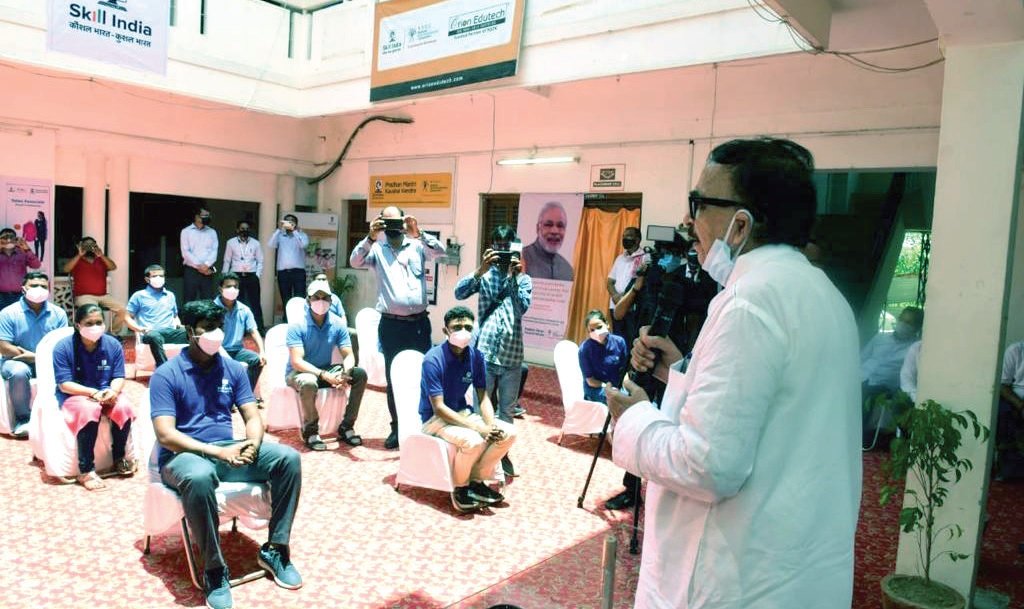
Corporate social responsibility (CSR) initiatives are an excellent opportunity for companies to make targeted interventions to address gaps in skilling that can prove to be catalytic both for the industry and the workforce.
CSR is an opportunity to work with like-minded partners for the betterment of society at large. Business cannot be successful if the society around you does not prosper. A well-planned and well-executed CSR activity can help foster a strong bond between the company and its people. It also helps in developing a deeper human connection. He added that consumers now are also aware and like to align with companies that invest their time, money, and efforts in creating a sustainable environment for all.
There is a huge scope to launch CSR initiatives in vocational training to improve the skills and employability of the needy and poor. Skill India seeks to give all Indians the opportunity to aspire and achieve a better future for themselves and their families. A combination of demographic, economic, and social factors make skill development an urgent policy priority for India.
According to a report by Samhita, Enhancing Capabilities, Empowering Lives CSR in Skills and Livelihood: What are India’s top companies up to? “While the corporate sector had always recognized the need for skill development and invested in skilled human resources for their operations, the introduction of Section 135 of the Companies Act, 2013 gave a fillip to their efforts through Corporate Social Responsibility. Under the ambit of CSR, skilling and livelihood development have garnered considerable interest among companies.”
Special CSR Thrust for Skill Development
Support interventions across the value chain
There are three ways in which a more holistic approach can be promoted –
- Companies can support the entire value chain themselves as part of their CSR projects with the help of their implementation partners
- Companies working in the same geography can collaborate with each other and other funders to create a ‘collective impact’ model where each company individually supports a particular step in the value chain
- Companies can support one particular gap at scale. For example, a company can support temporary hostel accommodation in an SEZ or grant awards for trainers across various institutes and invest in their capacity
Go beyond CSR as defined by Section 135
While Section 135 has offered an unprecedented opportunity for companies to participate in skills and livelihood development, it should not be seen as the only means. Some other models that can be explored are:
- Apprenticeships are a mutually beneficial way to skill the youth in a practical and application-oriented way. Recent amendments to the Apprenticeship Act 1961 are intended to simplify and streamline the process to encourage more corporate participation.
- As responsible employers, companies can go beyond CSR in ensuring fair wages to not just their employees but also contractual labour and supply chains
- Investing in and using micro-entrepreneurs and other social enterprises as vendors or suppliers for business products and services.
The government has asked the Public Sector Units (PSUs) in many sectors to utilize CSR funds for skill training and set up Centres of Excellence in collaboration with DGT or NSDC through strategic partnerships. These partnerships will play an important role in scaling up skill training initiatives and ensuring that skill training takes place at high quality in all sectors.
The government is focused on skill development. It is evident in setting up a dedicated ministry for skilling. It gives a lot of confidence to companies that wish to align their CSR activities with livelihood programs. One can expect more firms to enter the skill development space through CSR. The report by Samhita found that 90% of the top 100 companies had at least one CSR program in skills and livelihood development in the past three years. The median CSR budget allocated to skills and livelihood development was `3.92 crore, accounting for around 12.7% of the total CSR budgets on average.
According to industry experts, “the demand for Vocational Training is also here to stay and grow. It has been reported that India would continue to witness significant drop-out rates in high schools, as high as 60%. Though this might decline to 45%-50% by the end of 2022, it would remain a challenge. Therefore, Vocational Training is expected to be a key focus area to serve the needs of those who missed out on mainstream education.”
Such experts also point out that skill requirements in various sectors would drive the overall demand for skill development. Therefore, sector-based participation in CSR-oriented skill development initiatives and related industry-institute tie-ups is a strong possibility.
Implementation of many skill development initiatives that are announced and quality of execution has major scope for improvement. A clear trend of companies thinking strategically about CSR by offering programmes aligned to their core products, or business needs, is visible in many studies and reports. However, corporate India was not fully leveraging its non-financial expertise and resources to bring more rigor to the skills ecosystem, with very few companies offering non-financial support to their skilling programs and implementing partners.
The Samhita report suggests that companies and other organizations are attempting to span the breadth of the value chain through their programs and initiatives. It also urges them to look beyond CSR to enhance skill development.