Impact Stories

LaBL 2.0 sustainable livelihood program

LaBL 2.0: Powering Livelihoods Through Clean Energy Innovation

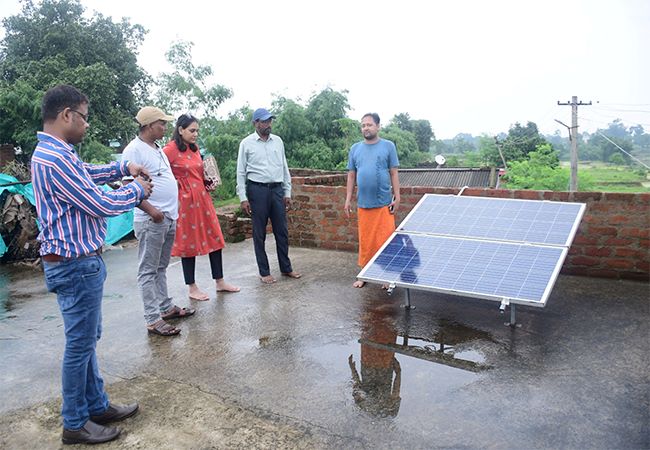
About the Initiative Lighting a Billion Lives©, launched by The Energy and Resources Institute (TERI), was a global initiative to facilitate access to clean lighting for energy poor communities across the world. In operation since 2008, the campaign enabled communities to transition from harmful kerosene based mediums to cleaner, more efficient and sustainable lighting alternatives through an entrepreneurial model of energy service delivery. Building on the success of the Lighting a Billion Lives© campaign, which provided energy access in India, South Asia and parts of Africa, TERI is launching LaBL 2.0 (Leveraging Clean Energy for a Billion Livelihoods), which aims to push the boundaries of energy access to energy for productive activities and builds the ecosystem for just energy transition.
Read More »
Net-zero targets India

From Net-Zero Targets to Last-Mile Impact: Powering India Through Decentralized Renewables

Authors : Mr. Prashanta Kumar Swain, Fellow, Social Transformation and CSR & Dr. Amit Kumar Thakur, Associate Director and Head CSR Introduction India has set ambitious and globally significant clean energy targets—500 GW of non-fossil fuel capacity by 2030 and net-zero emissions by 2070. These targets reflect not only climate leadership but also a development imperative: powering growth, livelihoods, and resilience sustainably. In recent years, India has accelerated renewable capacity additions, reaching 267 GW of installed non-fossil capacity by 31st December 2025. Rooftop solar, agri-solar, and decentralised renewable energy (DRE) solutions have expanded rapidly. Solarisation of agriculture, schools, health centres, MSMEs, and other community infrastructure is gaining momentum, supported by policies such as PM Surya Ghar and PM-KUSUM, falling technology

Read More »
CSR Energy with care

Energy with care: Powering progress through community well-being

When we speak of power, the conversation often revolves around megawatts, machinery, and transmission lines. At SEIL, power holds a deeper, more human meaning – the power to forge sustainable pathways toward dignity, health, and opportunity. As a responsible independent power producer operating advanced supercritical power plants, we understand that our long-term viability is intrinsically linked to the well-being of the communities we operate within. Our approach to CSR is guided by the strategic pillars of resilience, innovation, and sustainability. We believe that enduring growth is possible only when value is created equitably for all stakeholders, especially for communities that form the social ecosystem around us. Our CSR initiatives are closely aligned with the UN Sustainable Development Goals, and are

Read More »
Lifelong promise to the helpless

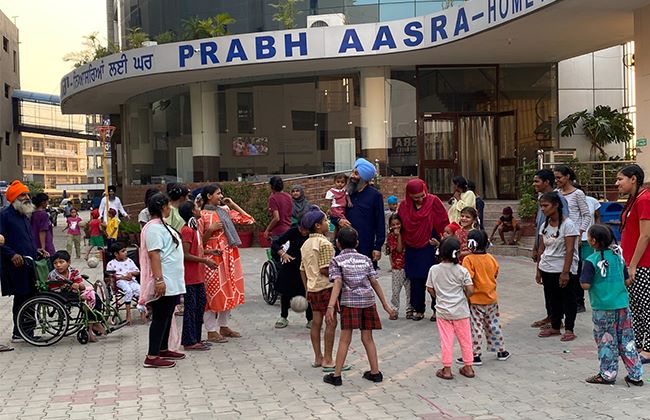
Prabh Aasra: A Lifelong Promise to the Helpless

How often do we encounter elderly citizens, newborn infants, or mentally challenged individuals left entirely on their own—abandoned at railway stations, on pavements, or by the roadside? Invisible, vulnerable, and stripped of dignity. For S. Shamsher Singh and his wife, Bibi Rajinder Kaur, such sights were deeply distressing. Witnessing unclaimed human lives struggling in unsafe and unhealthy environments stirred their shared conscience and compelled them to act. Together, Veer Ji and Bibi Rajinder Kaur ji tirelessly approached government departments, NGOs, and religious institutions, seeking shelter and basic facilities for these forgotten individuals. Despite numerous meetings and sincere efforts, meaningful support remained elusive. In a world increasingly focused on personal wellbeing, few couples possess the courage and conviction to shoulder responsibility

Read More »
Sustainable workforce development

Skilling the Youth for a Water-Secure Nation: WABAG’s Model for Sustainable Workforce Development

As India advances toward inclusive growth and environmental resilience, the demand for a skilled workforce in the water sector has taken centre stage. VA Tech WABAG Limited, a global pure-play water technology multinational, has embedded this priority into its Corporate Social Responsibility framework through structured, impactful and scalable youth skilling initiatives. WABAG’s CSR philosophy is grounded in outcome-driven, nation-building programmes rather than expenditure-led compliance. Since 2001, and in alignment with the CSR legislation introduced in 2014, the company has focused on initiatives that strengthen communities and support India’s long-term development agenda. Central to this approach is WABAG’s flagship Skill Development Programme, delivered under the National Apprenticeship Promotion Scheme (NAPS) and the National Apprenticeship Training Scheme (NATS). In FY 2024–25, WABAG

Read More »
Flipkart Foundation

Building Equitable Employment Pathways Through Skilling

India stands at a demographic crossroads. With nearly 65% of its population under the age of 35 and 26% in the 10–24 age group, the country has the world’s largest youth population (1). This demographic dividend offers an unprecedented opportunity—but only if people are  quipped with employable skills. Today, only about 4.7% of India’s workforce has received formal vocational training, compared to 24% in China and 52% in the US (2). The challenge is even greater for women and Persons with Disabilities (PwDs), who face systemic barriers to education and employment—female labour force participation, though improving, still stands at around 41.7% (3). Bridging these gaps is critical to prevent the dividend from turning into a liability and to meet the

Read More »
Right to healthcare access

RIGHT TO HEALTHCARE ACCESS

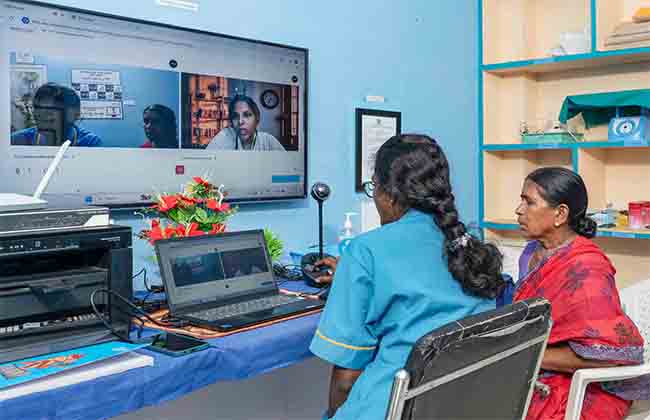
“Aarogyave Bh   agya” or “Health is our Destiny” summed up Koneru Gowda’s perspective on healthcare. As President of the Soliga Abhivriddhi Sangha, his succinct words captured the idea that health is fundamental to life and opportunity. The Foundation team met Gowda in the Biligirirangana Hills (BR Hills) while evaluating the outcomes of its primary healthcare program in remote hamlets of Chamrajnagar District, Karnataka. To strengthen primary healthcare in tribal areas, the Foundation has partnered with grassroots organizations which have long worked with indigenous tribes in Chamrajnagar. Field visits revealed significant barriers: remote villages in these dense forests had little access to basic healthcare, with tribal communities needing to travel 20–30 kilometers to the nearest health center.  In response, the

Read More »
PSI India

PSI India leads Diarrhoea Ki Baat ORS ke Sath

For decades, diarrhoea has quietly claimed the lives of thousands of children in India each year. It is a disease that thrives in silence, often dismissed as routine, yet devastating in its impact. Now, Population Services International India (PSI India) is fighting back with a bold initiative “Diarrhoea Se Darr Nahi” (DSDN) that blends government resolve, private sector support, and community engagement. DSDN, supported by Kenvue, is reaching half a million children across 16 districts in Uttar Pradesh and Bihar. The initiative works hand-in-hand with the National Health Mission (NHM), Integrated Child Development Services, and the Education Department, ensuring diarrhoeal management is not an isolated effort but part of a larger public health fabric. The programme integrates diarrhoeal management into

Read More »
Wild elephant conservation Assam

Building Ladders Where Opportunity Falls Short

India’s greatest strength has always been its people. From remote villages to crowded townships, classrooms across the country are filled with young minds that question, imagine, and dream with remarkable intensity. Spend time among these students and a striking truth becomes evident: ability is widespread, but opportunity is not. This imbalance lies at the heart of India’s education paradox. Education is constitutionally recognised as a fundamental right, yet its true power extends far beyond policy. It is a force capable of altering life trajectories, uplifting families, and breaking cycles of generational disadvantage. When education works, as it should, it becomes society’s most reliable equaliser. In practice, however, the pathway remains uneven. Education in India resembles a ladder that promises upward

Read More »
Vilankuppam sanitation initiative

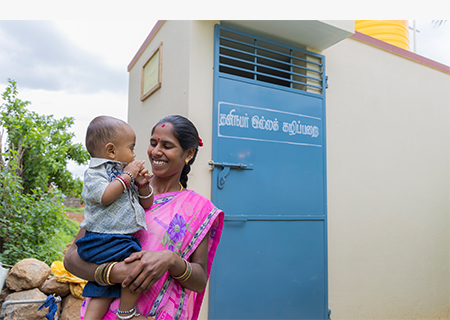
Vilankuppam’s Path to Open Defecation-Free Status: A Community-Led Sanitation Initiative

Srinivasan Services Trust (SST) works across six development verticals to enable holistic village development, reaching communities through a wide-ranging health, education, livelihood and infrastructure footprint. In FY 25 alone, SST-operated medical centres conducted over 75,000 consultations, while more than 2,300 medical camps reached 1,000 villages and enabled 1.15 lakh consultations. Through interventions such as mobile medical vans in remote regions and school-based hygiene programmes covering 51 schools and over 9,000 students, SST’s Health vertical addresses preventive and primary healthcare at scale. Within this broader health mandate, sanitation is treated as a critical public health priority – forming the foundation for disease prevention, dignity and long-term wellbeing. Vilankuppam village in Veerappanur panchayat, Tiruvannamalai district, Tamil Nadu, was identified as one such

Read More »

I/we Wish To...

Subscribe to
CSR TIMES Newsletter

It's Free. And, you can unsubscribe anytime.