Experts’ Corner

You're Here : Home » Experts' Corner » Page 3

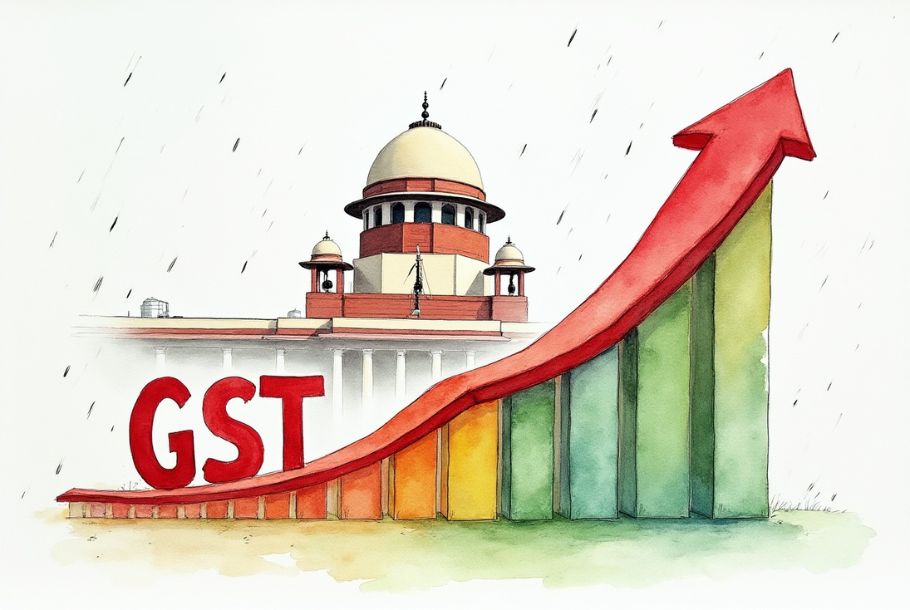
Reimagining Corporate Responsibility in the Age of GST Rationalization

GST, when it was implemented on 1 July 2017, was envisaged as a significant tax reform which would bring central and state taxes into a unified system and reduce the multifold and cascading effect of indirect taxes. 17 major taxes are subsumed under GST, barring Central Excise Duty, Service Tax and VAT, under the motto “one nation-one tax” of India’s indirect tax framework. While the GST Council has worked overtime and clarified many aspects with circulars and notifications been issued from time to time. In the last 8 years, GST also evolved via rate rationalization and process digitalization, but teething problems continued and proved to be a dampener for GST. Certain issues still remained resolved post its implementation in 2017


Read More »

CSR’s Missing Link: Mental Health in Education

Introduction: Beyond Marks and Classrooms Education in India has long been seen as the gateway to opportunity, mobility, and nation-building. Yet today, even as access expands, an invisible crisis shadows our schools and colleges—the mental health of students. The World Health Organization notes that one in seven adolescents suffers from a mental health disorder. NCRB data links academic stress with thousands of student suicides every year. This crisis is not confined to the classroom—it extends into homes, hostels, and the virtual worlds of social media. It is not just a personal issue—it is a systemic challenge with societal consequences. And it is here that Corporate Social Responsibility (CSR), with its deep investment in education, can play a transformative role. Inside

Read More »

International Tourism Day : Preserving the Past for a Sustainable Future

Imagine standing before the majestic Taj Mahal, its white marble shimmering under the Indian sun, or wandering through the ancient ruins of Hampi, where every stone whispers tales of a bygone era. These are not mere tourist attractions. They are portals to our past. They embody human creativity, resilience, and diversity. Heritage, both tangible, like monuments and sites, and intangible, like cultural and religious traditions and languages, connects us to our ancestors and to each other across borders and generations. Heritage in that sense is the legacy we inherit. Prime Minister Narendra Modi’s vision of Virasat bhi Vikas bhi – heritage and development, encapsulates this ethos. He emphasises that preserving our past is integral to building a sustainable future. Monuments

Read More »

From Compliance to Conscience: How GST Reforms Could Unlock a New Era of Corporate Social Investments

When governments reform taxes, the most visible debates usually revolve around consumption and fiscal spending. What often goes unnoticed is how tax changes ripple into the way corporations invest in society. A rich stream of international research shows that when firms receive windfalls from tax reductions, many do not merely increase dividends or capital expenditure—they also raise their corporate social responsibility (CSR) commitments. What research tells us about tax cuts and CSR Scholarly work across multiple countries demonstrates that tax cuts tend to be followed by improvements in CSR performance. A recent study by Chang, Jin, Yang, and Zhang (2025) used natural experiments in corporate income tax reforms and found that tax reductions led to substantial CSR gains, especially in

Read More »

CSR & CIVIL SOCIETY: FROM OBLIGATION TO OPPORTUNITY

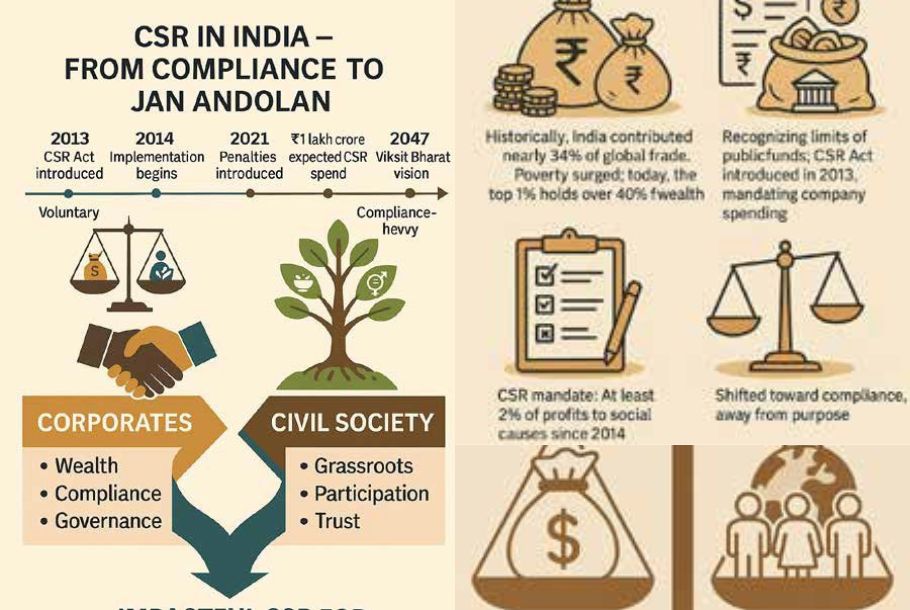
It is a widely accepted business principle that companies must generate profit to sustain and grow. In 1981, economist Milton Friedman famously stated, “The business of business is business,” emphasizing that a company’s primary responsibility is to its shareholders. Yet, he also acknowledged that businesses must operate within legal and ethical boundaries. Today, profit generation must be balanced with compliance, sustainability, and social responsibility to ensure long-term success and societal acceptance. India’s Journey: From Trade Powerhouse to Development Challenges Historically, India contributed nearly 34% of global trade in the early 18th century. However, during colonial rule, this share fell drastically to 1.4% by independence in 1947. Poverty surged to nearly 80%, creating deep inequalities that persist. A 2021 Oxfam report

Read More »

CSR POWERS THE ROAD TO VIKSIT BHARAT

In December 2023, the Prime Minister, Shri Narendra Modi gave an ambitious clarion call for transforming the nation into a fully developed, globally influential country— Viksit Bharat – by 2047. Viksit Bharat 2047, which envisions inclusive development, sustainable progress, and effective governance, among others, is based on four pillars: Yuva (Youth), Gareeb (Poor), Mahilayen (Women) and Annadata (Farmers). These pillars also align with some of the key tenets of the Sustainable Development Goals (SDGs) adopted by nations across the world in September 2015, to tackle challenges related to global sustainable development and achieve a more sustainable future by 2030. In that context, the then UN Secretary-General Ban Ki-moon had remarked that the private sector was required to partner with the

Read More »

Alpesh Kailash Napte’s Visionary CSR-ESG Model: Road Safety to Biodiversity

In a visionary leap toward sustainable infrastructure, Alpesh Kailash Napte is championing a multi-pronged initiative under MALHAR ROADLINES and SGVBS FOUNDATION that redefines road safety, ecological conservation, and climate action. His flagship CSR-ESG project, “Road Safety to Biodiversity,” is a pioneering model that integrates truck driver wellness, decarbonization of heavy transport, and biodiversity restoration—anchored by cutting-edge technology. Truck Driver Fitness Certification: Currentlu having with 1000+ truck drivers data for Safety Begins with Health Recognizing the critical role of truck drivers in India’s freight economy, Napte’s initiative introduces a structured fitness certification program. Drivers undergo health screenings, digital training, and wellness support to meet safety standards. This not only reduces accident risks but also elevates the social impact of logistics operations,

Read More »
A decade of CSR in India

A DECADE OF CSR IN INDIA: FROM COMPLIANCE TO COMMITMENT

When India amended the Companies Act in 2013 to introduce Section 135, mandating Corporate Social Responsibility (CSR) for qualifying companies, it marked a historic moment—not just for India, but for the global discourse on responsible business. India became the first country to legislate CSR, effectively transforming voluntary philanthropy into a structured, accountable, and strategic endeavor. Now, as we complete a decade of this landmark legislation, the CSR landscape in India has undergone a remarkable evolution—moving from ad hoc donations to purpose-driven interventions aligned with national development priorities. This journey offers lessons in innovation, partnerships, governance, and the expanding role of businesses in nation-building. CSR as a Boardroom Agenda Over the past ten years, CSR has transitioned from the periphery to

Read More »
12th National CSR Summit speech

“GAON KA PANI GAON MEI, KHET KA PANI KHET MEI, AUR GHAR KA PANI GHAR MEI”

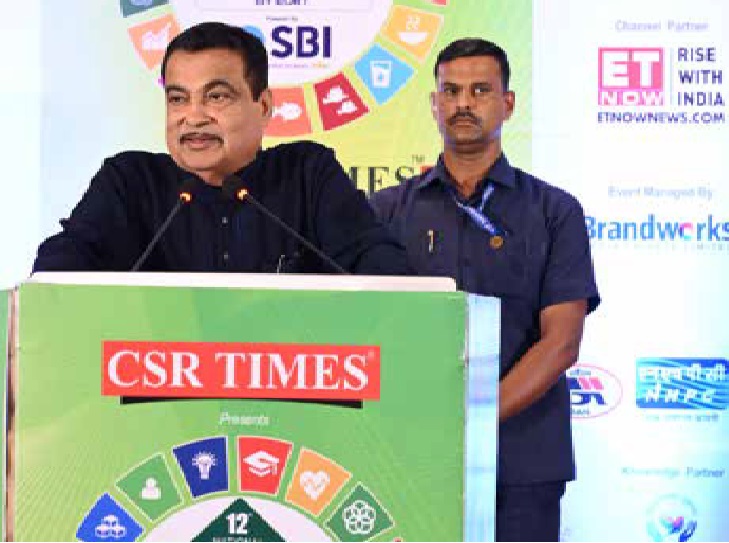
SPEECH BY SHRI NITIN GADKARI AT THE 12TH NATIONAL CSR SUMMIT 2025 First of all, I would like to congratulate everyone on this 12th National Corporate Social Responsibility Summit. This is a law that has been very helpful in changing the socio-economic picture of our country for the past many years. It is a part and parcel of society; what we earn from our society, we should return to it, which was the basic principle of this law. We have a song called “Chalo jalaye deep waha abhi abhi andhera hai.” There are many sectors in our society where people are socially, economically, and educationally backwards. We can change their lives with our positive efforts. I have been working in

Read More »
Jury perspective on CSR Awards

The CSR TIMES Awards 2025: A JURY’S PERSPECTIVE

Over the past decade, Corporate Social Responsibility (CSR) in India has evolved remarkably— from sporadic acts of corporate goodwill to a legally mandated mechanism, and now towards becoming a powerful force in nation-building. It’s no surprise, then, that the theme of the CSR Times Awards 2025, “The Role of CSR in Mission Viksit Bharat by 2047”, sparked vibrant discussion among policymakers, corporate leaders, and development practitioners. This is not a nominal figure. In FY 2023– 24 alone, according to the National CSR Portal, approximately `34,908.75 crore was spent by nearly 27,200 companies. These investments spanned critical sectors such as education, healthcare, rural development, social welfare, sports, and the environment sectors, essential for India’s leap from a developing nation to a

Read More »

I/we Wish To...

Subscribe to
CSR TIMES Newsletter

It's Free. And, you can unsubscribe anytime.