
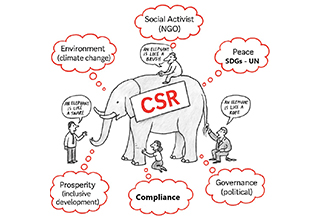

Corporate Social Responsibility (CSR) is like the proverbial elephant vast, multidimensional, and perceived differently by each observer. Environmentalists view it through the lens of climate action and planetary balance; social activists see it as a tool for justice and inclusion; policymakers interpret it in terms of governance, ethics, and accountability; international institutions associate it with peace, cooperation, and global solidarity; while businesses relate it to prosperity and inclusive growth. Each perspective is partial, yet together they reveal the true essence of CSR; a collective commitment to create value for people, planet, and society. No single view is absolute; it is in the convergence of these perspectives that the spirit of responsible business truly emerges.
A decade of CSR spending in India (FY 2014-15 to 2024-25)
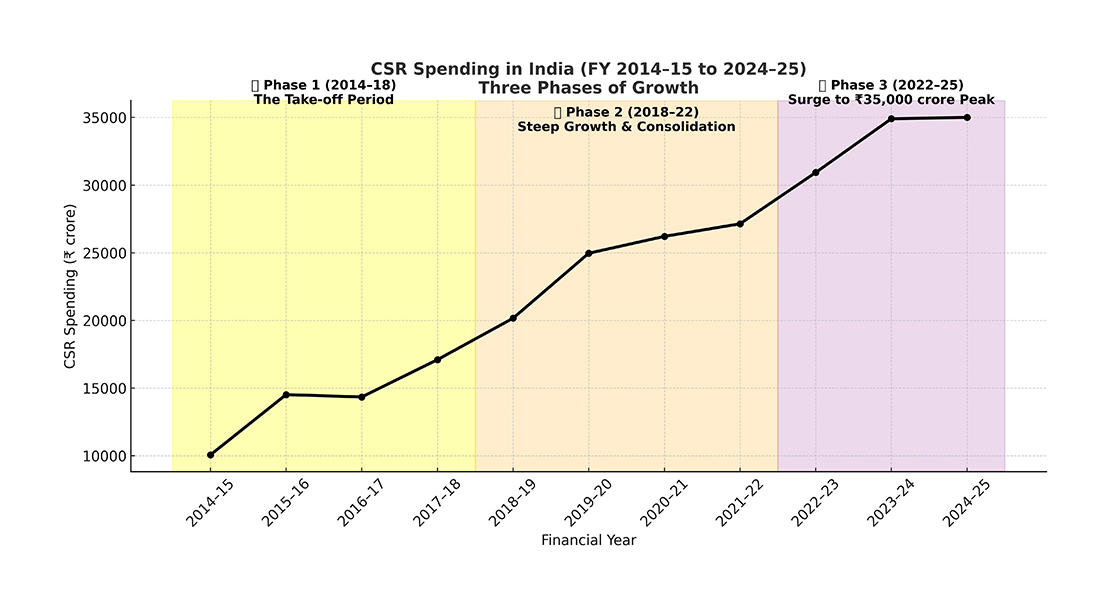
When CSR became mandatory under Section 135 of the Companies Act, 2013, India’s companies collectively spent about ₹10,064 crores in the very first year, 2014-15. What began as a cautious compliance exercise has, over twelve years, evolved into a sizeable parallel stream of social investment.
Phase 1 – The Take-off Years (2014-15 to 2017-18)
When India’s CSR law first came into force in FY 2014-15, corporate spending under Section 135 of the Companies Act amounted to about ₹10,064 crores. These formative years were devoted to putting basic systems in place constituting CSR committees, drafting policies, identifying implementing partners, and building reporting mechanisms. As corporate confidence and capacity grew, expenditure rose sharply from ₹10,064 crores in 2014-15 to ₹14,517 crores in 2015-16, recording an impressive 44 per cent increase. FY 2016-17 saw a mild consolidation at ₹ 14,344 crores as companies absorbed initial lessons, but by 2017-18 CSR outlay had surged again to ₹ 17,098 crores nearly 70 per cent above the first-year figure.
By the end of this phase, CSR had evolved from a cautious compliance exercise into a recognised line item in corporate budgets, embedding social responsibility in boardroom deliberations and setting the stage for large-scale, strategic engagement with communities.
Phase 2 – The Growth Curve Steepens (2018-19 to 2021-22)
The next four years marked a period of accelerated growth and institutional consolidation. CSR spending rose from ₹20,163 crores in 2018-19 to ₹27,141 crores in 2021-22 an expansion of nearly 35 per cent. Annual allocations crossed the ₹20,000-crore mark for the first time in 2018-19 and continued to climb through ₹24,966 crores in 2019-20, ₹26,211 crores in 2020-21, and ₹27,141 crores in 2021-22, even as the COVID-19 pandemic redirected large portions of CSR funds toward healthcare, humanitarian relief, and digital learning. By 2021-22, CSR had stabilised at around ₹ 27,000 crores a year, signifying both resilience and maturity.
Cumulatively, between 2014 and 2022, companies invested close to ₹ 1.66 lakh crores in social development programmes. This phase firmly established CSR as a reliable, large-ticket channel for national development supporting education, health, rural infrastructure, livelihoods, and the environment and prepared the ground for the decisive leap that followed.
Phase 3 – From Plateau to New Peak (2022-23 to 2024-25)
The next leg of India’s CSR journey marks a decisive expansion beyond the ₹25,000-crore plateau. After stabilising around ₹27,000 crores in FY 2021-22, corporate spending began to accelerate sharply. In FY 2022-23, CSR expenditure rose to ₹30,932 crores, reflecting renewed momentum as post-pandemic confidence returned. The upward trend continued in FY 2023-24, with spending climbing further to ₹34,909 crores, showing consistent double-digit growth. Preliminary data for FY 2024-25 from the National CSR Portal (MCA) places CSR expenditure at around ₹ 35,000 crores a historic high and nearly three and a half times the outlay in 2014-15 (₹ 10,064 crores).
In just twelve years, cumulative CSR expenditure has crossed ₹ 2.3 lakh crores, demonstrating how corporate social responsibility has evolved from a compliance requirement to a mainstream development investment framework. More than half of the total CSR spending since 2014 has occurred in the last five years, reflecting a convergence of economic growth, governance reforms, and social commitment. CSR in India has thus entered a new phase no longer a matter of compliance, but a strategic and enduring investment in national development.
CSR by the Numbers (2014–2025)
Over the decade, India’s CSR expenditure has multiplied more than threefold, growing from just over ₹10,000 crores in FY 2014–15 to ₹35,000 crores in FY 2024–25. This remarkable rise reflects institutional maturity, board-level accountability, and corporate conviction in aligning profit with purpose. With CSR now contributing over ₹35,000 crores annually, India commands one of the largest organized social investment frameworks in the world, reinforcing its position as a global leader in legislated corporate responsibility.
The Evolution of CSR in India: From Voluntary to Mandatory
Like a river that changes its course with time shaped by terrain, season, and the needs of those it nourishes the flow of CSR in India has continually evolved, adapting to new realities and expectations. When Section 135 of the Companies Act, 2013 first came into force in 2014, its intent was participatory, not punitive. The government invited companies to join hands in inclusive development, trusting transparency to drive responsibility. The initial phase was aptly described as “Name or Shame” firms disclosed their CSR policies and spending in the public domain, and visibility itself became a moral nudge.
By 2019, the current deepened. CSR moved from the periphery of communication to the heart of corporate deliberation under the “Comply or Explain” framework, where companies that fell short of the 2 % mandate had to justify their reasons in board reports. This was when CSR truly entered the boardroom not as an act of charity, but as a matter of governance.
In 2021, the river gathered force. The law became “Comply or Pay Penalty,” marking CSR’s transition from moral persuasion to managerial accountability. Unspent funds were now required to be transferred to designated accounts or attract penalties, signalling that corporate responsibility had matured into a statutory discipline. While many companies rose to this challenge, others struggled. According to the India CSR Outlook Report 2024 (CSRBOX), of 301 large listed companies, nearly half (48 %) spent less than the prescribed amount, and 68 reported unspent funds, citing partner identification issues, project delays, and staffing constraints.
Through these tides of change, the spirit of CSR has not been lost it has found new depth. What began as voluntary goodwill has transformed into a structured partnership for national progress. The journey from “Name or Shame” to “Comply or Explain” to “Comply or Pay” mirrors India’s own evolution from intent to institution, from empathy to efficiency. Today, CSR flows not as a tributary of goodwill but as a mainstream current of governance, aligning corporate purpose with the nation’s larger aspiration of Viksit Bharat 2047.
Emerging Directions in CSR Practice
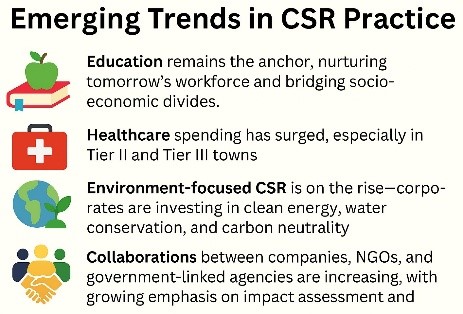
A decade into India’s CSR journey, the narrative has shifted from compliance to conscience, and now toward coherence where purpose, performance, and policy increasingly align. Over time, CSR has matured from fragmented philanthropy into a strategic pillar of nation building. Corporates now design multi-year, impact-driven programmes in education, health, livelihoods, and the environment, viewing them as long-term social investments rather than annual obligations. Education remains the anchor, yet with a forward-looking lens on employability and digital skills. Healthcare is expanding beyond hospitals to preventive and mental health, and environmental stewardship once peripheral has moved to the centre of corporate action.
The scale and ambition of CSR in India are expanding rapidly. With the corporate sector’s profitability rising and compliance tightening, annual CSR spending is projected to cross ₹1,00,000 crores within the next few years positioning CSR as one of the largest organised development funding streams outside the government. This quantum shift demands strategic depth and institutional rigour. Tier-II and Tier-III towns are emerging as new CSR frontiers, and implementation is increasingly professionalised through corporate foundations, universities, hospitals, and social enterprises. As highlighted by Sattva Consulting’s 2025 analysis, CSR and ESG priorities are steadily converging, with companies aligning their social investments more closely to core competencies and national missions. The true transformation, however, lies not merely in the magnitude of spending but in the maturity of intent in how India’s corporations internalise their social role as long-term partners in the journey toward Viksit Bharat 2047.
The Bigger Picture
India’s CSR is no longer about how much is spent, but how meaningfully it is aligned with purpose, people, and performance. The next decade will belong to intent-led, data-driven CSR that builds ecosystems, not just projects. India’s CSR landscape has matured into a strategic instrument for nation-building; one that combines corporate intent with social innovation. What began in 2014 as a legal obligation has evolved into a moral movement. CSR today is not merely about how much companies give, but how meaningfully they engage.
💬 “When business becomes a bridge between profit and purpose, CSR transforms from a line item in balance sheets to a lifeline for society.”

Dr. K. K. Upadhyay