
“Aarogyave Bh agya” or “Health is our Destiny” summed up Koneru Gowda’s perspective on healthcare. As President of the Soliga Abhivriddhi Sangha, his succinct words captured the idea that health is fundamental to life and opportunity.
The Foundation team met Gowda in the Biligirirangana Hills (BR Hills) while evaluating the outcomes of its primary healthcare program in remote hamlets of Chamrajnagar District, Karnataka. To strengthen primary healthcare in tribal areas, the Foundation has partnered with grassroots organizations which have long worked with indigenous tribes in Chamrajnagar. Field visits revealed significant barriers: remote villages in these dense forests had little access to basic healthcare, with tribal communities needing to travel 20–30 kilometers to the nearest health center.
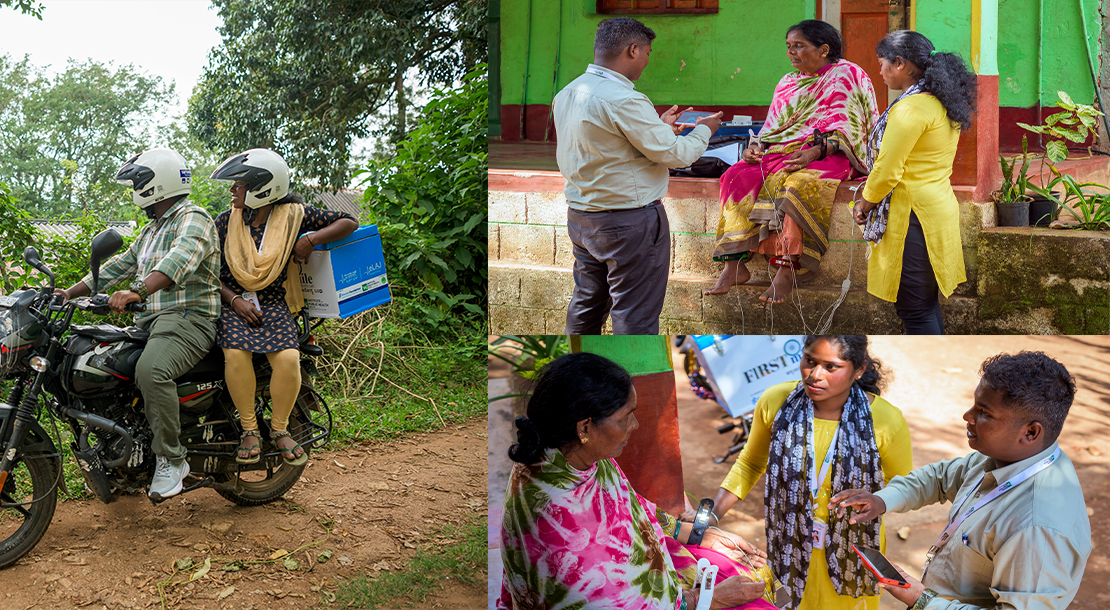
In response, the Foundation designed a hub-and-spoke model involving multiple mobile healthcare navigators, local youth equipped with two-wheelers; linked to an eLAJ clinic (a sub-center-level health facility established by the Foundation).
These trained navigators delivered household-level care, identified individuals needing further diagnostics, and referred them to the eLAJ clinics. After months of engagement, the communities began welcoming these visits, even chiding the navigators when they didn’t turn up on the odd day. The growing trust and steady clinic footfall became the initiative’s first significant milestone.
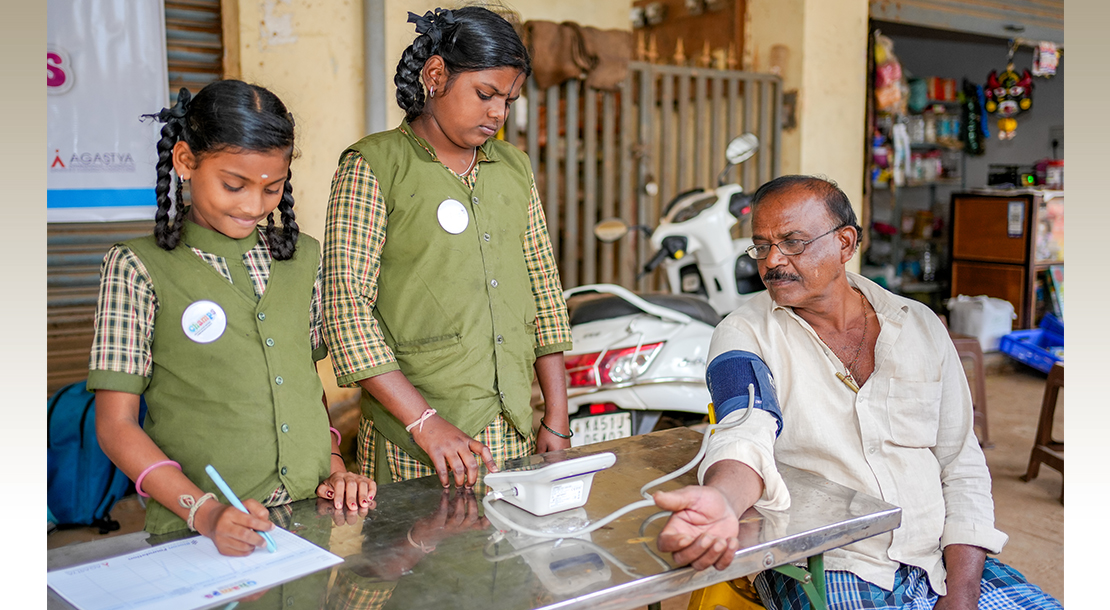
While working with socially cohesive rural and tribal populations has been easier, the teams have struggled with fragmented peri-urban populations comprising migrants, daily wage, and white-collar workers. Nudging these populations to value preventive healthcare amidst their existential realities required a different approach. The Foundation adopted multiple strategies: addressing health visits at places of work, targeting festivals and holidays, even training government high school students as community health ambassadors. On the technology front, we deployed point-of-care devices, some AI-enabled, which resulted in faster and reliable testing. Regular follow-up calls ensured that high-risk individuals visited the clinics or primary health centers. The effort was to shift the mindset from episodic to continued care.
These experiences underscored a crucial truth: healthcare delivery is deeply contextual. This also raises the broader systems-level question: what does access to healthcare truly mean, and what obligations must society uphold? India’s healthcare landscape has reflected a dual reality—healthcare as a right and as a market commodity. The government emphasizes access, affordability, and availability, while market forces drive choice and innovation, often narrowing access for many.
Historically, the right to health is codified in international instruments including the Universal Declaration of Human Rights (UDHR), the International Covenant on Economic, Social and Cultural Rights (ICESCR), and the Convention on the Rights of the Child (CRC). In India, while not explicit in the Constitution’s Fundamental Rights, Article 21’s Right to Life has been judicially interpreted to encompass health. The Directive Principles further guide state welfare policies.
Current policy debates focus on whether health can be a justiciable fundamental right, a discussion that hinges on the nation’s economic and infrastructural readiness. Over the decades, guided by key committees’ (Bhore, Mudaliar, Kartar Singh, and Srivastava), the Ministry of Health and Family Welfare has undertaken significant reforms, with the National Health Mission (NHM) at the center. Health being a state subject, states have adapted these frameworks to local needs.
However, access remains uneven. As per Rural Health Statistics 2021–22, India had 157,935 Sub Centers, 24,935 Primary Healthcare Centers (PHCs), and 5,480 Community Health Centers (CHCs). On average, a Sub Center served 5,691 people, a PHC 36,049, and a CHC 164,027. However, only 13% of PHCs and 8.4% of CHCs met Indian Public Health Standards (IPHS). Staffing gaps were stark: 13.8% of Auxiliary Nurse Midwife posts and 40.1% of male health worker positions at Sub Centers were vacant; at PHCs, 74.2% of health assistant posts and at CHCs, 79.5% of specialist posts were unfilled. The National Health Policy 2017’s vision of a Public Health Management Cadre aims to address these gaps, but progress is uneven.
As public systems grapple with these challenges, private healthcare has flourished, widening the access divide. Within this landscape, CSR initiatives have played a catalytic role, holding the tension between rights and markets, designing systems that are agile, innovative, and equitable. Corporate entities leading healthcare programs have strived to address primary healthcare infrastructure, maternal and child health, communicable as well as non-communicable diseases, leveraging collaborations, capacity building, research, and technology. In FY 2023-24, while CSR spending surged to INR 34,909 Cr, an almost threefold increase over a decade, it was the healthcare and education domains that accounted for 55% of the total expenditure. Yet, regional disparities exist; the Northeast region, witness to poor development, years of insurgency & natural disasters – received less than 2% of the spending.
These insights reinforce the emphasis on equitable access and last-mile delivery. From a CSR lens, several imperatives emerge: reducing regional disparities, co-developing programs with the government & academia, advancing research and innovation and adopting population-based approaches. Ultimately, it is the seamless, inclusive, and context-responsive delivery of healthcare that will honour Koneru Gowda’s belief that “Health is Destiny”.
