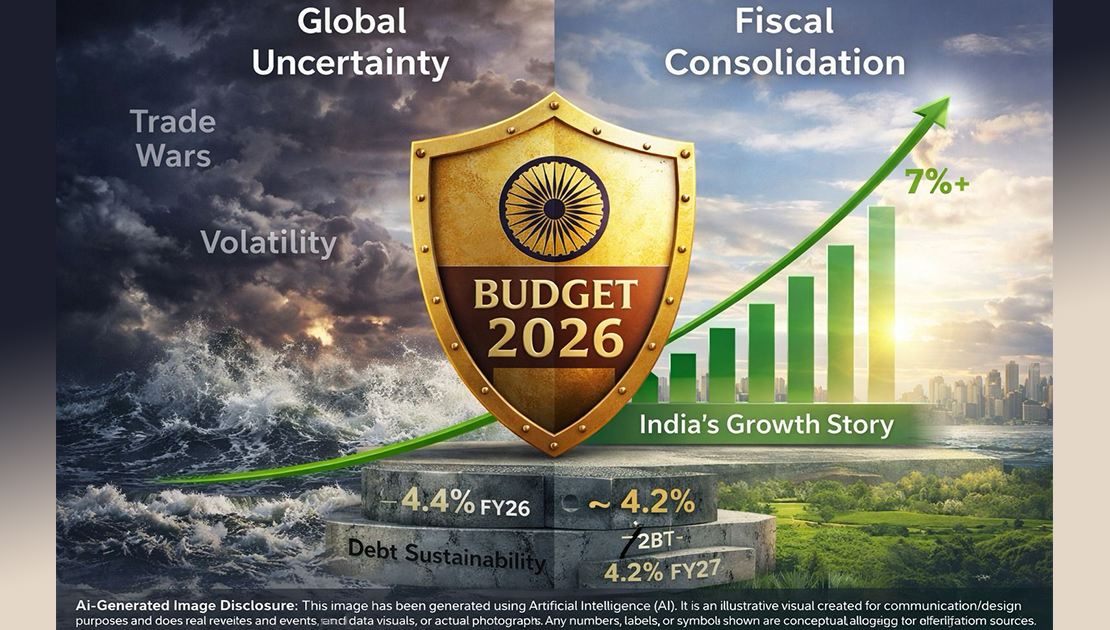

Walk through the textile lanes of Tirupur or the diamond polishing hubs of Surat, and observe how the abstract phrase “global uncertainty” suddenly looks very real. In Tirupur, factories that once hummed six days a week are cutting back to four, rattled by the threat of steep U.S. tariffs. In Surat, diamond units are shuttering as export orders dry up. This isn’t just market noise; it is the sound of a fractured global order knocking on our doors. As Finance Minister Nirmala Sitharaman prepares to present the Union Budget 2026-27, the stakes have shifted. We are no longer just managing a post-pandemic recovery; we are building a shield against a world weaponized by trade wars and protectionism. With the U.S.
floating the idea of punitive tariffs, some rumors put the figure at a staggering 50% or more for nations trading in the wrong blocs- this Budget cannot just be an accounting exercise. It must be a strategic doctrine. To protect India’s growth story, which the UN projects at a resilient 6.6% for 2026, the government needs to double down on three specific pillars: disciplined spending, aggressive institutional repair, and a hard look at our national debt.
The Discipline of “Patient Capital”
For the last few years, India has rigidly followed a “fiscal glide path,” aiming to bring the fiscal deficit below 4.5% of GDP by FY26. We are on track to hit 4.4%. But what comes next? The temptation in a pre-election cycle (even if distant) is always to loosen the purse strings. However, looking at the recent “Liz Truss moment” in the UK—where unfunded tax cuts crashed the bond market overnight — serves as a brutal reminder: in a high-interest-rate world, the market punishes profligacy instantly. Budget 2026 needs to adopt the mindset of India’s multi-generational family businesses, like Wagh Bakri or Cycle Pure Agarbathi. These firms don’t chase quarterly spikes; they rely on “patient capital” and internal accruals, refusing to over-leverage themselves for cheap growth. Similarly, the Finance Minister is expected to target a deficit of 4.1% to 4.3% for FY27. This isn’t austerity for the sake of it. By borrowing less, the government leaves more money on the table for private companies giants like Larsen & Toubro or UltraTech– to borrow at cheaper rates and build the factories that actually create jobs.
Institutional Repairs: Fixing the Plumbing
Money alone doesn’t build a nation; the ability to spend it effectively does. This is where “Institutional Reforms” come in. We have allocated massive sums for infrastructure, yet as of late 2025, nearly 489 road projects were reported delayed due to land acquisition and clearance hurdles. Consider the Diva Road Over Bridge (ROB) project near Mumbai. Initiated in 2019, it has faced endless delays due to land disputes and rehabilitation issues, leaving commuters in a chokehold for years. This is the “regulatory cholesterol” that clogs India’s arteries. The Budget 2026 needs to announce “Next Generation Reforms” that move beyond the center. We need an Inter-State Institutional Platform, modeled on the successful GST Council. Just as the GST Council forced states to agree on taxes, this new body would drive consensus on the thorny issues of land and labor. If a company like Foxconn wants to move its supply chain from China to India, it doesn’t just need a central PLI scheme; it needs the assurance that a state government won’t stall its factory walls for three years over a land dispute.
The Debt Anchor: A New North Star
Perhaps the most significant, albeit technical, shift expected is moving the goalposts from “Annual Deficit” to “Debt Sustainability.” The government has outlined a roadmap to reduce Central Government debt to 50% of GDP by 2031. Think of this like a corporate turnaround. When a company like Tata Steel or DLF decides to deleverage, they sell non-core assets and use cash flow to pay down loans. Why? To survive the bad years. With India’s general government debt hovering around 81% (according to IMF data), our interest payments are eating up money that should be going to schools and hospitals. By anchoring policy to a debt target, the government is signalling maturity. It tells global rating agencies (like S&P, which recently upgraded India’s outlook) that we are good for the money. This lowers the risk premium on Indian bonds, eventually lowering mortgage rates for the average homebuyer and interest rates for the small MSME owner in Ludhiana.
The Verdict
Budget 2026-27 will likely lack the populist fireworks of freebies, and that will be its greatest strength. By sticking to a 4.1% fiscal deficit, committing to a 50% debt anchor, and pushing for a consensus on land and labor, the government is essentially building a fortress.
In a world where major economies are struggling with recessionary trends and slapping tariffs on friends and foes alike, India’s strategy is clear: keep the house in order, lower the debt, and fix the structural pipes. If executed well, this Budget won’t just protect India’s growth story; it will ensure that when the global dust settles, India is the last one standing tall.