
It is a widely accepted business principle that companies must generate profit to sustain and grow. In 1981, economist Milton Friedman famously stated, “The business of business is business,” emphasizing that a company’s primary responsibility is to its shareholders.
Yet, he also acknowledged that businesses must operate within legal and ethical boundaries. Today, profit generation must be balanced with compliance, sustainability, and social responsibility to ensure long-term success and societal acceptance.
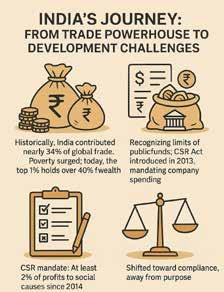
India’s Journey: From Trade Powerhouse to Development Challenges
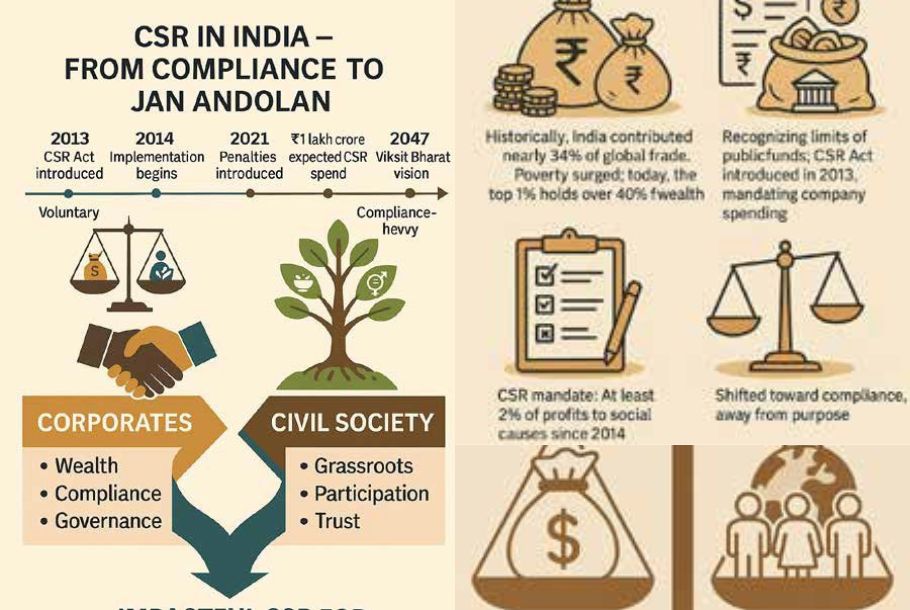
Historically, India contributed nearly 34% of global trade in the early 18th century. However, during colonial rule, this share fell drastically to 1.4% by independence in 1947. Poverty surged to nearly 80%, creating deep inequalities that persist. A 2021 Oxfam report found that India’s top 1% owns more than 40.5% of national wealth, while the bottom 50% holds just 3%. This divide worsened during the COVID-19 pandemic, when the world’s richest grew wealthier even as millions struggled.
Recognizing that eradicating poverty cannot rely solely on public funds, the government sought corporate participation. Companies hold substantial financial power—in the Union Budget 2025, 39% of government revenue came from direct taxes, including corporate tax. To leverage this, India became the only country to mandate CSR spending through Section 135 of the Companies Act, 2013.
CSR Mandate: Balancing Compliance and Purpose
The law requires companies meeting certain thresholds to spend at least 2% of their average net profits on CSR activities, focusing on poverty alleviation, education, gender equality, and environmental sustainability. This was meant not only to reduce economic disparity but also to embed social responsibility into corporate strategy.
From 2014, CSR implementation began, and by 2021 penalties were introduced for non-compliance. This shifted CSR from a largely voluntary, value-driven approach to a compliance-heavy obligation. While it has improved accountability, some argue that the spirit of CSR is being diluted, reduced to tick-box exercises.
Role of Civil Society: The Grassroots Connect
Corporates excel in wealth creation, but their direct engagement in grassroots development is often limited. Here, civil society—NGOs, social enterprises, and community organizations— plays a pivotal role. With their deep understanding of local contexts, they bridge gaps between corporate resources and community needs.
A 2018 Crisil Foundation survey showed that 74% of companies partnered with NGOs for CSR delivery. However, some corporations have created their own CSR arms or foundations to bypass compliance hurdles. When working with external NGOs, firms must ensure due diligence, registration under CSR-1, and compliance with fund utilization timelines.
Many practitioners describe this process as “Bahut Lafada Hai” (a big hassle), reflecting the bureaucratic complexity involved.
Case Examples: When Partnerships Work
Successful CSR projects often showcase effective corporate-civil society partnerships:
- Tata Steel Foundation: Empowering tribal communities through education and health interventions.
- Mahindra’s Nanhi Kali: Supporting education for underprivileged girls.
- HCL Foundation: Urban slum programs improving health, sanitation, and skill development. Such initiatives highlight the power of collaboration in creating lasting social impact.
The Way Forward: CSR as a Jan Andolan
Governments are increasingly guiding CSR funds toward specific causes, with state-level CSR authorities and local administrations influencing project choices. While this ensures alignment with regional priorities, the real transformation will come when CSR evolves into a Jan Andolan (People’s Movement).
By 2030, CSR funds are projected to reach `1 lakh crore annually. If deployed effectively, they can accelerate India’s journey to becoming a developed nation—Viksit Bharat by 2047. For this, businesses, civil society, and communities must co-create solutions, embrace technology for transparency, and invest in youth and academia as future CSR leaders.
CSR must move beyond compliance. It must inspire impact, collaboration, and trust—building an India where development is inclusive, sustainable, and truly people-driven.