

About the Initiative
Lighting a Billion Lives©, launched by The Energy and Resources Institute (TERI), was a global initiative to facilitate access to clean lighting for energy poor communities across the world. In operation since 2008, the campaign enabled communities to transition from harmful kerosene based mediums to cleaner, more efficient and sustainable lighting alternatives through an entrepreneurial model of energy service delivery. Building on the success of the Lighting a Billion Lives© campaign, which provided energy access in India, South Asia and parts of Africa, TERI is launching LaBL 2.0 (Leveraging Clean Energy for a Billion Livelihoods), which aims to push the boundaries of energy access to energy for productive activities and builds the ecosystem for just energy transition.
Core Objectives of LaBL 2.0
- Enable livelihood empowerment by supporting rural energy entrepreneurs—especially women—with training and finance to run solar enterprises.
- Scale replicable delivery models for decentralized clean energy through different packages for primary, secondary, and tertiary sectors.
- Build local capacity through intensive training and support to sustain energy systems and enable ongoing aftersales services.
Climate action through deployment of clean energy and abatement of fossil fuels
Vision & Green Commitments
LaBL 2.0 envisions a world where global energy poverty is meaningfully addressed through inclusive and sustainable solutions. The initiative is also committed to fostering gender equality and social inclusivity by ensuring that underserved communities and doubly marginalised women are active participants and beneficiaries of clean energy access. By promoting sustainable livelihoods, LaBL 2.0 integrates climate action with economic empowerment, creating long-term environmental and social impact. Central to this vision is the development of a strong and impactful global partnership network that brings together diverse stakeholders to collaboratively drive scalable, transformative change across the world.
LaBL 2.0 is strongly aligned with global green goals and sustainability commitments, contributing directly to 9 out of the 17 United Nations Sustainable Development Goals (SDGs). The initiative advances net-zero ambitions and climate action through carbon offset projects, carbon credit–based models, and development of net-zero communities. LaBL 2.0 has significantly improved lives and livelihoods, positively impacting over 14 million people through sustainable and inclusive energy solutions. Furthermore, its measurable Social Return on Investment (SROI) and adherence to global environmental compliances underscore its credibility, with reduced carbon footprints validated in accordance with CDM methodologies and UNFCCC accounting frameworks.
Highlights from LaBL 2.0 Pilots
- The LaBL 2.0 pilots in Jaisalmer and Gorakhpur districts demonstrate strong, human-centric stories of community empowerment, clean energy innovation, and livelihood transformation.
- In Jaisalmer, solarizing the Pochina Dairy, a women-run SHG enterprise serving 120+ households, will eliminate diesel dependency and unlock annual savings of ₹5.8 lakh, directly strengthening women’s incomes and leadership.
- The Hamira Spice Processing Unit, fully operated by women’s groups, will receive a dedicated solar system enabling uninterrupted grinding and packaging—supporting 100 beneficiary households.
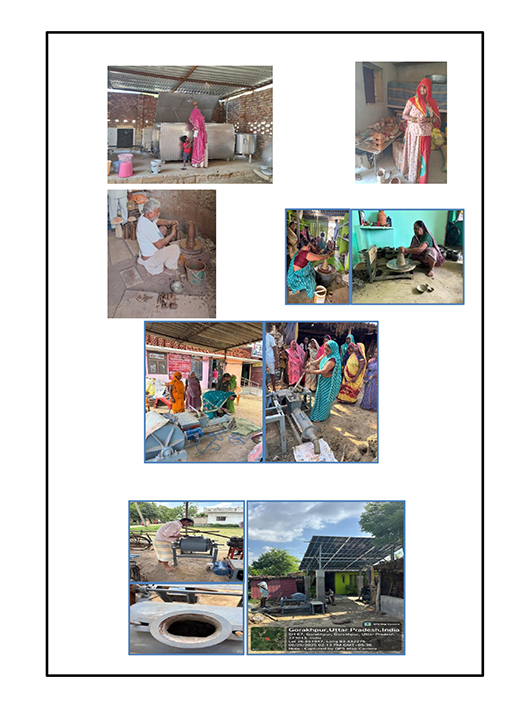
- In Gorakhpur, women-led clusters in food processing, stitching units, and micro-retail operations are being intervened for clean-energy solutions, enabling income diversification and reducing drudgery.
- The Pokhran Pottery Cluster (150–180 artisan households) will adopt hybrid solar systems to mechanize pottery production (pug mills, ball mills, wheels), lower energy costs by up to 70%, and expand youth participation in micro-enterprises.
- In Gorakhpur, youth-led enterprises—such as solar-powered digital service centres, carpentry units, and rural mobility charging hubs—are emerging as potential clean-energy incubation points.
- Across both districts, solar energy is enabling high-value rural activities: cooling, milling, grinding, processing, irrigation, mechanized craft work, and small machinery operations.
- Diesel-to-solar transitions are expected to significantly reduce emissions (e.g., 391 tonnes CO₂ avoided annually at Pochina Dairy alone).
- Both sets of pilots demonstrate replicable models for clean energy–powered rural enterprises, aligned with LaBL 2.0’s mission of Lighting to Livelihoods showcasing potential for expansion across Rajasthan, Uttar Pradesh, and other states with similar livelihood ecosystems.
LaBL 2.0 represents a strategic shift from providing access to light toward enabling energy for livelihoods. This integration of decentralized clean energy systems with entrepreneurship, gender inclusion, and climate action, is opening pathways for rural development. With strong partnerships and scalable frameworks in place, LaBL 2.0 is poised to expand across states and geographies, transforming energy access into sustainable economic opportunity for millions.