Nature took thousands of years to establish balance. Mountains rose, rivers found their courses, forests evolved, and life flourished within carefully calibrated limits. Early human progress respected this equilibrium. Communities grew, agriculture expanded, trade evolved all largely within nature’s carrying capacity. Development and nature coexisted.
The disruption began when development turned into domination. Industrialisation, fossil-fuel dependence, unchecked consumption, and the belief in infinite growth gradually disturbed this delicate balance. Carbon emissions rose relentlessly, ecosystems weakened, and the climate began to respond. Floods, cyclones, droughts, heatwaves, and rising sea levels became nature’s reminders that equilibrium was under threat.
Today, humanity faces an uncomfortable truth: if everyone lived at the consumption levels of developed economies, we would need nearly three Earths. The ambition to restrict global warming to 1.5°C increasingly looks fragile. Nature continues to adapt, but human systems struggle to change at the same pace.
Recognising these dangers, the global community began searching for collective solutions. The Brundtland Commission’s 1987 report, Our Common Future, was one of the earliest global acknowledgements that development must not compromise the needs of future generations.
This thinking shaped the Millennium Development Goals (2000–2015), which made progress but fell short in addressing inequality and environmental stress comprehensively.
A more integrated global response emerged in 2015, a defining year for sustainability. The world adopted the 2030 Agenda for Sustainable Development with its 17 Sustainable Development Goals, committing all nations to “leave no one behind.” In the same year, global leaders gathered in Paris for the UN Climate Change Conference (COP21) and adopted the Paris Agreement, a landmark climate treaty that entered into force in 2016. Its central aim was clear: to limit global temperature rise to well below 2°C, while striving for 1.5°C, through deep reductions in greenhouse gas emissions.
COP21 marked a turning point. For the first time, climate action was framed as a shared responsibility of all nations, albeit with differentiated capacities. The introduction of Nationally Determined Contributions (NDCs) recognised national circumstances while creating a global framework of accountability. Importantly, the Paris Agreement acknowledged that governments alone could not deliver the transition. Finance, technology, markets, and the private sector were formally brought into the climate solution.
Together, the SDGs and the Paris Agreement redefined sustainability as a collective endeavour one that required action from states, businesses, investors, and civil society alike. This convergence fundamentally reshaped the roles of corporations and gave rise to two parallel but interconnected frameworks: Corporate Social Responsibility (CSR) and Environmental, Social, and Governance (ESG).
India responded decisively to this global shift. In 2014, it became the first country to mandate CSR by law, embedding social responsibility into corporate functioning. Over time, this evolved further with structured sustainability disclosures through Business Responsibility and Sustainability Reporting (BRSR), aligning Indian corporations with global ESG expectations. India’s commitment to achieve Net Zero emissions by 2070 and its accelerated progress in renewable energy achieving targets ahead of schedule signal serious intent.
Yet, the global context today is complex. Geopolitical tensions, wars, economic uncertainties, and the withdrawal of key nations from climate forums have slowed collective momentum. The world stands at a crossroads. Climate change does not pause for political uncertainty, and the clean energy transition cannot afford delay.
This brings us to the often-debated question: CSR vs ESG: what are they, and how do they differ?
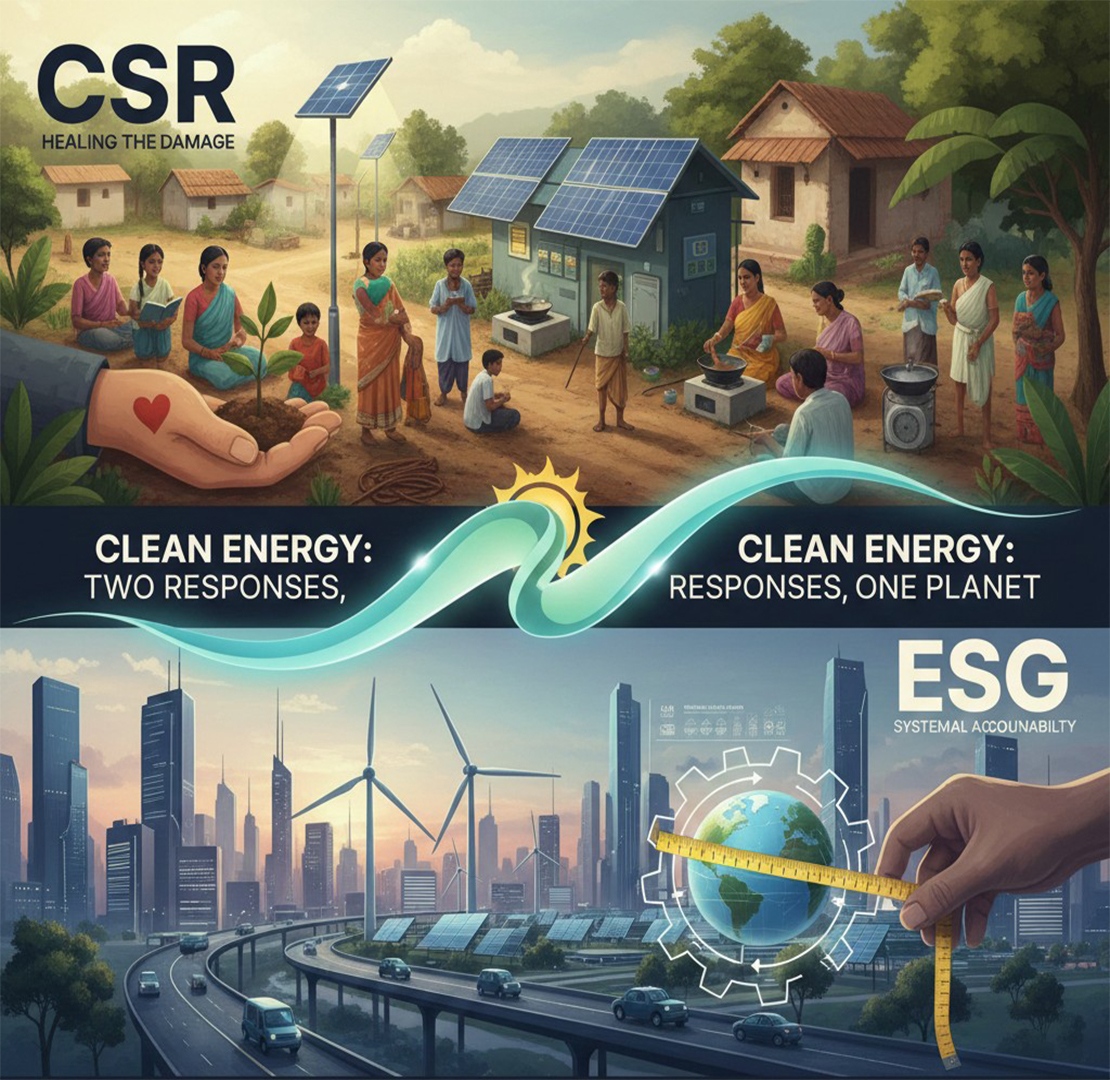
CSR represents the moral commitment of business to society. It is rooted in ethics, empathy, and redistribution. In the context of clean energy, CSR supports last-mile solutions: solar electrification in villages, clean cooking initiatives, renewable power for schools and healthcare centres, and community resilience. CSR addresses the social consequences of development and seeks to correct imbalance.
ESG, on the other hand, is a framework of systemic accountability. It focuses on how businesses operate, manage risks, and create long-term value. ESG brings climate action into boardrooms and balance sheets. It evaluates emissions, energy efficiency, transition risks, governance structures, and transparency. Under ESG, clean energy is not charity, it is strategy.
Put simply, CSR asks, “What should we give back?”
ESG asks, “How responsibly do we run our business?”
They are not competing ideas; they are complementary responses to the same planetary challenge. CSR helps heal the damage already done. ESG helps prevent future damage. Clean energy is the point where both converge. Clean energy is not merely about technology or megawatts installed. It is about justice, access, resilience, and intergenerational equity. CSR ensures inclusion in the energy transition. ESG ensures credibility and scale. Together, they translate global commitments from Paris to SDGs into local and corporate action.
As we look ahead, the challenge is clear. CSR must evolve from charity to capability building. ESG must move beyond reporting to real transformation. Clean energy must become affordable, accessible, and accountable. India has shown leadership, but ambition must be matched with execution.
We have borrowed the Earth from future generations.
CSR reminds us to care.
ESG reminds us to measure.
Clean energy reminds us that time is running out.