

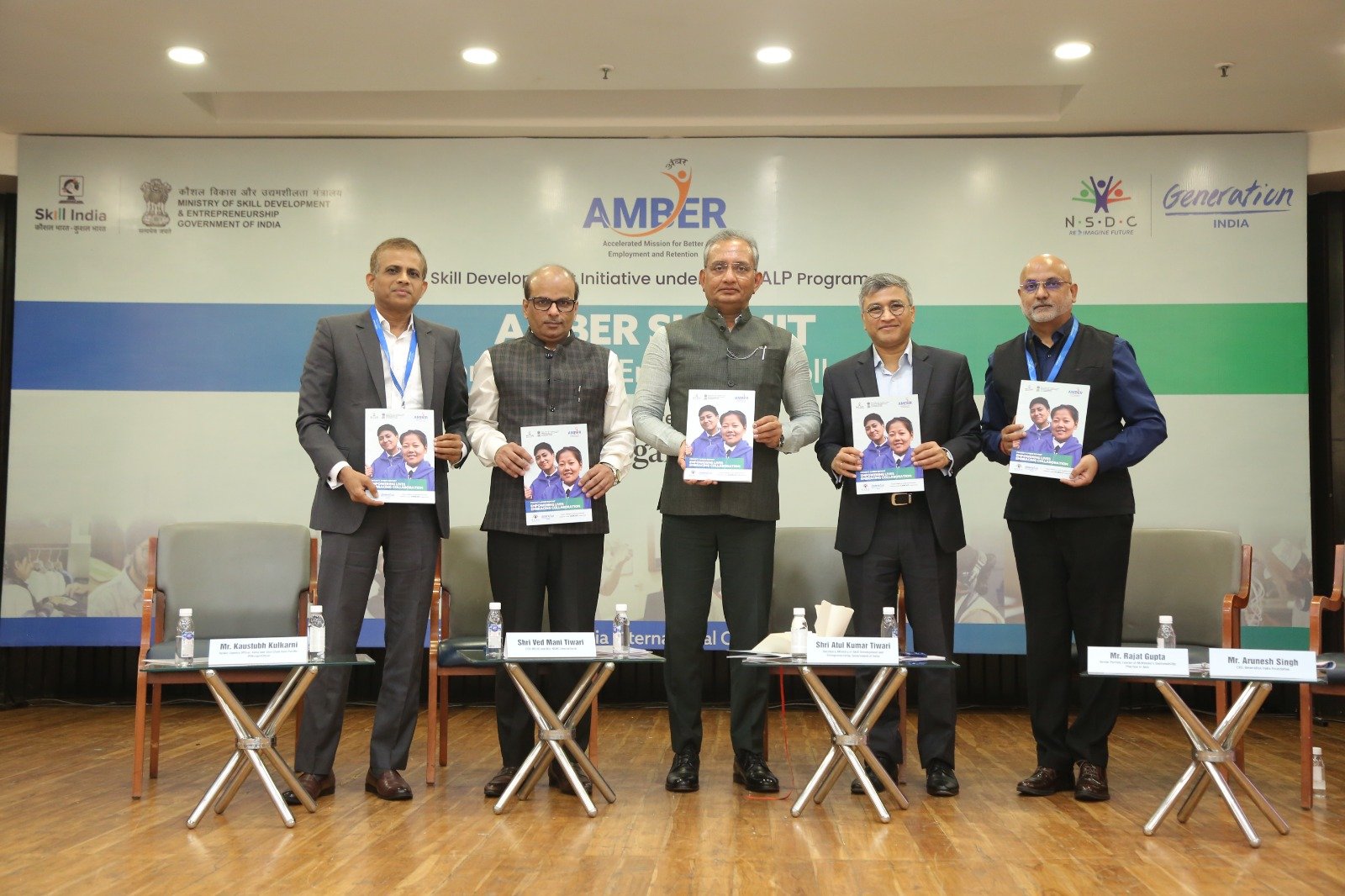
2nd August 2024: Project AMBER Report “Empowering Lives: Embracing Collaboration” was released at the AMBER Summit by Shri Atul Kumar Tiwari, Secretary, Ministry of Skill Development and Entrepreneurship, Government of India. This report highlights the project’s advancements in skills training and job placements, offering insights and best practices to guide future skills development initiatives in India.
Project AMBER (Accelerated Mission for Better Employment and Retention) is a joint initiative of the Ministry of Skill Development and Entrepreneurship (MSDE), National Skill Development Corporation (NSDC), and Generation India Foundation under Skill Acquisition and Knowledge Awareness for Livelihood Promotion (SANKALP), a World Bank-funded MSDE program. Supported by leading CSR entities in India, including JPMorgan Chase, Project AMBER is a unique public-private partnership in which the public and private sectors have collaborated to create a sustainable model for future skilling programs, benefiting both trainees and the broader economy.
Shri Atul Kumar Tiwari, while unveiling the report, emphasized the crucial role of skill development in economic growth, stating, “The AMBER project, launched to address supply-demand imbalances and equip the workforce with essential skills for a rapidly changing job market, exemplifies public-private collaboration. By focusing on all aspects of the skilling lifecycle and using innovative methods and targeted interventions, it has provided valuable insights for improving short-term training programs. Moving forward, we aim to scale efforts, enhance inclusivity, leverage technology, and strengthen partnerships to boost skill development and employment outcomes in India.”
Key Findings
- Project AMBER achieved a 73% reported placement rate within three months of graduation.
- 51% of the nearly 26,000 trainees were women.
- Based on a short-term outcomes evaluation conducted by a third-party agency, 85% of graduates found jobs directly related to their training, earning 14–38% higher wages than their peers.
- The project enhanced the capacity of 20+ Training Partners and integrated multiple technology tools across the training value chain.
The report highlights how Project AMBER has empowered individuals to succeed in a dynamic job market. Dheeraj, an AMBER graduate, said, “Project AMBER has completely changed my perspective on life, the future, and struggle. Meeting people from diverse backgrounds broadened my outlook and reshaped my career.”
The report also discusses the project’s potential for scalability and replication across various regions and sectors. These insights can help refine strategies to meet the evolving needs of skills development. Arunesh Singh, CEO of Generation India Foundation, commented, “The AMBER report highlights the project’s remarkable effectiveness. Using the holistic Generation 7-step Methodology, we aim to further refine skilling processes and outcomes, setting new standards for effectiveness and scalability in the industry.”
At the AMBER Summit 2024, government and private sector stakeholders discussed how skills programs can drive transformative change. Kaustubh Kulkarni, Senior Country Officer, India & Vice Chair Asia Pacific, JPMorgan Chase, emphasized the company’s support for workforce development through initiatives like Project AMBER and said, “At JPMorgan Chase, we are committed to advancing a more inclusive and equitable economy in India. Our philanthropic programs align with the national priority of skilling youth, ensuring that India can fully leverage its demographic advantage in the coming years. Project AMBER’s collaborative approach to skills development demonstrates a scalable model for impactful change.”
With a commitment to delivering tangible results and a proven track record, Project AMBER is set to influence policy and programmatic changes, driving sustainable improvements in youth employment and skill acquisition. This initiative marks a significant step forward in bridging the skills gap and fostering a more skilled and well-equipped future workforce.