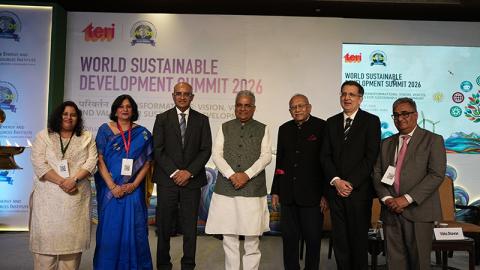
Over the past two and a half decades, WSDS has evolved into a leading platform on sustainable development, shaping global conversations from Rio to Paris, convening Heads of State, Nobel Laureates, industry leaders, and youth changemakers, and translating dialogue into action. From transformative campaigns like Lighting a Billion Lives to advancing circular economy approaches, the Summit has consistently moved intent into implementation.
The inaugural session set the tone for the days ahead, beginning with a welcome address by Mr Nitin Desai, Chairman, TERI, who stated, “Today, the world is completely different. Our challenge is not awareness. Our challenge is action. The whole transition of the World Sustainable Development Summit has been away from just talking about awareness, to better understanding of what needs to be done to promote sustainability. We have a very serious problem of actual implementation.”
Dr Vibha Dhawan, Director General, TERI, in her Theme Address, highlighted, “Over 25 editions, WSDS has evolved into the only independently convened platform shaping discourse on climate change and sustainable development for the global south. We have done enough talk show in what we require today’s action both at India’s level and at global level.”
Before signing off, Dr Dhawan read out a Special Message shared by Shri Narendra Modi, the Hon’ble Prime Minister of India. One of the pertinent remarks that stood out, “Our approach is guided by Antyodaya, the rise of even the most disempowered. Climate action must first protect the vulnerable, the poor, and the disadvantaged. The Global South bears a disproportionate burden of climate change. Yet for them, development is imperative. Climate justice is therefore essential. Developing nations must eradicate poverty and hunger, while safeguarding the planet. This requires technology transfer, financing options and partnerships. Developed countries bear a special responsibility to move faster, live sustainably, and deliver finance and technology at scale. Let this conference strengthen resolve, deepen cooperation and secure a sustainable future for our planet. I extend my best wishes for productive and forward-looking deliberations at the Silver Jubilee edition of WSDS.”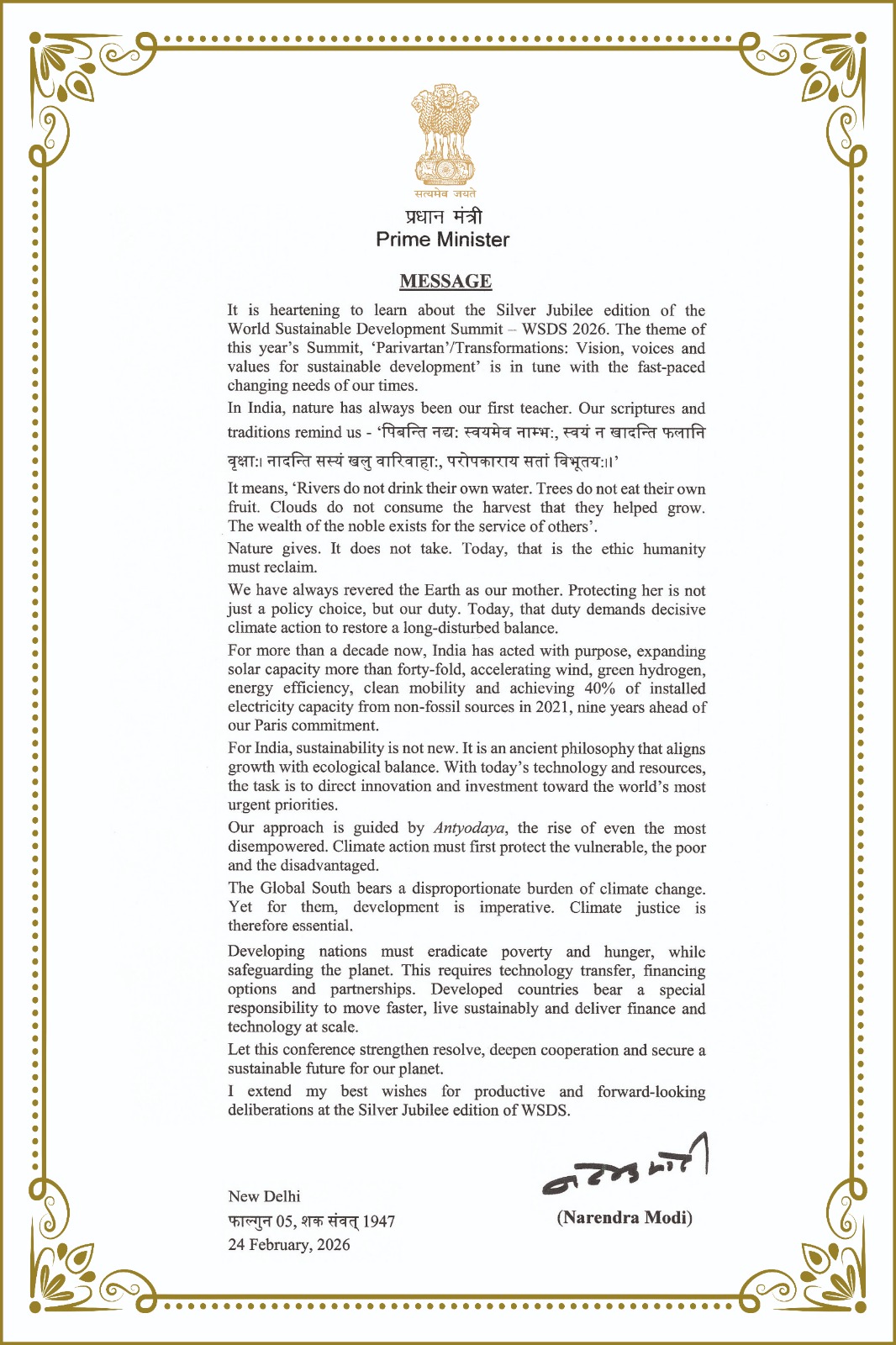
In the Special Address, Mr Siddharth Sharma, CEO, Tata Trusts, underscored, “This is a time for action, it’s important that we democratize the language of climate change, it is not something which has to be restricted to conferences, to drawing room discussions, to boardrooms, it has to go to the masses, they have to understand how it impacts them and then we have to work on solutions which are rooted in the local context with equal emphasis given to adaptation as we give to mitigation.”
The Summit was formally inaugurated by Shri Bhupender Yadav, Hon’ble Minister for Environment, Forest and Climate Change, Government of India. In his Keynote Address, the Minister underscored India’s commitment to climate ambition anchored in equity, resilience, and sustainable growth, noting, “Let परिवर्तन not remain a theme. Let it become a global movement.”
In the Inaugural Address, H.E. Dr Bharrat Jagdeo, Vice President, Cooperative Republic of Guyana remarked, “When this Summit began twenty-five years ago, the focus was on raising awareness of climate and sustainability issues. Today, the challenge is no longer awareness, but resolute action and higher ambition to meet our goals. With major economies stepping back, achieving climate targets, especially in carbon pricing, multilateral regimes, and sectors like aviation and shipping, becomes far more difficult. Yet strong national leadership can drive progress. In Guyana, our 2009 Low Carbon Development Strategy has proven that standing forests provide high-quality, cost-effective mitigation. We have sold forest carbon credits worth hundreds of millions into voluntary and compliance markets, even as we responsibly develop oil resources, showing that sustainability delivers real economic value”.
A key highlight of the inaugural day was the launch of Him-CONNECT– An Innovation Mela from and on the Himalayas, an initiative of the Ministry of Environment, Forest and Climate Change (MoEFCC). The platform aims to connect technologies developed for the Himalayan region under the National Mission for Himalayan Studies with start-ups, entrepreneurs, and investors to accelerate sustainable mountain development, and the launch signals a renewed policy thrust on safeguarding fragile mountain ecosystems.
TERI unveiled the WSDS Silver Jubilee Commemorative publication titled: World Sustainable Development Summit (2001–2026): 25 Editions of Driving Ambition and Action on Sustainable Development – An Archival Pocketbook. The publication chronicles 25 years of global dialogue, leadership, and partnerships shaped through WSDS, documenting its journey of convening Heads of State, Ministers, Nobel Laureates, business leaders, and change-makers from across the world.
The Vote of Thanks was delivered by Mr Sanjay Seth, Senior Director, TERI. He expressed his sincere gratitude to the eminent dignitaries and acknowledged the efforts and support of international partners, the Ministries of the Government of India, state governments, corporate partners, academic institutions, think tanks and civil society organizations. He shared, “The collective efforts of our partners is what gives WSDS its depth, credibility, and impact, and we deeply appreciate their forthcoming support in shaping the Summit and its outcomes.”
Over the past 25 years, WSDS has evolved into a pivotal global platform amplifying Southern perspectives on sustainable development. As the world confronts intersecting crises such as climate, biodiversity, finance, and equity, the 2026 Silver Jubilee edition seeks to move beyond incrementalism toward systemic transformation. WSDS 2026 will continue through 27 February 2026, convening high-level plenaries, global leadership addresses, and sectoral deep-dives aimed at accelerating ambition and action for a just, resilient, and sustainable future.