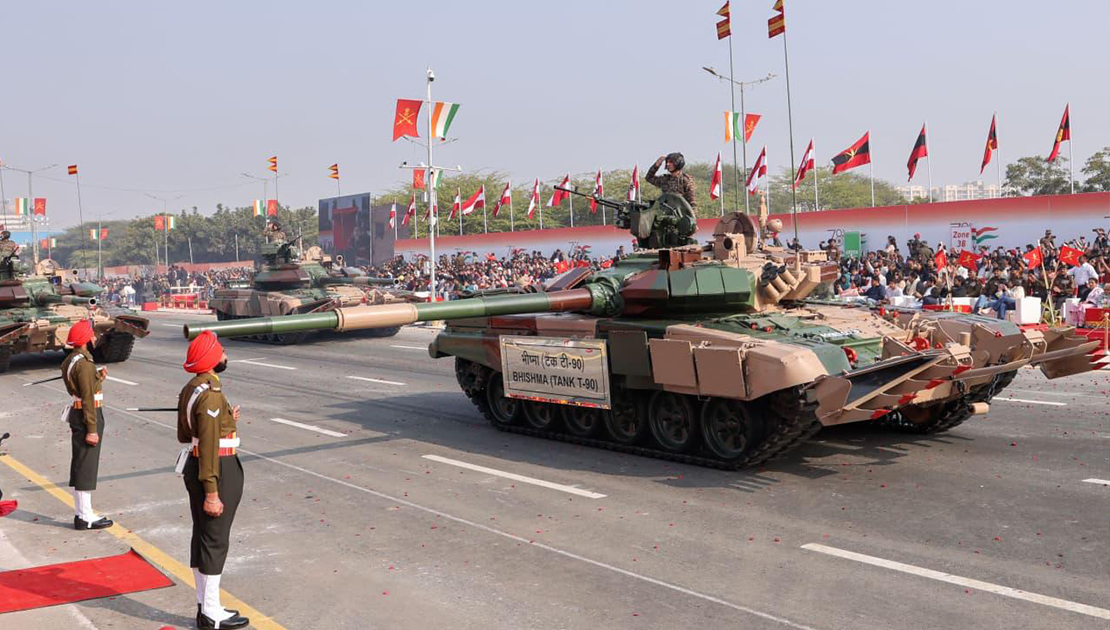
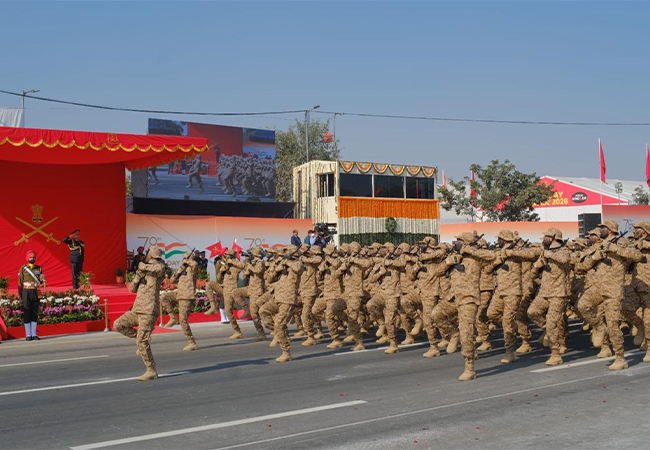
Army Day commemorates 15 January 1949, when General (later Field Marshal) K M Cariappa became the first Indian Commander in Chief, replacing the last British officer, General Francis Bucher. It symbolised India’s military independence after 1947 and marks a historic transition when India took full command of its own Army on 15 January 1949. Indian Army conducts a grand parade every year on 15 January with military displays and acknowledges the selfless service and supreme sacrifices. The day is dedicated to remembering and saluting soldiers who continue to protect India’s borders and maintain internal security.
Status of Army on 15 August 1947 and Emerging Security Threats
The Indian Army in 1947 was undergoing an emotionally charged transition in its history. The four Lakh British Indian Army was under division between India and Pakistan as per the Indian Independence Act, marking the administrative end of the British-led force. The division involved massive troop movements in the shadow of communal riots. Lord Louis Mountbatten transited as the first Governor General of independent India (1947 to 1948) and Field Marshal Sir Claude Auchinleck served as the Supreme Commander of both armies during the transition as Indian and Pakistani command structures were still forming, creating uncertainty and administrative delays. Splitting regiments, equipment, stores, and infrastructure as well as the reorganisation of units with mixed religious composition was complex. Besides preparing for external threats, Indian Armed Forces in general and Army in particular, had to face security challenges on three fronts, i.e., deal with riots in Punjab & Bengal, integration issues of the princely state and the looming Kashmir conflict (which erupted in October 1947). Refugee protection duties spread on both fronts amidst widespread violence, was a herculean task, given that the armed forces were not trained for such duties like, escorting refugee columns, protecting trains or restoring order in riot-hit areas. The leadership was stretched due to moving out of British officers with inadequate replacement of Indian officers, especially in the higher ranks. Moving troops, weapons, and supplies became extremely difficult, given the disruption in railways and communication networks due to violence and sabotage. Thus, the younger Indian officers were baptized in leadership due to the magnitude of the crisis. Despite these overwhelming challenges, the army managed to stabilise the situation and later played a decisive role in defending Kashmir.
Evolving Indian Army Command Structure and Role of Gen Cariappa
The Indian Army inherited the British Indian Army’s structure on 15 August 1947, under Commander-in-Chief, General Sir Robert Lockhart (Aug 1947 – Feb 1948). India initially had three operational commands. The Delhi and East Punjab (DEP) Command was renamed Western Command in January 1948, with Lt Gen (later Field Marshal) K M Cariappa as GOC in C. Still heavily staffed by British officers until late 1947, rapid Indianisation began in 1947–48. Many regiments were divided between India and Pakistan based on religious composition. It was at the backdrop of such events that Gen Cariappa, being the senior most Indian Officer, rose to the occasion to steer the Indian Army. He had joined the British Indian Army in 1919 and served in the Middle East (1941–42) and Burma (1943–44) during World War II. He became the first Indian officer to command a battalion in 1942 and was awarded the Order of the British Empire (OBE) for wartime service. He oversaw the division of the Indian Army between India and Pakistan during Partition in 1947 and was appointed Commander of Eastern Command in 1947 and later Western Command and led Indian forces on the Western Front during the Indo Pakistani War of 1947–48. He was appointed as the first Indian Commander in Chief of the Indian Army on 15 January 1949. He retired from the Army in 1953 and was honoured with the rank of Field Marshal in 1986, becoming the second Indian to receive this distinction after FM Sam Manekshaw.
Major operations and deployments during the Army’s most turbulent formative years (August 1947 to 1950) under Gen Cariappa are summarized as under:-
- The Punjab Boundary Force (PBF) was created in August 1947, to control communal violence during partition and included Indian and Pakistani units under British command. Escorting refugee convoys, securing rail lines, roads, and managing mass migration of nearly 14 million people.
- First Indo Pak War (Oct 1947 – Dec 1948) Jammu & Kashmir Operations were triggered when Pakistan-backed tribal forces invaded Kashmir. India airlifted troops to Srinagar after the Maharaja signed the Instrument of Accession. These operations continued until the UN mandated ceasefire on 1 January 1949.
- Integration of Princely States (1948) Operation Peace – Junagadh (1948) and Operation Polo – Hyderabad (13–18 September 1948) – police action to integrate the Nizam’s Hyderabad into India.
- Post War Reorganization (1949–1950) Territorial Army Act (1948) led to raising of new infantry and artillery units in 1949. Ceasefire Line Management resulted in Army deployment along the newly drawn Ceasefire Line (later LoC) and began fortification, patrolling, and defensive consolidation.
- Internal Security & Nation Building Assistance in maintaining law and order in newly integrated states as well as support to civil administration during refugee resettlement.
Thus, Field Marshal Cariappa is remembered as a nation builder of the Indian Army, emphasising discipline, secularism, and professionalism and 15 January is celebrated as a day of national pride.