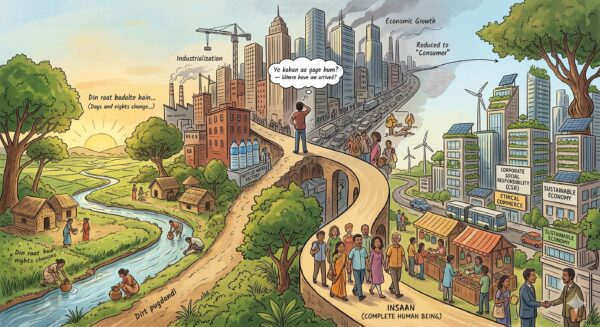
“Din raat badalte hain, haalaat badalte hain, Saath mausam ke phool aur paat badalte hain.”
Times have indeed changed. Human societies once lived in close harmony with nature, drawing sustenance from rivers, forests, and fertile land. With industrialization, however, the rhythm of life began to shift. Villages transformed into towns, towns into expanding cities, and skylines once defined by trees and open skies rose with concrete and glass. The pugdandi gave way to highways, and the jhonpadi looked up at towering skyscrapers. Even drinking water once freely available from wells and streams now arrives sealed in bottles on supermarket shelves. What we call “development” has reshaped not only our lifestyles and aspirations, but also our relationship with nature and with each other.
This transformation has brought undeniable progress, innovation, connectivity, and economic growth. Yet it has also produced deep paradoxes. Prosperity has increased, but inequalities have widened. Consumption has expanded, but natural resources face unprecedented stress. In this journey, one question inevitably arises: “Ye kahan aa gaye hum?” Where have we arrived? In modern economic systems, individuals are increasingly defined by their purchasing power. From being a complete human being an insaan one often finds oneself reduced to a “consumer.” Yet this is not the end of the story. If consumers shape markets through their choices, then empowering them becomes central to building responsible and sustainable economies.
Consumer Empowerment in the Context of Responsible Business
Businesses today are among the most influential institutions in society. They shape production systems, consumption patterns, and even public discourse. As corporate scale and influence have expanded, so too have questions of accountability. Who ensures that the pursuit of profit aligns with societal well-being? For much of the twentieth century, economic thought was guided by shareholder primacy, the idea that businesses exist primarily to maximize returns for shareholders. Over time, this perspective came under scrutiny as environmental degradation, social inequality, and ethical concerns became more visible.
The emergence of stakeholder theory marked a critical shift. It emphasized that businesses must consider the interests of all those affected by their actions: employees, communities, suppliers, governments, and importantly, consumers. From this perspective, consumers are not passive end-users but central stakeholders whose well-being is directly shaped by corporate decisions. Recognizing this transforms the purpose of business. It shifts the focus from merely selling products to creating value responsibly. This shift underpins contemporary frameworks such as Corporate Social Responsibility (CSR) and Environmental, Social, and Governance (ESG) principles, which extend accountability beyond investors to society at large.
Consumer empowerment, therefore, becomes essential. It involves enabling individuals to make informed and responsible choices through access to accurate information, protection from misleading practices, and assurance of fairness in markets. In this sense, empowerment is not just about rights it is about agency.
From Responsibility to Accountability: The Market Mechanism
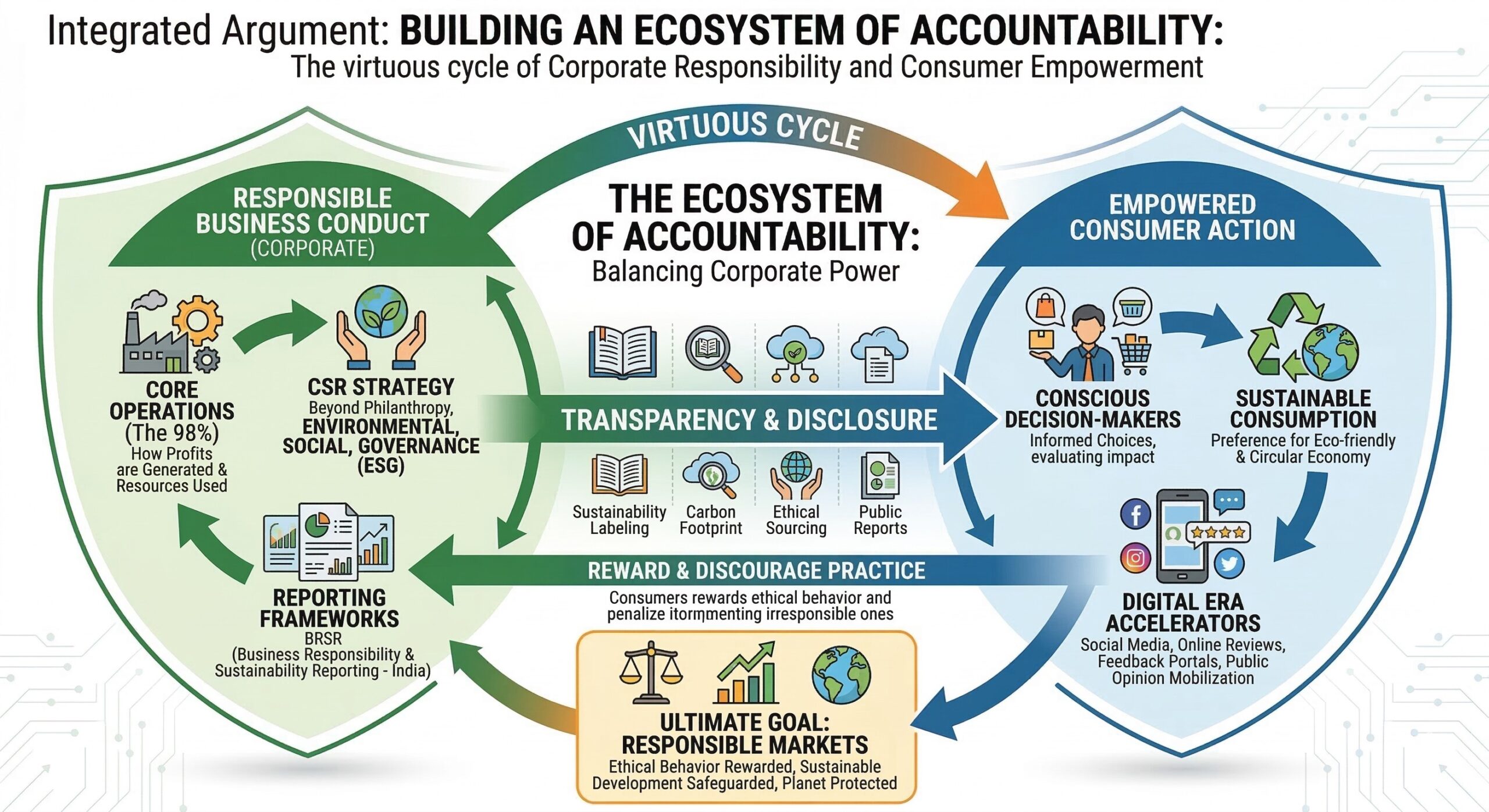
Modern approaches to responsible business reveal a deeper transition: accountability is increasingly embedded within the functioning of markets themselves. Traditionally, CSR was often viewed as a peripheral activity, largely confined to philanthropic contributions. While such initiatives remain important, contemporary thinking places greater emphasis on how businesses generate profits their core operations, value chains, and impact on society and the environment. Frameworks such as ESG and India’s Business Responsibility and Sustainability Reporting (BRSR) reflect this evolution from charity to accountability. At the centre of this transformation lies transparency.
Disclosures related to sustainability practices, carbon footprints, ethical sourcing, and governance standards reduce information asymmetry between businesses and consumers. This transparency enables consumers to evaluate not just products, but the values and practices behind them. It is here that consumer empowerment translates into accountability. When consumers make choices based on sustainability, ethics, and trust not merely price they influence demand patterns. Responsible businesses are rewarded through loyalty and market share, while irresponsible practices face reputational and economic consequences. In this way, markets begin to self-correct. The digital ecosystem has significantly accelerated this process. Social media platforms, online reviews, and real-time feedback mechanisms amplify consumer voice and enhance corporate visibility. Accountability is no longer delayed or distant; it is immediate and continuous. This creates a dynamic feedback loop:
- Businesses act and disclose responsibly
- Consumers evaluate and respond
- Markets reward or penalize behaviour
Through this interaction, an ecosystem of accountability emerges, one in which responsibility is not imposed externally but reinforced through collective participation.
Towards Responsible Markets: A Shared Responsibility
This evolving relationship between corporate responsibility and consumer empowerment redefines the very nature of markets. Markets are no longer neutral spaces of exchange; they are becoming value-driven systems where ethics, sustainability, and accountability shape outcomes. However, this transformation cannot be driven by any single actor alone. Governments provide regulatory frameworks, businesses adopt responsible practices, and consumers make informed choices but meaningful change emerges only through their collective alignment. This principle finds global recognition in the United Nations Sustainable Development Goals (SDGs), particularly SDG 17, which emphasizes partnerships for sustainable development. Responsible markets, therefore, are built not on isolated actions, but on shared responsibility.
In many ways, this vision resonates deeply with the Indian ethos of Vasudhaiva Kutumbakam the world as one family. In such a framework, responsibility is mutual and interconnected. Businesses, consumers, governments, and communities are not separate actors, but participants in a shared system shaping the future. The challenges of climate change, resource depletion, and social inequality leave little room for delay. The moment calls not for fragmented efforts, but for collective commitment.
The Indian Context: Institutionalizing Accountability and Empowerment
India presents a compelling example of how policy frameworks can align corporate responsibility with consumer empowerment to shape responsible markets. The Consumer Protection Act, 2019 has strengthened consumer rights by addressing unfair trade practices, misleading advertisements, and e-commerce transactions, while also promoting awareness through initiatives such as “Jago Grahak Jago.” These efforts aim to transform consumers from passive buyers into informed and vigilant participants in the marketplace. On the corporate side, the Companies Act, 2013 institutionalized Corporate Social Responsibility (CSR), mandating eligible firms to allocate a portion of profits toward social development. While significant, the deeper shift lies in governance frameworks such as SEBI’s Business Responsibility and Sustainability Reporting (BRSR), which require companies to disclose their environmental, social, and governance performance in a structured and transparent manner.
Together, these mechanisms create a reinforcing ecosystem: responsible companies are encouraged to act transparently and ethically, while informed consumers are equipped to evaluate and respond to such behaviour. The result is a gradual transition toward markets where accountability is embedded, and sustainability is not an aspiration, but an outcome.
Conclusion
The future of responsible markets will not be decided in boardrooms alone, but in the everyday choices of millions. When consumers act with awareness, markets respond with accountability. An empowered consumer, therefore, is not merely a participant in the marketplace but its most powerful regulator.