

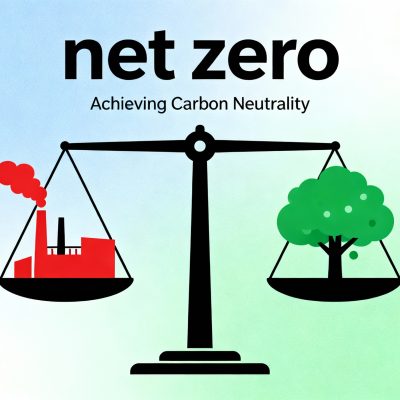
Net Zero is no longer a distant aspiration; it has become a defining challenge for nations, industries, and communities worldwide. For India, the pledge to achieve net-zero emissions by 2070 is both a responsibility and an opportunity. At the heart of this mission lies afforestation, one of the most effective and natural strategies for carbon offsetting. Trees act as powerful carbon sinks, absorbing carbon dioxide and restoring ecological balance, while also providing co-benefits such as biodiversity conservation, soil enrichment, and livelihood creation. In a country where rapid urbanization and industrial growth have reduced green cover, afforestation projects are emerging as a critical pathway to mitigate climate change and align corporate social responsibility with national priorities.
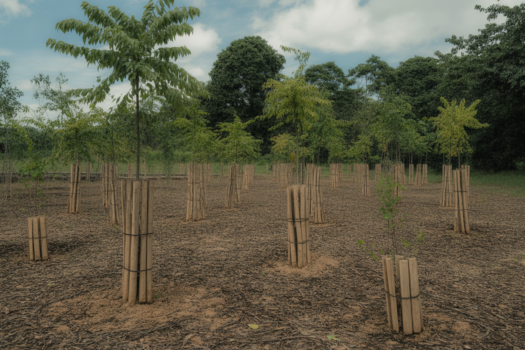
Afforestation — planting trees where none existed before — is a proven method of carbon sequestration. Forests absorb nearly 2.6 billion tonnes of CO₂ annually worldwide. In India, where deforestation and urbanization have reduced green cover, afforestation projects are vital to restore ecosystems, improve soil health, and enhance biodiversity.
CSR initiatives in afforestation not only mitigate climate change but also generate co-benefits: rural employment, water conservation, and community development.
The importance of achieving Net Zero cannot be overstated. If the world fails to act decisively, the consequences will be catastrophic: rising global temperatures, extreme weather events, biodiversity loss, and threats to food and water security. For India, with its vast population and growing economy, inaction would mean jeopardizing livelihoods, public health, and long-term sustainability. Afforestation offers a practical and scalable solution, and corporate India has begun to recognize its potential. Several companies are already investing in large-scale plantation drives and community-led forestry programs as part of their CSR commitments.

 Case studies highlight the transformative potential of afforestation. ITC’s Social Forestry Program has not only sequestered millions of tonnes of carbon but also empowered farmers by providing sustainable livelihoods. Mahindra’s Hariyali Project has created awareness among urban citizens, encouraging them to participate in plantation drives. Wipro’s biodiversity parks in Bengaluru have become community hubs, blending environmental restoration with public engagement. “Afforestation is not charity; it is an investment in resilience,” remarked Anand Mahindra, Chairman of Mahindra Group, underscoring the business case for sustainability.Infosys, for instance, has pledged carbon neutrality and invested in afforestation projects across Karnataka, planting millions of trees to offset emissions.“We see afforestation not just as a carbon offset, but as a way to restore ecosystems and empower local communities,” said an Infosys sustainability officer in a recent interview.
ITC Limited runs its Social Forestry Program, which has greened over a million acres, benefiting farmers while sequestering carbon. Mahindra Group launched the Mahindra Hariyali Project, planting over 18 million trees across India, while Wipro has supported urban afforestation and biodiversity parks, creating green lungs in cities. These initiatives demonstrate how CSR can align with sustainability goals while delivering tangible social impact.

Top 5 Afforestation CSR Projects in India
- ITC Limited – Social Forestry Program
- Over 1 million acres greened across India.
- Provides sustainable livelihoods to farmers while sequestering millions of tonnes of carbon.
- Recognized as one of the largest corporate-led afforestation programs globally.
- Mahindra Group – Hariyali Project
- More than 18 million trees are planted nationwide.
- Focuses on community participation and awareness, encouraging citizens to join plantation drives.
- Aims to plant 1 million trees annually.
- Infosys – Carbon Neutrality Drive
- Large-scale afforestation projects in Karnataka.
- Millions of trees planted to offset corporate emissions.
- Integrates biodiversity restoration with community development.
- Tata Steel – Plantation Drives in Jharkhand & Odisha
- Afforestation is linked with livelihood programs for local communities.
- Focus on restoring degraded land and improving soil health.
- Supports India’s Net Zero commitment through long-term forestry projects.
- Wipro – Urban Biodiversity Parks
- Creation of green lungs in Bengaluru and other cities.
- Promotes urban afforestation and ecological awareness.
- Enhances biodiversity while improving air quality in metropolitan areas.
The risks of ignoring Net Zero targets are severe. Without urgent afforestation and carbon offsetting, India faces increased frequency of floods, droughts, and heatwaves, declining agricultural productivity due to soil degradation, worsening air pollution, and loss of biodiversity. These challenges will directly affect economic growth and social stability. Recognizing this, the Government of India has taken significant steps. At COP26, India committed to achieving Net Zero by 2070 and reducing emissions intensity of GDP by 45 percent by 2030 compared to 2005 levels.

Risks of Inaction
Without urgent afforestation and carbon offsetting, India faces:
- Increased frequency of floods, droughts, and heatwaves.
- Declining agricultural productivity due to soil degradation.
- Severe air pollution and health crises in urban areas.
- Loss of biodiversity and ecosystem services critical for survival.
The government has launched the National Mission for a Green India, which aims to increase forest and tree cover, restore ecosystems, and enhance livelihoods. The Compensatory Afforestation Fund Management and Planning Authority (CAMPA) channels funds into forest restoration, while the recently introduced Carbon Credit Trading Scheme establishes the Indian Carbon Market, enabling offset mechanisms for voluntary climate projects. Future plans include expanding carbon markets, incentivizing private sector afforestation, and integrating CSR with national climate goals.
Government Schemes at a Glance: Afforestation & Net Zero
National Mission for a Green India (GIM)
- Launched under the National Action Plan on Climate Change.
- Targets increased forest/tree cover and ecosystem restoration.
- Focuses on biodiversity, water, and livelihood enhancement.
Compensatory Afforestation Fund (CAMPA)
- Channels funds from diverted forest land into afforestation projects.
- Supports large-scale reforestation and ecological restoration.
Nationally Determined Contributions (NDCs)
- India pledged to reduce emissions intensity of GDP by 45% by 2030.
- Commitment to achieve Net Zero by 2070.
Indian Carbon Market (ICM)
- Introduced in 2023 under the Carbon Credit Trading Scheme.
- Enables voluntary carbon offset projects, incentivizing afforestation.
Future Plans
- Expansion of carbon markets to include private sector afforestation.
- Incentives for CSR-linked forestry projects.
- Integration of afforestation with livelihood, biodiversity, and climate resilience goals
Net Zero is India’s defining challenge and opportunity. The time to act is now. By aligning CSR with afforestation, organizations can transform climate pledges into living forests, and citizens can turn awareness into action. Together, we can plant the seeds of a greener tomorrow and ensure that India’s growth story is also a sustainability story.

CSR Opportunities for Organisations
Companies can design impactful CSR projects around:
- Community-led afforestation: Partnering with local communities to plant and maintain forests.
- Urban greening: Developing biodiversity parks and green belts in cities.
- Agroforestry: Integrating trees into farming systems to improve yields and sequester carbon.
- Mangrove restoration: Protecting coastal ecosystems while offsetting carbon.
- Carbon offset partnerships: Collaborating with NGOs and government programs to scale afforestation.
Such projects not only offset emissions but also strengthen brand reputation, stakeholder trust, and compliance with ESG frameworks.
India’s Net Zero journey is not a solitary mission of government policy or corporate pledges — it is a collective responsibility that demands synergy. The government has laid the foundation through ambitious schemes like the Green India Mission, CAMPA, and the Indian Carbon Market, while corporates have stepped forward with landmark afforestation projects that restore ecosystems and empower communities. Together, these efforts demonstrate that sustainability is no longer a choice but a necessity.
Yet, the road ahead requires more than scattered initiatives; it calls for scale, transparency, and purpose-driven collaboration. Afforestation must be seen not merely as tree planting, but as an investment in resilience, livelihoods, and the integrity of our environment. Every sapling nurtured today is a promise to future generations — a promise of cleaner air, fertile soil, and thriving biodiversity.