 Introduction: Growing urgency of climate change and global warming
At the closing of the recent COP30 held in Belem in November 2025, the UN Climate Change Executive Secretary Simon Stiell declared that “….climate cooperation is alive and kicking, keeping humanity in the fight for a livable planet”, infusing a dose of cautious optimism in the ongoing global discourse on climate change.
Climate change refers to long-term shifts in temperatures and weather patterns, due to natural causes, or due to human activities such as burning of fossil fuels – coal, oil and gas – as has been the case since the 1800s. The average temperature of the Earth’s surface is now about 1.42°C warmer than it was in the late 1800s – prior to the industrial revolution -and warmer than at any time in the last 1,00,000 years! In fact, the decade of 2015-2024 was the warmest on record, and each of the last four decades has been warmer than any previous decade since 1850. Climate change is not just about rising temperatures, it manifests itself in more disruptive and visible ways – intense droughts, water scarcity, severe fires, rising sea levels, flooding, melting polar ice, catastrophic storms and declining biodiversity, negatively impacting our health, ability to grow food, housing, safety and work. Scientists and government entities have agreed that limiting global temperature rise to no more than 1.5°C would help us avoid the worst climate impacts and maintain a livable climate; yet current policies predict up to 2.8°C of warming by the end of the century.
However, responsibility for this crisis is unevenly distributed globally. The six biggest emitters (China, the United States of America, India, the European Union, the Russian Federation, and Indonesia) together account for more than half of all global greenhouse gas emissions, whereas the 45 least developed countries contribute only 3% of the same. While everyone needs to take climate action, people and countries creating more of the problem have a greater responsibility to act first.
Shift from government-only responsibility to business accountability
In September 2015, when 193 countries came together at the United Nations to adopt and commit to 17 Sustainable Development Goals (SDGs) to tackle challenges related to global sustainable development, the perception was that it was largely the mandate of governments and policy-makers. That view has evolved since then. It has now been acknowledged that achieving SDG goals and addressing the climate crisis by any country would require all stakeholders – individuals, businesses, local and federal bodies – to collaboratively work towards adopting environmental-friendly actions and initiatives.
On 20th January 2017, addressing the World Economic Forum in Davos, Switzerland, United Nations Secretary-General António Guterres called for a new generation of partnerships with the business community to limit the impact of climate change. His argument was that only the private sector possesses the innovation and market capabilities necessary to develop new green technologies, and that implementing SDGs was not just a moral imperative; they also had massive investment opportunity, estimated to generate returns of around $30 billion per year.
Leading by example: Net-zero emissions targets by businesses
Historically, firms worldwide have contributed to climate change effects such as cross-border pollution and rising insurance costs, generating excess greenhouse gas emissions by burning fossil fuels, manufacturing cement, steel, and iron, and the resultant waste, transporting goods, clearing land, and using refrigeration and air conditioning. Today, however, many firms are repositioning themselves as part of the solution. Across industries, companies and business leaders are redesigning operations, rethinking supply chains, and investing in cleaner technologies, to reduce harmful emissions and ensure that their organizations are more socially responsible by enacting positive change.

Today, over 8,000 companies globally have committed to net-zero initiatives and 96% of the world’s top 250 report on sustainability. A recent study also found that at least 25% of Fortune 500 companies have pledged to reach carbon neutrality by 2030. The examples below show that climate action is not just an environmental obligation; it is also a strategy for long-term business resilience:
Patagonia, the outdoor apparel manufacturer, has long been known for its environmental stewardship. Since 1985, the company has pledged one percent of its salesto preserving and restoring the natural environment and, since 2002, has been part of a global network of firms committed to inspiring collective action and preventing greenwashing. More recently, Patagonia’s founder, Yvon Chouinard, announced that Earth was the “only shareholder,” and that all of the company’s profits would go to a specially created trust and nonprofit dedicated to addressing the environmental crisis.
New Belgium Brewing Company, a craft beer maker achieved a major milestone in 2020: making its flagship offering, Fat Tire Ale, the first certified carbon-neutral U.S. beer.
Technology giant Google is now on a mission to tackle climate change using artificial intelligence (AI). Google’s AI-driven actions have included:
- Implementing fuel-efficient routingin Google Maps
- Building a Flood Hub platformthat provides real-time information to prepare for and respond to riverine floods.
Microsoft achieved carbon-neutrality as early as in 2012. Since then, it has set even bolder goals: by 2030, the company aims not only to be carbon neutral, but to be carbon negative, removing more carbon than it emits, through initiatives such as:
- Investing in a wind farm in Texas and solar projects in Chile.
- Creating a $1 billion Climate Innovation Fund to accelerate decarbonization technologies.
- Developing digital tools that help other businesses track their company carbon footprint.
Ford, the automotive giant, has pledged to become a carbon neutral company by 2050, tackling emissions both in its factories and in its cars. Ford’s strategy includes:
- A $11 billion investment in electric vehicles (EVs).
- Development of solid-state batteries to improve EV range.
- Transitioning manufacturing plants to run on renewable energy.
Apple, one of the world’s most recognizable brands, has pledged to make its entire supply chain and product lifecycle carbon neutral by 2040. Apple’s efforts include:
- Designing products with recycled and low-carbon materials.
- Requiring suppliers to switch to renewable energy sources.
- Investing in high-quality carbon offset projects that restore forests and ecosystems.
Amazon has one of the largest and most complex supply chains in the world, making its pledge to be carbon neutral by 2040 particularly ambitious. Amazon’s carbon neutral solutions include:
- Deploying 100,000 electric delivery vehicles across its fleet.
- Building renewable energy capacity, such as a solar farm in Virginia.
- Committing $100 million to reforestation projects globally.
- Launching “Climate Pledge Friendly,” a label to help consumers choose sustainable products.
- Cardano, one of the top blockchain platforms in the cryptocurrency sector has positioned itself as a carbon neutral business. Its primary strategy is using a proof-of-stake protocol, which consumes far less energy than traditional mining. The Cardano Foundation has also committed to supporting projects that remove carbon from the atmosphere, helping offset any remaining emissions.
- In India, firms such as Tata Power are shifting aggressively toward renewables, aligning with India’s national “Panchamrit” plan to reach net-zero by 2070.
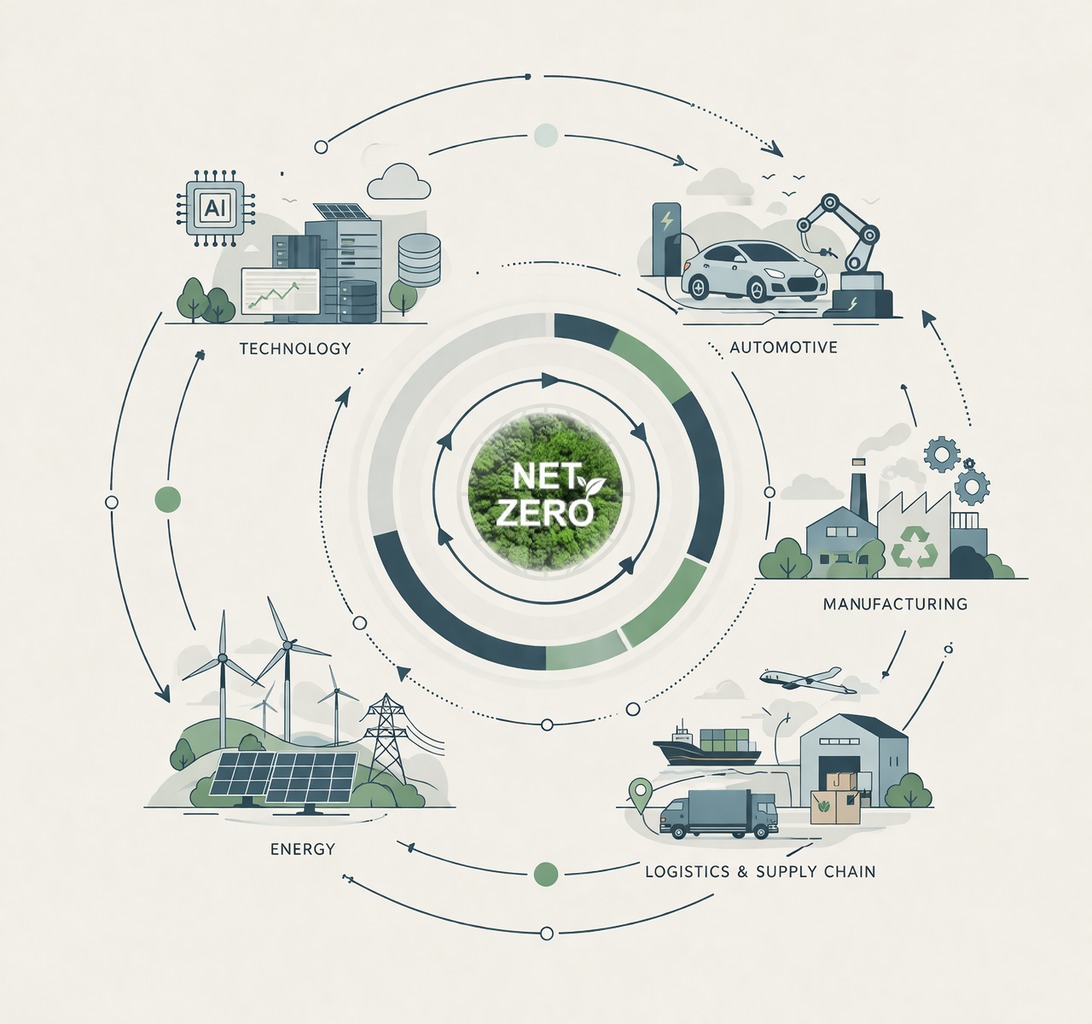
Investment in clean technologies (EVs, carbon capture, green hydrogen)
Global investment in clean technologies has reached unprecedented levels today, having surpassed $2.2 trillion in 2025, heavily driven by electric vehicles (EVs), renewable power, and energy storage. For the first time, clean energy investments are outpacing spending on upstream oil and gas. The key investment areas have been:
- Electric Vehicles (EVs) & Transport (reached $130 billion in 2024 and is projected to rise to $160 billion in 2025),
- Battery storage (set to reach $66 billion in 2025),
- Green Hydrogen (reached $4.3 billion in 2024 – 80% increase from 2023, and expected to nearly double in 2025 to $8 billion),
- Carbon Capture, Utilization, and Storage (CCUS) (projects potentially to increase more than tenfold by 2027 if all approved projects move forward).
Regionally, China remains the dominant force in overall investment, spending $800 billion in 2025, which accounts for over 34% of the global total. United States and Europe have also increased their investments significantly, while India is emerging as a major player, with investments rising 15% to $68 billion in 2025, focusing on solar, battery storage, and green hydrogen.
The Path Forward: Profit with Purpose
The rapid rise in AI adoption across industries and rise of AI data centers has spurred investment in “behind-the-meter” power generation and onsite energy solutions, as grid capacity becomes constrained. Increasingly, innovations are focusing on high-temperature process heat for heavy industry, direct lithium extraction (DLE), and advanced wastewater treatment. On the other hand, despite these high figures, global investment still needs to go up by three times the current levels to align with net-zero 2050 targets.
The integration of environmental sustainability into core business strategies is no longer optional. The very definition of business success is evolving – from profit maximization to profit with purpose – the purpose of protecting the planet. Businesses are rapidly emerging as some of the most influential players in the global race to net-zero. Through a combination of innovation and accountability, businesses are proving that economic growth through profits can go hand in hand with the larger purpose of environmental preservation and protecting the planet for our future generations.