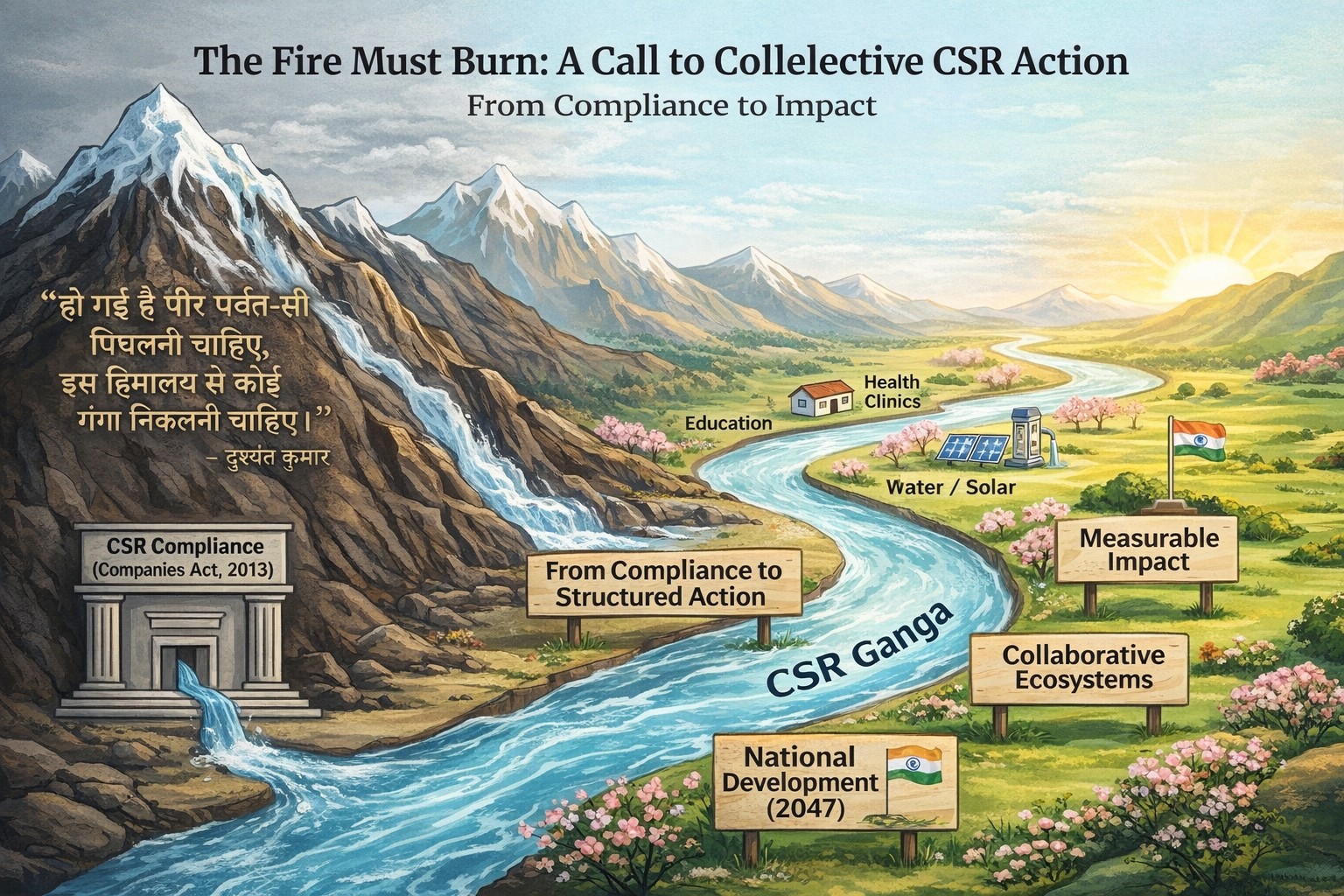
The evolution of Corporate Social Responsibility (CSR) in India has been nothing short of transformational. What began as a compliance mandate under Section 135 of the Companies Act, 2013 has today evolved into a dynamic ecosystem driving measurable social impact and aligning closely with national development priorities. As we step into the financial year 2026–27, particularly in the context of “PSU Day,” it is an opportune moment to reflect on where CSR stands today and where it is headed. At this juncture, the timeless words of Dushyant Kumar resonate deeply: “हो गई है पीर पर्वत-सी पिघलनी चाहिए, इस हिमालय से कोई गंगा निकलनी चाहिए।” The pain has piled up like a mountain it must now melt; from this Himalaya, a Ganga must flow. For decades, social challenges in India stood like a mountain vast, immovable, and deeply entrenched. What we are witnessing today is that gradual melting. That emerging flow that Ganga is CSR. From policy intent to structured action, from fragmented efforts to collaborative ecosystems, CSR has begun to channel resources, intent, and accountability into a continuous stream of development.
From Structure to Substance: The Making of Modern CSR
If the mountain has begun to melt, it is not by chance, it is the result of a carefully created structure. The story of CSR in India formally began on 1st April 2014, when Section 135 of the Companies Act came into force. What was once confined to discretionary philanthropy moved decisively into the boardroom. CSR committees were constituted, policies were framed, and for the first time, social responsibility became a matter of governance and accountability. Over time, this structure has only strengthened. Recent policy directions for Public Sector Undertakings (PSUs), as also reflected in thought leadership shared by Dr. Bhaskar Chatterjee, indicate a continued emphasis on strategic alignment, transparency, and measurable outcomes. CSR is no longer an adjunct; it is integral to institutional functioning.
But structure alone does not create impact. What truly transformed CSR was its shift into a project-based approach. Social interventions began to be designed with clear objectives, defined timelines, and measurable outcomes. The introduction of mandatory third-party impact assessments for large projects added another layer of credibility, ensuring that intent translates into tangible change on the ground.
Parallel to this structural evolution was a quieter, yet equally significant transformation the coming together of corporates and NGOs. There was a time when these two operated in silos, often viewing each other with hesitation. Corporates questioned the governance of NGOs, while NGOs were wary of corporate intent. It was, in many ways, a relationship marked by a “trust deficit.” And yet, as the system evolved, so did the stakeholders. NGOs began adopting professional practices bringing in governance frameworks, financial discipline, and impact measurement. At the same time, corporates started developing a deeper understanding of community realities, moving beyond cheque-writing to meaningful engagement. This gradual convergence can perhaps be best described in simple words “kuchh to barf pighli hai.”. Today, we see a new paradigm emerging:
- NGOs becoming more structured and accountable (Corporatization of NGOs)
- Corporates becoming more empathetic and socially aligned (socialization of corporates)

What once seemed like water and oil has begun to blend into a cohesive force for development. This convergence has been critical. It has allowed CSR to move from isolated efforts to collaborative impact, where each stakeholder brings its unique strength resources, reach, or relationships. In many ways, this is where the first streams of that “Ganga” begin to form structured, purposeful, and steadily gaining direction.
Emerging Opportunities in FY 2026–27: Expanding the CSR Ecosystem
As the streams of CSR gather momentum, the river begins to widen carving new pathways and shaping a larger ecosystem of impact. The coming financial year presents not just opportunities, but a responsibility to deepen and scale this journey. At the heart of this next phase lies the idea of co-creation. CSR is gradually moving away from a model where communities are treated as passive beneficiaries. Instead, communities are becoming active partners in design, implementation, and ownership. Whether in education, healthcar
e, rural development, or work in aspirational districts, the most effective interventions today are those that are rooted in local realities. Solutions that are community-driven, context-specific, and capable of scaling sustainably are no longer optional; they are essential. This shift ensures that development is not imposed, but emerges organically from within.
Alongside this, India’s CSR ecosystem has reached a stage of maturity. Today, there exists a fairly well-defined cycle from need assessment and project design to implementation and impact evaluation. Yet, the next leap will depend on strengthening this ecosystem further. Building institutional capacities, developing standardized metrics for impact measure
ment, and embracing data-driven decision-making will be critical. As CSR integrates more deeply with business strategy and sustainability frameworks, the demand for precision, comparability, and transparency will only increase.
This evolution is closely linked to the broader shift from CSR to ESG. With frameworks introduced by the Securities and Exchange Board of India, particularly through Business Responsibility and Sustainability Reporting (BRSR), companies are now being evaluated beyond financial performance. In this expanded lens, CSR represents the social dimension of ESG bridging compliance with conscience. It reflects a natural progression where responsibility is no longer an external obligation but an intrinsic part of doing business. In this context, CSR assumes a critical role in advancing the national vision of Viksit Bharat 2047. The focus is increasingly on inclusive development reducing inequalities, promoting social justice, and ensuring dignity for all sections of society. CSR initiatives, when aligned with this vision, have the potential to create not just outputs, but lasting societal transformation.
However, sustaining this momentum will require investing in people. The need for a professional CSR cadre is becoming increasingly evident. Managing complex, multi-stakeholder development projects requires specialized skills ranging from impact assessment and community engagement to ESG integration. Developing such a cadre will significantly enhance the effectiveness, credibility, and scalability of CSR interventions in the years ahead. As Dushyant Kumar poignantly reminds us, “सिर्फ़ हंगामा खड़ा करना मेरा मक़सद नहीं,
मेरी कोशिश है कि ये सूरत बदलनी चाहिए।” I do not seek to raise mere noise or unrest;
I strive to transform the very state of things. This spirit of moving beyond rhetoric to real transformation must guide the next phase of CSR evolution. Equally important is the role of the media as a catalyst in this journey. By documenting impact stories, creating awareness, and recognizing best practices, media platforms contribute to both accountability and inspiration. Publications like CSR Times are not merely chroniclers of change; they are active participants in shaping the discourse and direction of the CSR movement.
As this “Ganga” of CSR continues to flow, its strength will depend on how inclusively it expands, how responsibly it is managed, and how purposefully it is directed. The opportunity before us is not just to sustain this flow, but to ensure that it reaches every segment of society bringing with it the promise of equity, dignity, and sustainable development.
Aavahan: A Call to Collective Action
India’s CSR journey has laid a strong foundation over the past decade. What lies ahead is not merely an expansion of spending, but a deepening of impact. With CSR projections expected to cross ₹39,000+ crore in FY 2025–26, the opportunity is immense but so is the responsibility. The future of CSR will not be defined by the breadth of expenditure, but by the depth, quality, and sustainability of outcomes it creates.
The path forward lies in collaboration, innovation, and accountability where stakeholders move beyond silos and work as a collective force for change. The future of CSR is not in isolated efforts, but in shared purpose. It is no longer about “you” or “me” it is about “we.” A powerful reminder, “मेरे सीने में नहीं तो तेरे सीने में सही, हो कहीं भी आग, लेकिन आग जलनी चाहिए।” If not in my heart, then in yours; but let the fire of change keep burning, somewhere. This spirit of shared responsibility and unwavering commitment must define India’s journey towards 2047 where CSR plays a pivotal role in ensuring that growth is not only economic, but also equitable, inclusive, and truly sustainable.