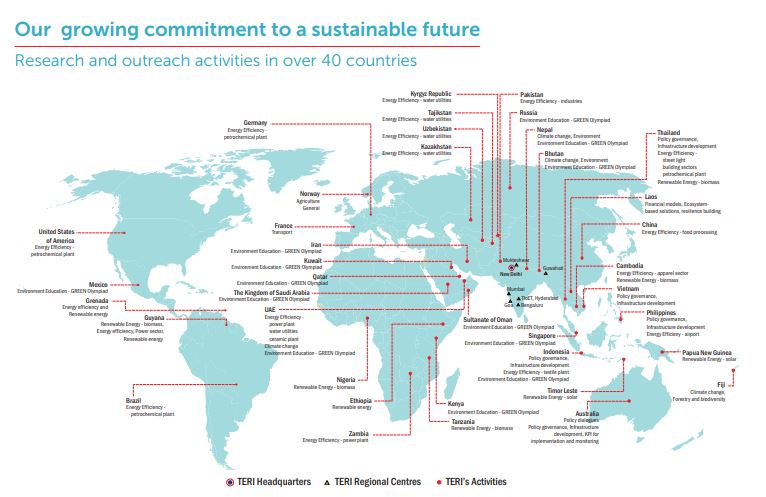
 Environmental sustainability is increasingly recognized as an institutional challenge as much as a technological or scientific one. While advances in renewable energy and climate science are essential, translating knowledge into policy and global commitments into local action depends on institutions that bridge these domains. As the world confronts climate change, biodiversity loss, and resource degradation, the ability to shape sustainable development pathways assumes critical importance. In this context, organizations such as The Energy and Resources Institute (TERI) have played an important role in India’s environmental transition. Equally significant has been the contribution of the TERI School of Advanced Studies (TERI SAS), which has helped build the next generation of sustainability professionals and researchers through interdisciplinary education and research. Together, TERI and TERI SAS represent an ecosystem that combines knowledge generation, capacity building, and field-level action, an increasingly critical requirement in addressing complex environmental challenges.
India’s sustainability challenge is particularly complex. The country must address climate change, energy security, and resource constraints while continuing to pursue economic growth and poverty reduction. Its commitments under the Paris Agreement, including achieving net-zero emissions by 2070, expanding non-fossil fuel energy capacity, and reducing emissions intensity, reflect this balancing act. Equally important are India’s commitments under the Sustainable Development Goals (SDGs) and Mission LiFE, which emphasize sustainable lifestyles and inclusive development.
Achieving these objectives requires institutions capable of generating evidence, informing policy, developing innovative solutions, and supporting implementation. Since its establishment in 1974, TERI has evolved from an energy information centre into one of Asia’s leading institutions working on energy, environment, climate change, and sustainable development. Its multidisciplinary approach, combining research, policy engagement, technology development, field implementation, and capacity building reflects the understanding that sustainability requires integrated solutions connecting ecological, economic, and social dimensions of development.
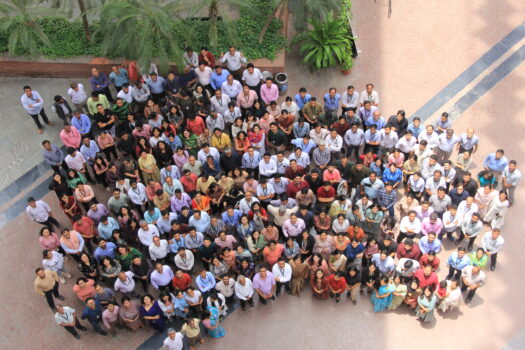 One of TERI’s important contributions has been its work in supporting India’s transition towards cleaner and more efficient energy systems. Long before renewable energy became central to national policy, TERI was contributing to research and discussions on energy efficiency, resource conservation, and sustainable energy pathways. Such efforts have complemented India’s broader climate and energy goals while supporting progress towards SDG 7 on affordable and clean energy.
However, environmental transitions are not solely about replacing fossil fuels with renewable technologies. They also involve questions of equity, livelihoods, and social inclusion. Increasingly, climate action is being viewed through the lens of a ‘just transition’, one that ensures environmental progress while creating economic opportunities and reducing vulnerabilities.
TERI’s long-standing engagement with decentralized renewable energy is reflected in its flagship Lighting a Billion Lives (LaBL) initiative, which demonstrated the potential of community-based approaches in addressing energy poverty and expanding access to clean energy. Beyond electrification, the programme highlighted the wider developmental benefits associated with decentralized energy systems.
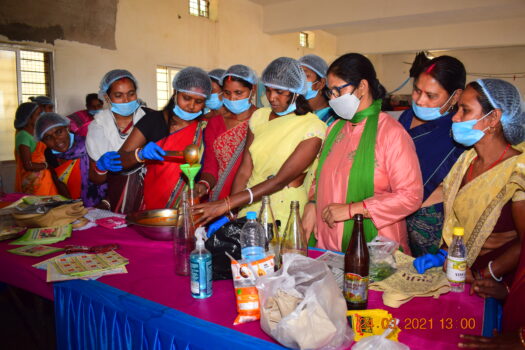
Building on these experiences, TERI has articulated the vision of LaBL 2.0 – Leveraging Clean Energy for a Billion Livelihoods. This shift represents an important evolution in sustainability thinking. While earlier approaches focused primarily on energy access, LaBL 2.0 emphasizes productive uses of energy that support livelihoods, enterprise development, and local economic resilience. It recognizes that energy should be viewed not merely as a service, but as an enabler of income generation, women’s economic participation, and community development.
This evolution mirrors broader changes in India’s sustainability discourse. Increasingly, the energy transition is being linked with rural livelihoods, women’s empowerment, and local enterprise development. Such approaches help bridge the often-perceived divide between environmental sustainability and economic development.
 Another important dimension of TERI’s work lies in its emphasis on translating research into practice. Through its work on renewable energy, natural resource management, climate resilience, sustainable agriculture, and community development, TERI has sought to bridge the gap between policy aspirations and implementation realities through a ‘lab-to-field’ approach. Equally significant has been the role of TERI SAS in strengthening India’s intellectual and human resource base in sustainability through teaching, research, and academic engagement. Together, these efforts underscore the importance of coupling knowledge creation with knowledge dissemination and capacity building.
The growing complexity of environmental challenges highlights the importance of institutions that can operate across disciplines and sectors. Climate change, water scarcity, biodiversity loss, and resource insecurity are increasingly interconnected problems that demand collaborative responses.
Ultimately, the significance of organizations like TERI lies not merely in their institutional legacy, but in their ability to create public value. Environmental sustainability is fundamentally a collective endeavour that requires institutions capable of generating knowledge, facilitating dialogue, testing innovations, and supporting implementation. India’s environmental ambitions, from achieving climate goals to building resilient livelihoods and sustainable economies cannot be realized by governments alone.
As the country advances towards a low-carbon future, institutions operating at the intersection of science, policy, technology, and community engagement will become increasingly important. The experience of TERI demonstrates that environmental sustainability is not simply about protecting natural resources; it is equally about shaping development pathways that are economically viable, socially inclusive, and environmentally resilient. In this sense, institutions matter because they provide the bridge through which environmental commitments are translated into meaningful and lasting outcomes for people and the planet.