
 World No Tobacco Day, observed each year on May 31, is often framed as a public health campaign. But for those who shape institutions, influence society, and define standards—leaders, professionals, and decision-makers—it represents something deeper: a question of discipline, clarity of judgment, and long-term legacy.
Tobacco is not an indigenous habit. It entered India in the 16th century through colonial trade routes, gradually embedding itself into social behavior across classes. Yet, if we turn to classical Indian knowledge systems such as the Charaka Samhita and Sushruta Samhita, we find no endorsement of such substances. These texts, foundational to Ayurveda, emphasize restraint, balance, and conscious living. Health, in this framework, is not merely the absence of disease—it is a state of physical vitality, mental clarity, and moral discipline.
Tobacco stands in direct contradiction to these principles.
Modern science now articulates what traditional systems implicitly upheld: tobacco is a systemic toxin. It is associated with malignancies of the lung, oral cavity, esophagus, and pancreas; it accelerates atherosclerosis, precipitates myocardial infarction, and contributes to chronic respiratory disease. These are not distant risks—they are predictable outcomes. For individuals in positions of influence, the implications extend beyond personal health. Decision-making capacity, productivity, and longevity are all compromised.
Equally important is the optics of behavior. Leadership is not exercised solely through policy or instruction; it is reinforced through personal example. In professional and social ecosystems, habits are often imitated before they are questioned. A senior executive, a clinician, a policymaker, or an academic who uses tobacco inadvertently normalizes it within their sphere of influence. Conversely, visible abstinence reinforces a culture of discipline and responsibility.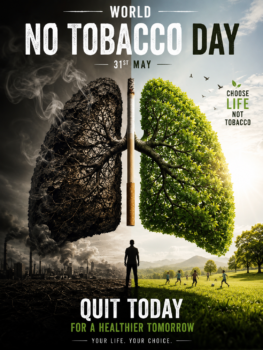
India’s tobacco landscape is uniquely complex. Unlike many Western settings, the burden here is not limited to smoking. Smokeless forms—gutka, khaini, and related products—are widely consumed and often underestimated in their harm. The result is a disproportionately high incidence of oral cancers, many presenting at advanced stages. This is not merely a clinical concern; it reflects gaps in awareness, regulation, and social messaging.
From an economic standpoint, the argument against tobacco is equally compelling. At an individual level, the cumulative expenditure is substantial, though often overlooked. At a societal level, the cost of treating tobacco-related illnesses far exceeds the revenue generated through taxation. For a nation striving toward economic growth and healthcare equity, this imbalance is unsustainable.
Yet, the persistence of tobacco use is not a failure of information—it is a function of addiction. Nicotine’s impact on neurochemistry creates dependence that is both physiological and behavioral. Quitting, therefore, is not simply a matter of intent; it requires structured intervention, whether through counseling, pharmacological support, or behavioral modification strategies. Recognizing this complexity is essential, particularly for those in leadership roles who are positioned to influence healthcare access and policy.
There is also a broader philosophical dimension. In high-performance environments, where clarity, resilience, and sustained focus are valued, dependence on any substance represents a vulnerability. Tobacco does not enhance performance; it undermines it. It offers transient relief at the cost of long-term decline. For individuals who operate at the highest levels, this trade-off is neither rational nor acceptable.
 The way forward is not limited to individual cessation, though that is critical. It involves shaping environments—corporate, institutional, and social—that actively discourage tobacco use. This includes strict enforcement of smoke-free spaces, support for cessation programs within organizations, and clear, consistent messaging that aligns health with professionalism and success.
Equally, there is value in revisiting indigenous frameworks of health. Ayurveda, with its emphasis on preventive care, disciplined living, and alignment with natural rhythms, offers a counterpoint to the culture of excess and dependency. Practices such as regulated diet, physical activity, breath control, and mental conditioning are not merely traditional—they are increasingly validated by contemporary science as pillars of long-term well-being.
World No Tobacco Day, therefore, is not just an awareness event. It is an opportunity for recalibration. For those who influence others—whether in boardrooms, clinics, classrooms, or public life—it is a moment to align personal habits with professional values.
The question is not whether tobacco is harmful; that is unequivocally established. The question is whether individuals who lead, decide, and inspire are willing to embody the standards they advocate.
To abstain from tobacco is not merely a health choice. It is a statement—of discipline over impulse, of foresight over habit, and of responsibility over convenience.
Legacy is built not only through achievements, but through the example one sets