
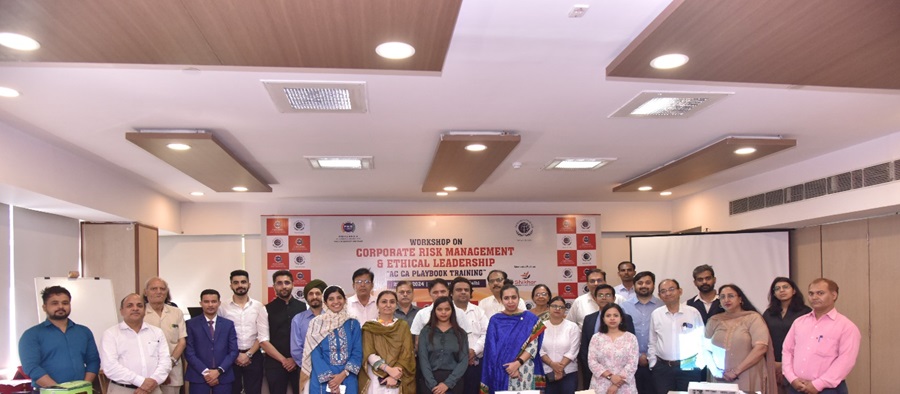


Wednesday, 22 May 2024: UN Global Compact Network India (UN GCNI) in collaboration with PHD Chamber of Commerce and Industry (PHDCCI) organized a training workshop on “Corporate Risk Management and Ethical Leadership Through Anti-Corruption Collective Action” on May 22, 2024, at PHD House, Delhi.
The thematic area of discussion was mainly around strengthening Transparency, Governance, Ethical Practices, and Integrity in Business to combat corruption through collective action. The workshop witnessed the presence of noted dignitaries from across the sectors including the business community.
Mr. Ashish Mohan Wig, Chair, of the HR IR Committee, PHDCCI emphasized the significance and importance of collective action to fight corruption in the business sector; He said that businesses and societies face complex corruption challenges daily around the world, and Collective Action is a key approach to slowing the scale of this issue.
Mr. Ratnesh Jha, Executive Director, UN GCNI discussed the UNGC’s 10th Principle “Anti-Corruption”. He shared “It is not only about individually avoiding and mitigating the risks, pitfalls, and likely costs of corruption such as legal or financial, but above all seizing the opportunities and associated benefits of a robust culture of integrity that is fostered and implemented collectively by a committed group of like-minded stakeholders”.
Mr. Ashutosh Shukla, Head of Corporate Affairs, Jackson Group, chief guest for the workshop delivered a special address emphasizing the need for joint efforts of multiple sectors. He said “Collective Action is born out of companies’ need to foster more ethical, transparent, and less corrupt business environments while mitigating potential business risks. Collective Action can complement, enhance, and further develop current and future laws and regulations whenever the latter are weakly enforced or simply nonexistent.”
Dr. Somnath Singh Deputy Director, UN GCNI set the tone of the workshop by sharing the background and Importance of Anti-Corruption Collective Action (AC CA). He shared that The AC CA Playbook builds upon resources developed by the UN Global Compact as part of multiyear projects/programs implemented under the Siemens Integrity Initiative (SII). Further research was conducted using publications and resources from strategic partners and leading organizations in the field. A series of consultations were also conducted with Global Compact Local Networks representatives and the Anti-Corruption Collective Action Working Group globally to receive feedback and tailor the Playbook to meet geographic, cultural, and other important considerations relevant to their business environments so that this AC CA playbook can be useful enough for all the sectors to identify and mitigate corruption challenges.
Mr. Arya Dev, Assistant Manager, UN GCNI gave a brief introduction to the AC CA playbook and shared the six-step process to combat corruption. He also emphasized the key roles of business actors in collective action.
The expert trainers Mr. Krishnendu Biswas, Head – Ethics & Compliance at TAKEDA Biopharmaceutical India Pvt. Ltd and Ms. Rukaiya Joshi, Retd, Professor, SPJIMR, Mumbai lead the technical sessions which include Corporate Compliance Risks and Ethical Leadership and its link with AC CA, Overview and six steps of AC CA Playbook to mitigate corruption challenges, Deep Dive on suggested steps, Risks and Opportunities in Adopting and Integrating AC CA (Business Environment; Corruption Challenges, and Stakeholders; Drivers and Incentives; Trust and Transparency, etc.), Sharing success stories and open discussion on corruption challenges and solutions.
Around 40 representatives from the potential sectors attended the workshop and took the pledge to uphold ethical conduct in all corporate affairs and promote Anti-Corruption Collective Action.
About the Organizers-
UN Global Compact Network India (UN GCNI)
UN Global Compact Network India (UN GCNI), the Indian Local Network of the United Nations Global Compact (UNGC), New York, is the first Local Network globally to be established with full legal recognition. As the UNGC local arm, GCNI, https://www.globalcompact.in/) has been acting as a country-level platform in providing a robust platform for Indian businesses, academic institutions, and civil society organizations to join hands to strengthen responsible business practices. Our ‘10 Principles in areas of Human Rights, Labour, Environment and Anti-Corruption’ provide a common ethical and practical Framework for Corporate Responsibility. The 17 Sustainable Development Goals (SDGs), adopted by all 195 Member States of the United Nations, including India, are understood, and implemented by businesses around the world, regardless of size, complexity, or location.
PHD Chamber of Commerce and Industry (PHDCCI)
PHD Chamber of Commerce and Industry (PHDCCI) has been working as a catalyst for the promotion of Indian industry, trade, and entrepreneurship for the past 118 years. It is a forward-looking, proactive, and dynamic PAN-India apex organization. As a partner in progress with industry and government, PHDCCI works at the grassroots level with strong national and international linkages for propelling progress, harmony, and integrated development of the Indian economy.
PHDCCI, acting as the “Voice of Industry & Trade” reaching out to more than 1,50,000 large, medium, and small industries, has forged ahead leveraging its legacy with industry knowledge across multiple sectors to take the Indian Economy to the next level.
At the global level, we have been working with the Embassies and High Commissions in India and overseas to bring in International Best Practices and Business Opportunities.