
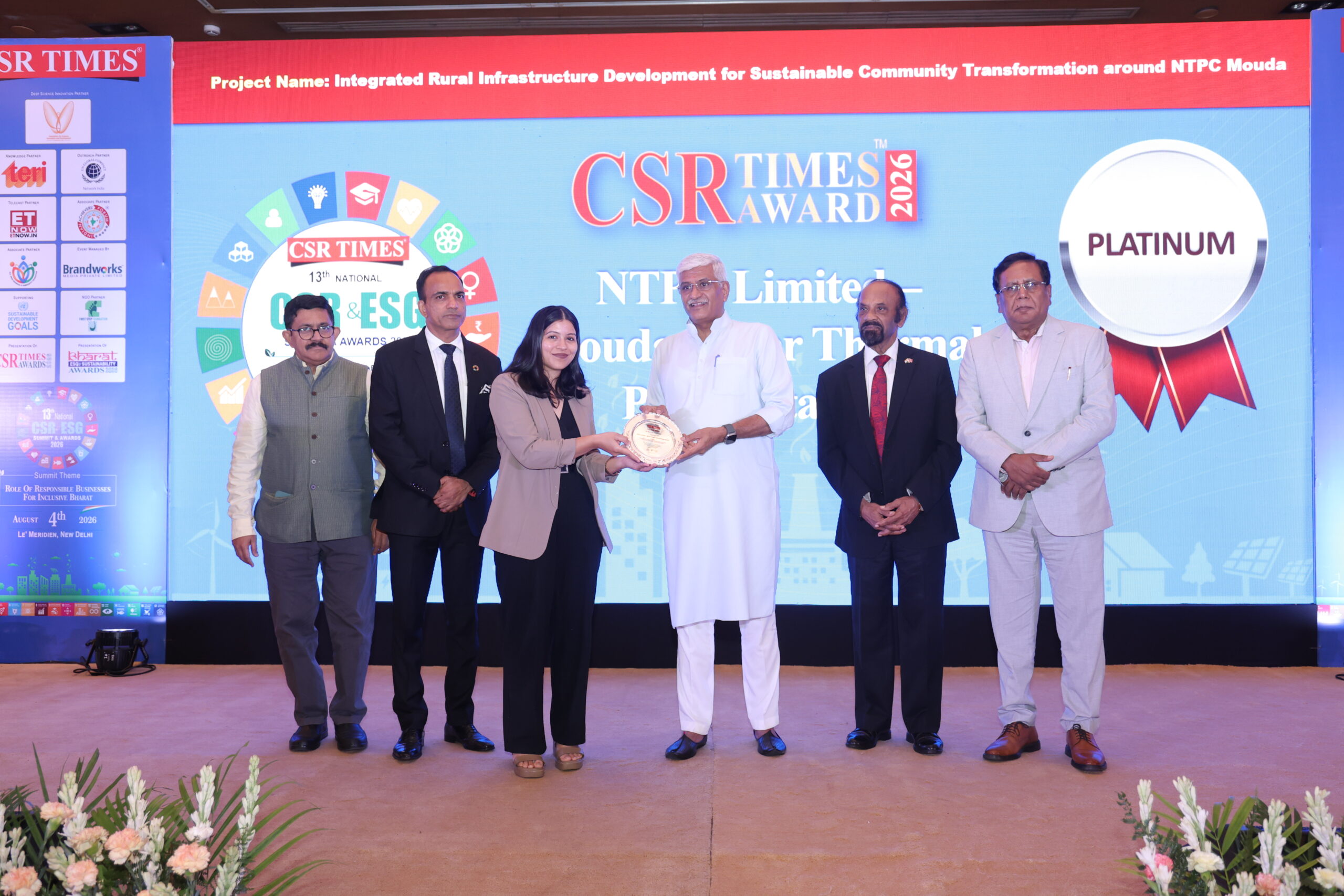
In the villages surrounding NTPC Mouda, rural development is increasingly being experienced not as a distant promise, but as a visible transformation in everyday life. Through its comprehensive Rural and Infrastructure Development programme, NTPC Mouda has adopted an integrated approach that goes beyond the creation of physical assets. Roads, schools, water facilities, community spaces, sports infrastructure and healthcare services have become building blocks for a larger vision—creating healthier, better connected, more educated and economically empowered communities.
The programme, implemented across villages in the Mouda region and selected interventions extending to Nagpur and Gadchiroli districts, was conceived through consultations with local communities, Panchayats, government departments and beneficiary groups. The focus was clear: identify the infrastructure gaps that directly affect quality of life and address them through sustainable, need-based interventions. The initiative covers villages including Tarsa, Chacher, Kotgaon, Narsada, Nimkheda, Khandala, Isapur, Rahadi, Dhamangaon, Lapka, Babdeo, Navegaon, Ajangaon, Gangner, Hiwara and Kumbhari.
Education: Creating better spaces to learn
The transformation begins with the classroom. NTPC Mouda has supported the construction and renovation of Zilla Parishad schools, installation of digital classrooms, playground equipment, toilets, kitchen sheds and other essential facilities. Through an MoU with Empathy Foundation, four government schools at Tarsa, Narsada, Chacher and Kotgaon were taken up for construction and renovation at a project cost of ₹220 lakh.
The commitment to inclusive education is particularly visible in the adoption of the Adivasi School at Nimkheda, serving around 180 tribal students. The intervention includes school uniforms, play equipment, toilets and bunk beds, addressing not only educational needs but also dignity, hygiene and residential facilities.
The impact assessment confirms that these investments are changing the learning experience. Digital classrooms were associated with a 70.5% increase in student interest and an impressive 98.4% improvement in academic performance. Playground interventions contributed to a 77% increase in physical activity and an 86.9% improvement in school attendance.
Healthcare: Taking care closer to the community
For rural families, access to healthcare can often be limited by distance and cost. NTPC Mouda has responded by bringing healthcare services directly to communities through a Mobile Medical Unit equipped with doctors, a trained nurse and pharmacy support. The MMU provides preventive and primary healthcare, including maternal and child health services.
The programme has also supported vulnerable patients through nutrition assistance to 72 identified tuberculosis patients for one full year under the Pradhan Mantri Bharat TB Mukt Abhiyan.
At the tertiary-care level, NTPC Mouda partnered with AIIMS Nagpur for establishment of a Bone Marrow Transplantation Unit and support for three patients, with a project cost of ₹1 crore. Cataract screening camps and surgeries, ambulance support and critical eye-care equipment have further expanded the healthcare ecosystem.
The impact is measurable: the IICA evaluation recorded 97.6% awareness of mobile medical services and a 54.8% reduction in the travel burden associated with accessing healthcare.
Infrastructure: Connecting communities and improving dignity
The programme’s physical infrastructure interventions respond to the everyday needs of rural households. Community halls have been developed at Kumbhari, Tarsa and Lapka; roads and drains have been constructed in villages such as Khandala and Isapur; and funeral grounds, marketplaces and other public-use facilities have been created or upgraded.
Water security has received equal attention through overhead water tanks and Water ATMs, while 17 solar high-mast lights have been installed across villages including Ajangaon, Isapur, Dhamangaon, Rahadi, Navegaon Ashti, Lapka, Babdeo, Khandala, Hiwara and Tarsa. These interventions improve not only public convenience but also mobility, sanitation and perceptions of safety.
The IICA assessment found strong improvements in infrastructure, sanitation and safety indicators, with 80–85% positive improvement across several school and infrastructure parameters.
Sports and livelihoods: Investing in confidence and opportunity
NTPC Mouda recognises that rural development must create opportunities for young people to discover their potential. A modern sports complex at Mouda now provides facilities for athletics, basketball, badminton, kabaddi and wrestling. The Rural Sports Tournament has brought together students from seven Zilla Parishad schools, with 124 students participating in the 2025 edition.
The initiative extends to Gadchiroli, where NTPC Mouda has partnered with Yashodeep Sanstha to establish a Sports Academy focused on nurturing traditional archery among tribal children.
Livelihood development complements these physical investments. An Agarbatti training and production unit for women Self-Help Groups in Dhamangaon provides a pathway towards skill development and income generation.
From infrastructure to lasting social value
The scale of the programme is reflected in its reach. The project summary estimates more than 20,000 direct and indirect beneficiaries, with thousands benefiting during FY 2025–26 alone.
Most importantly, the programme has been independently assessed by the Indian Institute of Corporate Affairs (IICA). Its Social Impact Evaluation covered 12 villages through 384 household surveys, 12 Focus Group Discussions and 36 Key Informant Interviews. The evaluation recorded 94.9% awareness of NTPC’s CSR initiatives and 96.9% direct beneficiary reach.
The programme’s estimated Social Return on Investment of 6.8:1 provides a powerful measure of the value created—indicating that every ₹1 invested generated approximately ₹6.8 in social, economic and environmental value.
The story of NTPC Mouda is therefore a story of infrastructure with a human purpose. A school becomes a gateway to aspiration. A road becomes a link to opportunity. A Water ATM becomes a source of dignity. A mobile medical unit becomes reassurance for a family. A sports ground becomes a stage for talent. A livelihood programme becomes a step towards economic independence.
By bringing these interventions together under one integrated rural development vision, NTPC Mouda is demonstrating that meaningful CSR is not merely about building assets—it is about building capabilities, confidence and communities. The programme represents a sustained partnership with rural India and offers a replicable model of how infrastructure-led CSR can translate investment into measurable and lasting social transformation.