“The deepest struggles are often the ones the world cannot see.
|
 Invisible disabilities exist all around us. They do not come with visible markers. They do not announce themselves. They sit quietly within classrooms, workplaces, and homes, often misunderstood, mislabelled, or completely overlooked. We live in a world that is quick to respond to what it can see, but often silent toward what it cannot. When a person uses a wheelchair, society immediately recognizes the need for accessibility and support. But when a child struggles to process instructions, becomes overwhelmed by noise, avoids eye contact, forgets tasks, or reacts differently in social situations, the response is often judgement instead of understanding.
A student with ADHD may be called careless because they cannot sit still in class. A child with autism may be labelled rude because they do not respond socially in expected ways. A learner with dyslexia may be considered weak in academics despite being highly intelligent and creative. An individual with sensory processing difficulties may avoid crowded spaces, not out of arrogance, but because the environment feels unbearable to them. Many neurodivergent individuals are punished for behaviours that are actually expressions of stress, anxiety, confusion, or sensory overload.
In workplaces too, invisible disabilities often remain unnoticed. An employee may struggle with communication, time management, multitasking, or sudden changes in routine, yet hesitate to seek support because their challenges are not visibly apparent. Society often expects everyone to function in the same way, at the same pace, and within the same structure, forgetting that human minds process the world differently. This is not just an educational gap. It is a societal gap.
For decades, the conversation around disability has largely focused on what is visible. As a result, invisible disabilities have remained on the margins, leading to delayed identification, lack of support, and missed opportunities for meaningful development.
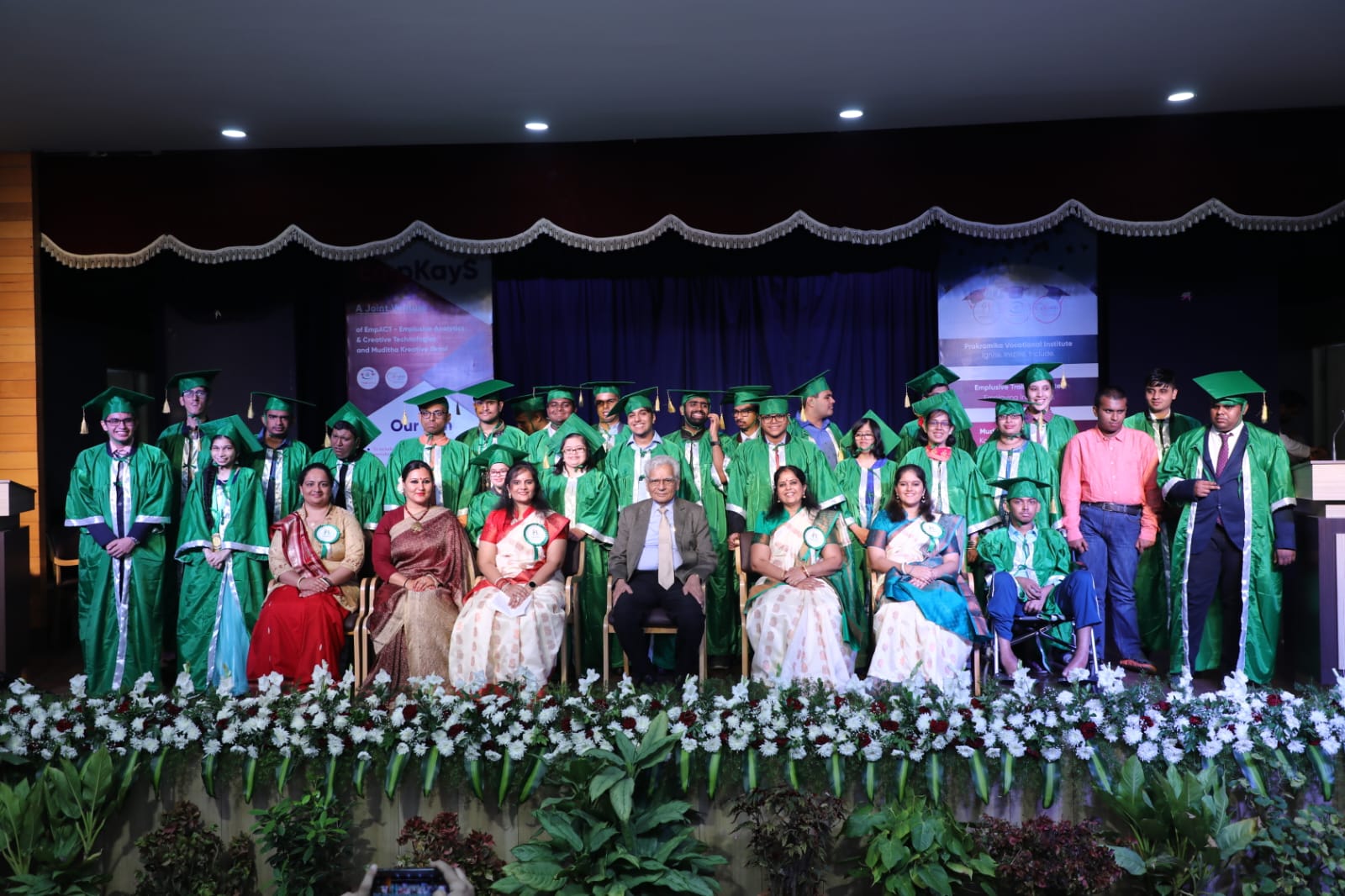
At Prakramika Vocational Institute, we have worked extensively with individuals across a wide spectrum of abilities. One consistent observation stands out. When the right structure is provided, when teaching is adapted, and when skills are built step by step, individuals who were once considered incapable begin to demonstrate remarkable competence.
This shifts the question from “What is wrong with the individual?” to “What is missing in the system?”
True inclusion requires differential teaching methodologies and universal learning design. Education must adapt to how the student learns, not force the student to adapt to rigid systems. Structured supports, flexible teaching strategies, and individualized pathways create meaningful participation, independence, and dignity. Education must move beyond textbooks and examinations. It must become a space where every learner is understood in terms of their functional abilities, learning styles, and developmental readiness. A uniform system cannot cater to diverse needs. Yet, a structured system can.
 This is where the idea of Unifying Pathways – One School, Many Abilities becomes critical. Inclusion is not about placing all children in the same classroom and expecting uniform outcomes. Inclusion is about designing pathways that allow every learner to progress meaningfully, with dignity and purpose.
When invisible disabilities are not recognised, individuals often grow up without acquiring essential life skills. Communication remains limited. Independence is compromised. Confidence is affected. Over time, this impacts employability and social participation. On the other hand, when early identification is followed by structured intervention, the outcomes are transformative. Skills can be built. Independence can be nurtured. Careers can be aligned with strengths. Lives can change.
Skill development plays a powerful role in this journey. It moves the focus from limitation to capability. It answers a fundamental question: “What can this individual do?” rather than “What can they not do?”
In a rapidly evolving world, success cannot be defined by academic performance alone. It must be defined by the ability to function, adapt, communicate, and contribute. This is especially true for individuals with invisible disabilities. Families, educators, and policymakers must work together to bridge this gap. Teachers must be equipped with practical tools, not just theoretical knowledge. Parents must be guided to understand their child beyond comparisons. Systems must be built to track progress, not just label limitations.
We must also address a critical transition that is often ignored: the journey from education to employment. Many individuals receive some form of schooling, but very few are guided toward sustainable livelihoods. Without skill-based training and structured career pathways, independence remains a distant goal.
The conversation on invisible disabilities is not just about inclusion. It is about responsibility. If we truly believe in an inclusive society, then we must ensure that no learner is left behind simply because their challenges are not visible. We must build systems that recognise diversity, respect individuality, and create opportunities that are accessible to all. Because at the end of the day, inclusion is not about removing labels. It is about building pathways so strong that every learner can move beyond them.
A truly inclusive society is not built when we merely recognize disabilities.
It is built when we redesign education, employment, and human interaction in a way that every individual, regardless of how they learn, communicate, or perceive the world, is given the opportunity to live with dignity, purpose, and independence. Inclusion is not an act of sympathy. It is the responsibility of a mature society. When education begins to value functional growth, emotional well-being, communication, and independence as much as academic achievement, invisible disabilities will no longer remain invisible.
“The goal of inclusion is not to create identical learners.
|