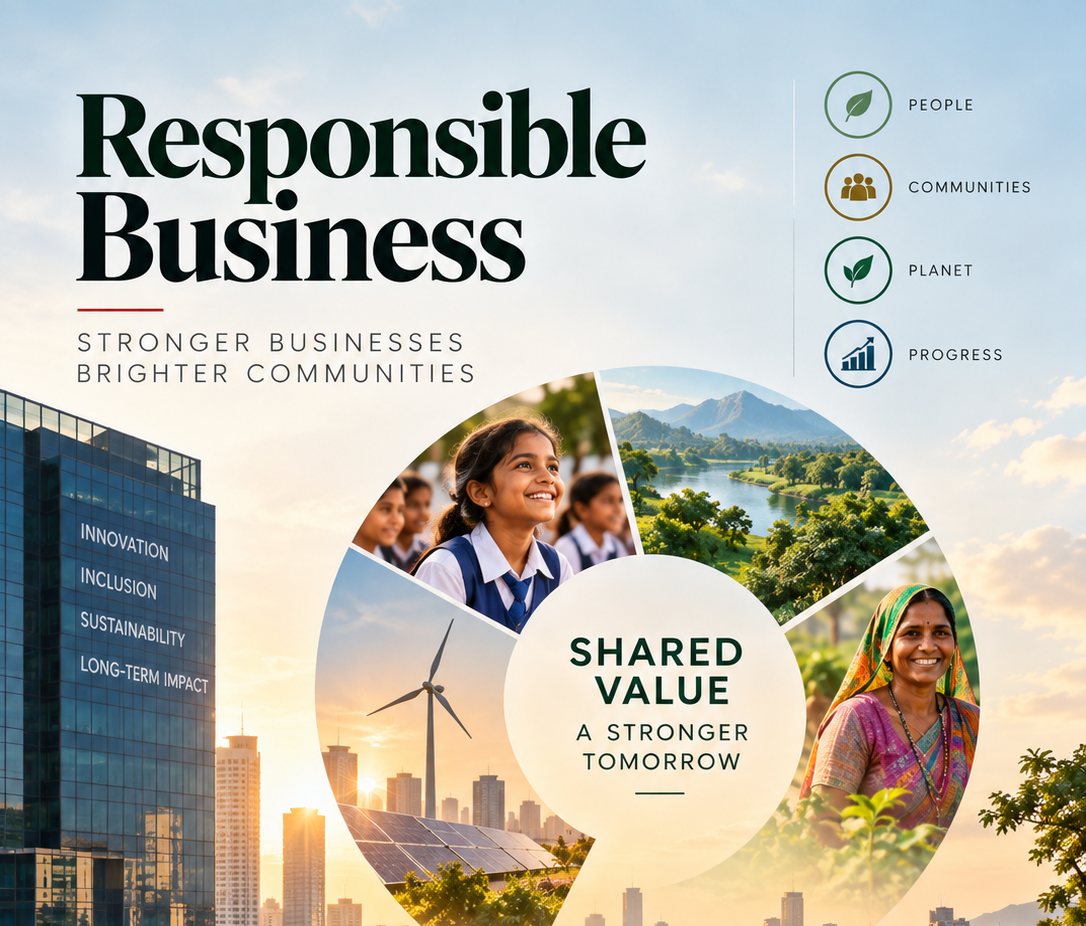
The past decade has witnessed increased assertion around climate change, inequality, malnutrition, public health, and unemployment concerns no government can handle alone. Businesses provide resources, technology, talent, and last-mile reach that make them key partners in tackling them.
A responsible business concedes its impact on people, communities, the environment and incorporates that understanding into its core activities rather than viewing it as compliance or altruism. Consumers are increasingly choosing brands that resonate with their values; investors consider ESG attributes; and younger employees seek genuine meaning. As a result, responsible business must become a significant driver of repute, competitiveness, and stakeholder trust. Shared value is not an adage but a disciplined practice: identifying opportunities where addressing a social challenge may simultaneously strengthen the business’s own ecosystem.
The Indian Opportunity
India’s development gaps are vast, persistent, and structurally stratified; but, so are the capabilities within Indian firms, including capital, technology, management expertise, and the capacity to make an intervention meaningful beyond a single hamlet.
India’s approach to responsible business has evolved over a purposeful policy arc. It began with the 2009 National Voluntary Guidelines and culminated in the 2019 National Guidelines for Responsible Business Conduct (NGRBC), which officially connected Indian enterprises’ activities with the UN Sustainable Development Goals. SEBI’s Business Responsibility and Sustainability Reporting (BRSR) framework now requires top-tier listed businesses to report standardized indicators on environmental stewardship, worker welfare, and governance, transitioning India from guidance to required disclosure.
India amended its corporate social responsibility (CSR), 2026 legislation to improve disclosure, responsibility, and impact. The new standards stress increased transparency in CSR expenditure, encouraging businesses to link their projects with sustainable development goals and demonstrable social consequences. These improvements also encourage tougher reporting standards, ensuring that firms not only make cash contributions but also actively participate in long-term community development. The updated methodology aims to turn CSR from mere compliance to a strong weapon for societal improvement by emphasizing real partnerships and purposeful initiatives.
The companies that will be most important in the future will not necessarily be those who spend the most money on CSR projects but the companies that are willing to ask challenging questions, collaborate with government, listen to communities rather than design for them from afar, and invest for the long-term impact rather than short term gains. A child eating nutritious food, a girl staying in school, a woman gaining economic independence, a worker treated with dignity some things are worth doing because they matter. This also necessitates a fundamental shift in how impact is defined and reported: away from easily quantifiable inputs, activities, outputs but towards meaningful outcomes, systemic change, and lifelong improvements in people’s lives.
At the same time, every CSR program should prioritize social return on investment, but not every commercial activity can be marketed as having a social impact. Credibility stems from being honest about the distinction and exercising discipline in determining where commercial competence and true social need cross.
The Role of Partnerships
Complex social challenges necessitate collaborative action, and each partner brings something unique: government brings legitimacy and last-mile reach that no private actor can match; civil society organizations bring technical expertise and trust earned through years of direct community work; businesses bring capital, technology, and scaled execution; and research institutions bring the rigor to test what’s actually working.
Not all social ventures require financial rationale. The true test of corporate responsibility will be how wisely a company uses its resources, influence, and alliances to help solve important challenges. This does not imply that a firm must fix every societal problem; rather, it entails being thoughtful about the problems to which a company may make a meaningful contribution. A technology company may be best suited to close digital access gaps; a company with an agricultural supply chain to build farmer resilience; a healthcare company to improve access and awareness; or a manufacturer to invest in skills or resource efficiency. When these capabilities are combined, solutions for nutrition, healthcare, education, water conservation, and livelihoods become more scalable, measurable, and sustainable.
From Projects to Purpose
The most significant shift is in cultural mindset: from embracing social impact as a portfolio of projects to viewing it as part of the company’s purpose. The true differentiation is not doing more CSR but becoming a genuinely responsible firm where profitability and purpose are not competing concerns. As corporate expectations evolve, organizations that integrate social impact into the fabric of their strategy rather than adding it after will be the ones who deliver long-term value for shareholders and society.
____________________________
- She is a senior Social Impact and Public Health Expert
- Development and Inequality in India | Springer Nature Link
- RBCI Brochure
- National-Guidelines-on-Responsible Business Conduct.pdf
- Notifications