
 CleanMax is a leading force in Asia’s renewable energy sector, setting benchmarks in sustainability for the commercial and industrial (C&I) segments. Established in 2011, the company’s operations span solar, wind, wind-solar hybrid, energy storage and carbon market services. Its innovative ‘Energy Sale’ model for rooftop solar has catalysed a transformation in the Indian energy market, bringing clean and affordable energy solutions to a diverse range of businesses. With more than 750 companies across sectors as partners, CleanMax follows a turnkey approach to project development.
Alongside its role in advancing the clean energy transition, CleanMax has increasingly focused on strengthening the communities that host its renewable energy assets. Through an education-focused CSR strategy, the company has invested in improving government schools, expanding access to learning resources, strengthening WASH facilities and creating opportunities for students in rural, underserved and low-income communities. With renewable energy projects located across Karnataka, Maharashtra, Gujarat, Tamil Nadu, Chhattisgarh, Haryana and Rajasthan, CleanMax has emerged as a long-term stakeholder in its host communities. Many of these project locations are rural or backward regions where schools face gaps in infrastructure, sanitation, drinking water and access to modern learning resources. Education therefore forms the cornerstone of CleanMax’s CSR approach.
The initiatives are guided by the principle that investment in a safe, inclusive and engaging learning environment can generate benefits extending well beyond the immediate intervention. During FY 2024–25, around 45% of the organisation’s allocated CSR funds were dedicated to education. The focus expanded further in FY 2025–26, with interventions reaching a wider geographical region and incorporating more technology-enabled, experiential and holistic learning components.
FY 2025–26: Expanding Scale and Deepening Impact
Building on its FY 2024–25 investments in school infrastructure, WASH and learning, CleanMax expanded its CSR footprint in FY 2025–26 to communities associated with a 453 MW Solar Project in Gadag, Karnataka; a 70 MW Solar Project in Isharwal, Haryana; a 50 MW WSH Project in Vaghasiya, Gujarat; a 40 MW Wind-Solar Hybrid Project in Kalikanagar, Morbi; a 50 MW Solar Power Project in N. Subbaihapuram, Tamil Nadu; a 75 MW Solar Project in Saraipalli, Chhattisgarh; and a 350 MW Solar Power Project in Bikaner 2, Rajasthan.
In Karnataka, seven government schools across Raichur, Ballari and Davangere received renovations, smart classrooms, RO plants, STEM facilities, digital learning systems, sanitation upgrades, furniture, play equipment and water-recharge infrastructure. United Way Hyderabad served as the implementation partner across the Karnataka school interventions, covering schools in Turdagi, Bannigol, Adapura, Sidiginamola, Meenahalli, Taitoni and Huchhavvannahalli. The interventions collectively impacted 1,103 students. The PDF also lists the renovation of GHPS Kalakamba in Kalburgi under United Way Hyderabad.
Maharashtra’s FY 2025–26 initiatives focused on Dhanore and Sarsi in Amravati, combining sanitation and drinking-water improvements with libraries, reading corners, Brain Gym facilities, environmental education, sports and classroom upgrades, benefiting 82 beneficiaries. Ennoble Social Innovations served as the implementation partner for both projects.
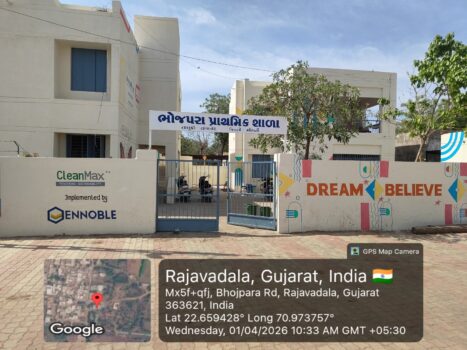
Tamil Nadu interventions covered four schools in Virudhunagar, addressing handwashing, sanitation, girls’ menstrual hygiene, school safety, play facilities and classroom infrastructure, reaching 551 students. United Way Hyderabad served as the implementation partner for all four interventions.In Gujarat, schools in Bhoj Para and Sardharka villages at Vaghasiya and Mathak village in Morbi received comprehensive transformation initiatives involving libraries, Mini STEAM Labs, VR-enabled learning, green-school measures, sanitation, safe drinking water, playscapes and classroom improvements, benefiting 1,162 beneficiaries. Ennoble Social Innovations served as the implementation partner across all four projects.
Chhattisgarh saw interventions at three schools in Kena and Ichapur villages in Mahasamund, including RO plants, toilet upgrades, recharge pits, building repairs and sports facilities. United Way Hyderabad served as the implementation partner for these interventions. In Rajasthan, the Government Senior Secondary School in Bhanipur village, Bikaner, received three new classrooms and improvements to sanitation, electrical infrastructure, furniture and learning spaces, reaching 400 students. Ennoble Social Innovations served as the implementation partner. In Haryana, the Khawa and Katwar schools received extensive infrastructure, WASH, safety, waste-management and learning-resource upgrades, impacting 166 beneficiaries. Ennoble Social Innovations served as the implementation partner for both schools.
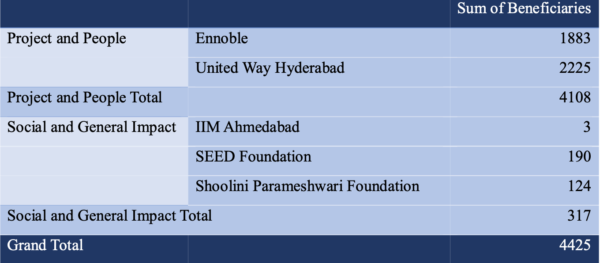 Across FY 2024–25, the education-focused CSR portfolio reached 1,799 beneficiaries according to the programme’s consolidated reporting, while FY 2025–26 initiatives reached 4,425 beneficiaries. Girls accounted for approximately 41% of beneficiaries in FY 2024–25 and around 45% in FY 2025–26, reflecting a continued emphasis on gender-inclusive educational development.
Beyond project-adjacent schools, CleanMax also supported higher education and learning opportunities through scholarships for students at IIM Ahmedabad, the EKA Fellowship in Bengaluru and SEED Foundation’s Slum Education Empowerment Drive in Mumbai. These initiatives extended the company’s education focus to higher education, leadership development, life skills and children from low-income communities. IIM Ahmedabad was the partner for the higher education scholarships, Shoolini Parameshwari Foundation implemented the EKA Fellowship, and SEED Foundation implemented the Slum Education Empowerment Drive.
The programme demonstrates a model in which renewable energy development and community development progress together. The interventions aligned with SDG 4 on Quality Education, SDG 6 on Clean Water and Sanitation, and SDG 10 on Reduced Inequalities. By responding to locally identified needs and combining physical infrastructure with digital, STEM, WASH and experiential learning, CleanMax is working to create safer, more inclusive and better-equipped learning environments while enabling communities hosting India’s clean-energy transition to share in its long-term social benefits.
After efforts in FY 2025–26, CleanMax’s education-focused CSR initiatives are expected to reach additional 4425 beneficiaries across multiple states and programme verticals. ~45% of girls will benefit from these initiatives.