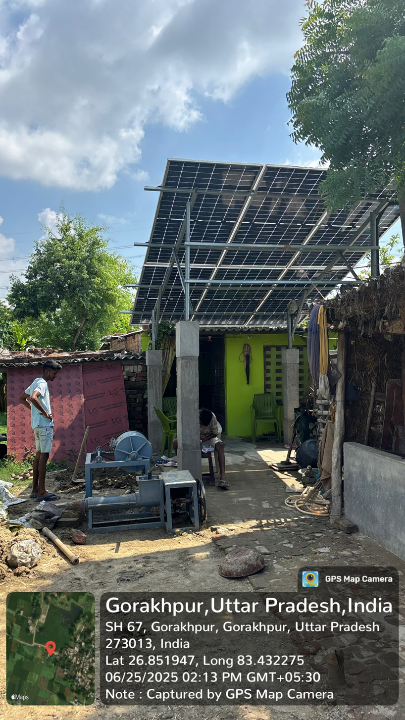
Implemented under The Energy and Resources Institute (TERI)’s Leveraging Clean Energy for a Billion Livelihoods (LaBL 2.0) programme, this initiative has helped equip two women-led terracotta production centres in Gorakhpur with a 5 kW off-grid solar system backed by 7.2 kWh of battery storage. The system runs three pieces of equipment that used to depend entirely on manual labour and an unreliable grid connection- a motorised grinder that pulverises dried clay into fine powder, a pug mill that mixes clay with water, and a motorised pottery wheel. Roughly six hours of daily power, extending further during festival-season demand peaks, now keeps this entire production running without interruption.
OTBL’s CSR Model in Practice
The project aligns with OTBL’s primary CSR vision of leveraging rural energy access to deliver deeper, more measurable returns. Reflecting on LaBL’s experiences with rural clean energy, wherein it is seen that while a solar-lit home improves quality of life, a solar-powered production line improves a household’s livelihood for posterity, this unique intervention creates pathways for income enhancement, women’s economic empowerment, and climate action.
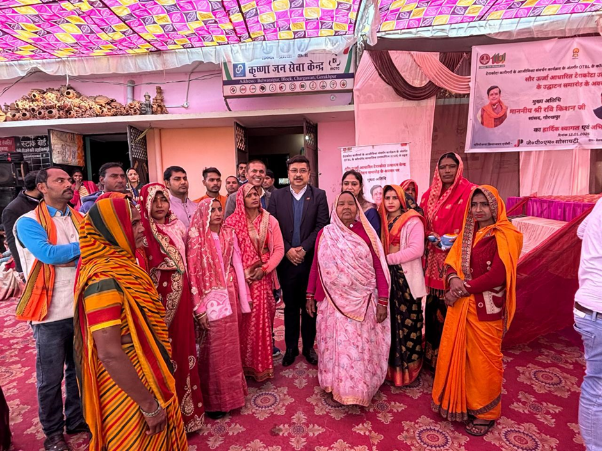
Figure 1 Women artisans at the inauguration for the OTBL CSR initiative
The results are already visible in the terracotta cluster. Artisan output has grown by roughly 1.5 times, production time per finished piece has fallen by nearly half, and incomes have risen 30 to 40 per cent. Twenty artisans benefit directly from the intervention, with close to 100 more benefiting indirectly through the surrounding local economy of suppliers, traders, and allied craft workers who depend on them.
Institution-Building alongside Infrastructure
The success of the project is highlighted by the value it has created beyond infrastructure. Two self-help groups (SHGs), each with ten women members, have formed directly around the intervention, which is an outcome of institutional strengthening. SHGs give the income gains a structure, mechanism for collective decision-making, shared resource planning, and continuity that outlasts project funding.
Time Savings for Women’s Labour
Sirjawati, a 28-year-old member of one of the SHGs in Belwaraipur village, sums up the change simply, “Earlier we had to put in a lot of effort to do all this manually, and now the same work takes half the time. I get some free time now, which I spend with my children, helping them with their studies.”. The reduced drudgery of manual clay mixing has been instrumental in saving up time from women’s daily routine of household and productive work. This time could be utilised by women for rest, recreation, family, or any activity of their choice.
Figure 2 Solar technology powering a motorised grinder at a terracotta unit
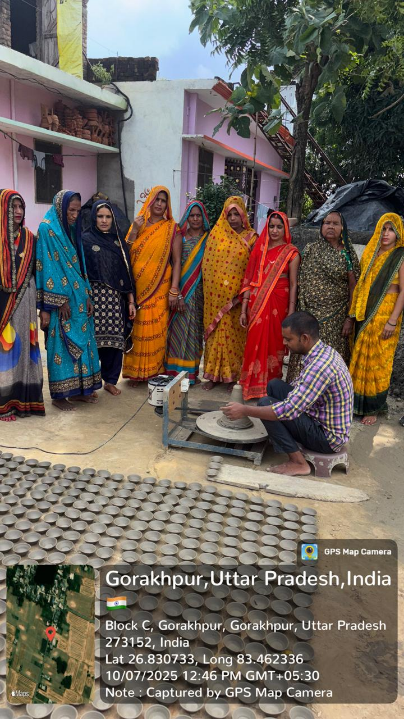
Figure 3 Women artisans getting trained to operate a motorised pottery wheel
Subtle Reduction in Out-migration
For years, young people from artisan families in Gorakhpur’s terracotta clusters left for cities in search of steadier income, often ending up in unskilled, informal work with poor returns. With production now faster, less physically punishing, and considerably more profitable, there is a subtle yet noticeable reduction in the youth looking towards cities for gainful employment. Nirma Devi, from Bharbaliya village, describes it this way, “Earlier, our children used to go to cities in search of other work. Now, after these solar-powered machines came into our artisan work, the younger generation has started taking an interest in this craft again, and some have even stopped going to the cities.” For a CSR programme, retaining skilled inherited craftsmanship within a community, is a high-value outcome.
Sustainability and Scale
The model’s sustainability rests on three pillars. First, it uses proven, low-maintenance solar-battery technology designed to enhance productivity without affecting the product quality. Second, it is anchored institutionally in SHGs lending it the power of collective action for expansion and sustainability. Third, it works alongside existing government frameworks, building on Gorakhpur terracotta’s GI tag and its status as the district’s officially designated product under the One District One Product (ODOP) scheme, and aligning with national initiatives like Vocal for Local and the PM Vishwakarma Yojana.
TERI’s plan to extend the model to 50 additional terracotta centres, reaching roughly 500 artisans directly and 2,500 indirectly, offers a clear, costed pathway for OTBL and other CSR partners to scale similar programmes for maximum impact. OTBL’s investment in Gorakhpur serves as a template for climate action investments with reportable social return.
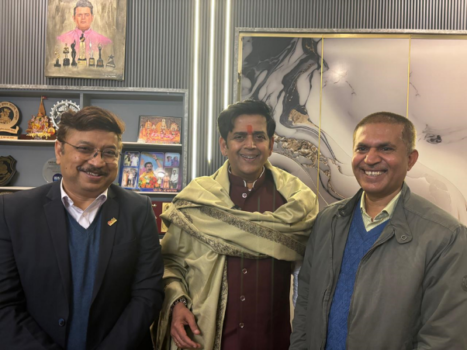
Figure 4 Shri Ravi Kishan, Member of Parliament from Gorakhpur (centre) acknowledges the impact created by the project in his constituency; with Dr Dipankar Saharia, Senior Director, TERI (left) and Mr Jitendra Tiwari, Senior Field Manager, TERI (right)
Share:
Disclaimer: The opinions expressed in this section and articles contributed are those of the respective authors, who have submitted it as their original work. They do not reflect the opinions or views of CSR Times, or its employees, management and group publications. The accuracy and reliability of information presented has not been verified by CSR Times. CSR Times will not be held responsible in any way for the content of this article.
I/we Wish To...
Sustainability breeds its constant ongoing need for regularity, credibility, and a strong, collaborative ecosystem. Since 2014, CSR Times has been at the forefront in curating powerful stories, spotlighting transformative initiatives, and amplifying the voices of diverse organizations and individuals who are shaping India’s responsible growth narrative. Through its magazines and flagship events, CSR Times has built a trusted platform that bridges corporate vision with grassroots impact. And now the CSR TIMES Newsletter emerges as a timely and purposeful initiative designed to inform, inspire, and connect stakeholders across the corporate social responsibility ecosystem, designed to meet a different and more immediate need.
The CSR TIMES Newsletter is your front-row pass to our magazine’s most loved moments: audience-favorite clips, our most popular features, powerful quotes, and the most important stories crafted for a fast-paced digital experience. Designed for today’s four-screen world, it delivers high-impact content straight to your inbox, allowing you to stay updated anytime, anywhere, and absolutely free of cost, so you never miss the conversations shaping the future of sustainability and responsible leadership. Ultimately, CSR TIMES Newsletter is about building an informed and inspired community of leaders who are committed to driving positive social and environmental change.