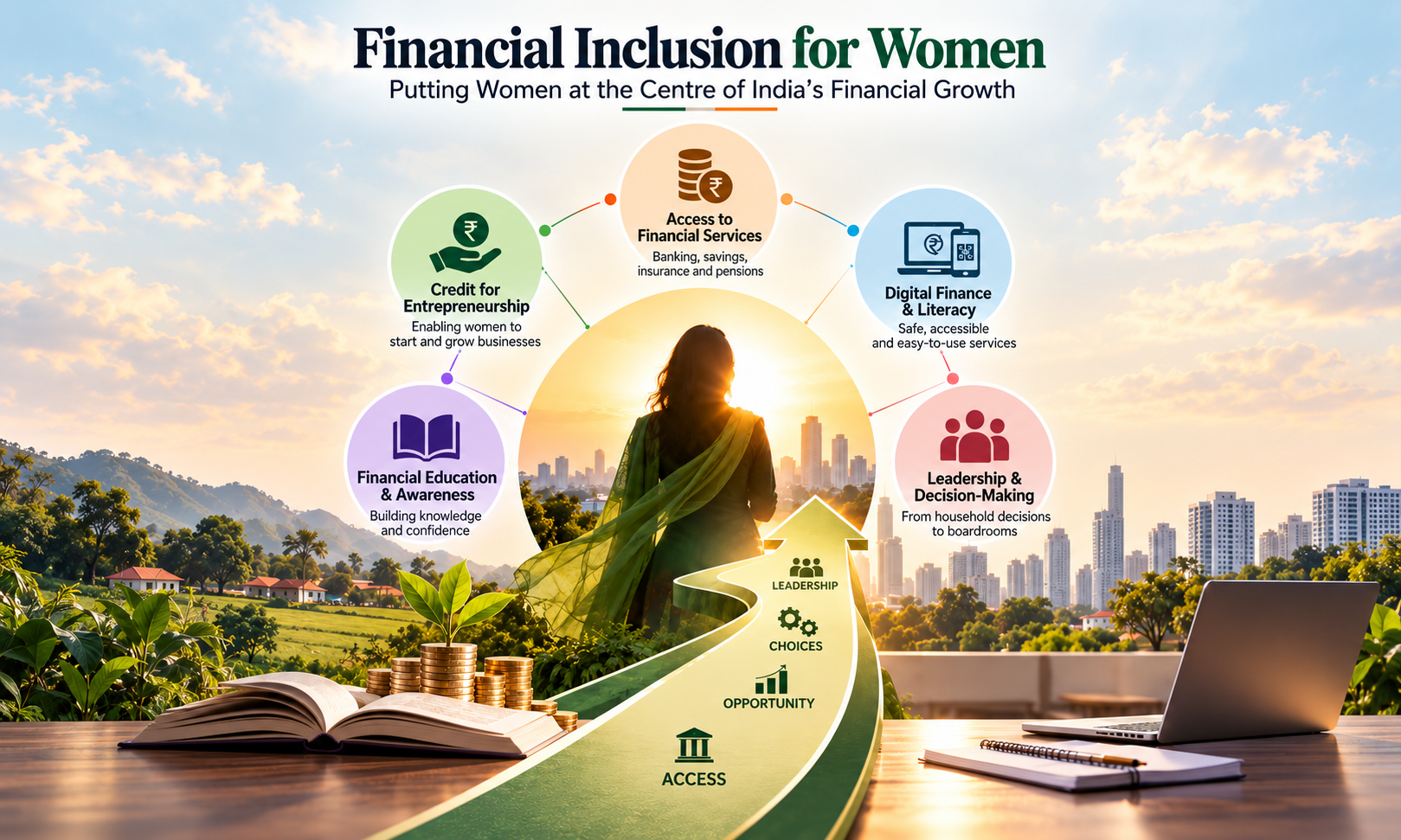
 Financial inclusion has become one of the most formidable tools of social change in independent India. India has traversed a long way in the last decade to take millions of Indians who were financially excluded into the formal system. While financial inclusion can benefit every household, for women it is an enabler to earn, negotiate and even make decisions. But the next leg of financial inclusion has to be about more than account holders. It is about empowerment and the contribution that women can make as decision makers to India’s inclusive growth.
# From Access to Agency
Government initiatives like Pradhan Mantri Jan Dhan Yojana have taken the banking sector to the doorstep of the excluded and the disenfranchised. The direct transfer of benefits to the beneficiaries’ bank accounts has placed the government closer to the people it serves. However, an account in a woman’s name may not always empower her. There could be social and institutional barriers that hinder her from exploiting the account to her liking or making independent decisions with the money. Women may be dependent on spouses for the transaction of their digital money. Financial inclusion, therefore, needs to be a continuum from simple access to the freedom to make choices and the confidence to build and grow wealth.
# Credit as a Catalyst for Women’s Entrepreneurship
The single biggest step from access to economic agency is credit. Across the country, women are running successful micro-enterprises, managing self-help groups, creating handmade products, setting up retail shops, rendering services and building digital enterprises. India has a thriving women entrepreneurship ecosystem. There are still barriers that women entrepreneurs have to overcome in order to get credit, for example, collateral, credit history, documents, and unconscious bias. The formal system has schemes such as Pradhan Mantri MUDRA Yojana and supports women’s self-help groups under Deendayal Antyodaya Yojana – National Rural Livelihoods Mission. However, banks and other formal financial institutions can go a step further and provide credit, services and support to women entrepreneurs. While access to credit is important, women need to be helped to scale their businesses, adopt technology and diversify their products and services so that they can access new markets and create more wealth and employment. India’s women entrepreneurs can change the economic story of the nation through their enterprises. Women when economically empowered have a ripple effect of improved nutrition, education, the local economy and other women’s aspirations.
# Digital Finance: Opportunity with Responsibility
India’s digital finance revolution will offer many opportunities for women entrepreneurs and workers to develop their businesses and further their careers. But women need to be digital literate and have access to appropriate technology to take advantage of this revolution. Women entrepreneurs may not have the digital skills to utilize the range of financial products and services that technology makes available. Women in their homes may not have independent access to mobile phones on which digital finance products and services run. Banks, technology providers, telecom companies and civil society have to work together to develop appropriate products and services and educate women in their use. These services and products have to be accessible in local languages and easy to use. Community-based digital literacy and assisted banking can help women to gain confidence in using digital payments, checking account balances and protecting themselves from fraud and cyberattacks.
#Understanding the Role of Corporate India
Women’s empowerment is not just about social change. It’s also a chance for corporate India to grow and do good. Companies can help by supporting women through literacy starting businesses learning digital skills and connecting them to markets. This kind of work falls under social responsibility.
To make a difference companies should team up with banks, NGOs, schools and self-help groups. They can jointly create programs that will instruct and guide women from underprivileged backgrounds how to manage money and start their own businesses. These efforts can change lives. Also bring long-term benefits to businesses.
Financial literacy needs to go beyond savings and products to include insurance, pensions, credit scores, and building wealth. Women entrepreneurs need to be guided on raising capital and taking their enterprises to the next level of growth. Corporate India has to measure its impact on women’s financial inclusion in more meaningful ways. Counting how many women have been trained in a financial literacy programme or how many bank accounts have been opened is not enough. More important are metrics like increase in personal savings, access to credit and insurance, rise in revenues and profits, purchase of assets and increase in confidence in making financial decisions. Companies can also demonstrate leadership by demonstrating economic parity in their own hiring and wage practices, promoting women in leadership positions and buying from women enterprises.
# From Household Decisions to Boardroom Leadership
The aim of financial inclusion has to be not just to make women economically independent but to give them a voice in economic decision-making. That could be at the level of the household or the community or an enterprise. At the individual level, women need to have a say in personal financial decisions relating to education, health and other matters. At the community level, they need to be members and leaders of self-help groups, cooperatives and other institutions. At the enterprise level, women need to be owners, investors, financial advisors and board members of companies. Calls for women’s voices and choices to be heard and respected in the bank, insurance, technology and investment sectors. Calls for women’s voices and choices to be heard and respected in the bank, insurance, technology and investment sectors. They need to be on boards of directors and public policy think tanks. A financial system with greater gender diversity at the decision-making level will be more attuned to the varied needs of its customers. Measuring progress via empowerment India’s ambitions of becoming a developed nation by 2047 would need the active participation of its women. Financial inclusion has the potential to advance this agenda by enabling women to be key contributors to the economy. But this will be possible only when women are given the opportunity and the confidence to grow economically. Policymakers, banks, corporates, educational institutions and civil society have to work together to build an enabling environment. Policy and product design have to focus on expanding women’s access to financial products and services that meet their specific needs. Educational initiatives have to equip women with the knowledge and confidence to make informed financial decisions. India’s next big leap in financial inclusion should not be about account holders but about a generation of women who can manage and grow wealth, take businesses to the next level, make informed choices about personal finance, influence public policy and build financial products and services. A simple bank account might get a woman to the doorstep of financial inclusion, but what she does from there is what truly determines her journey.