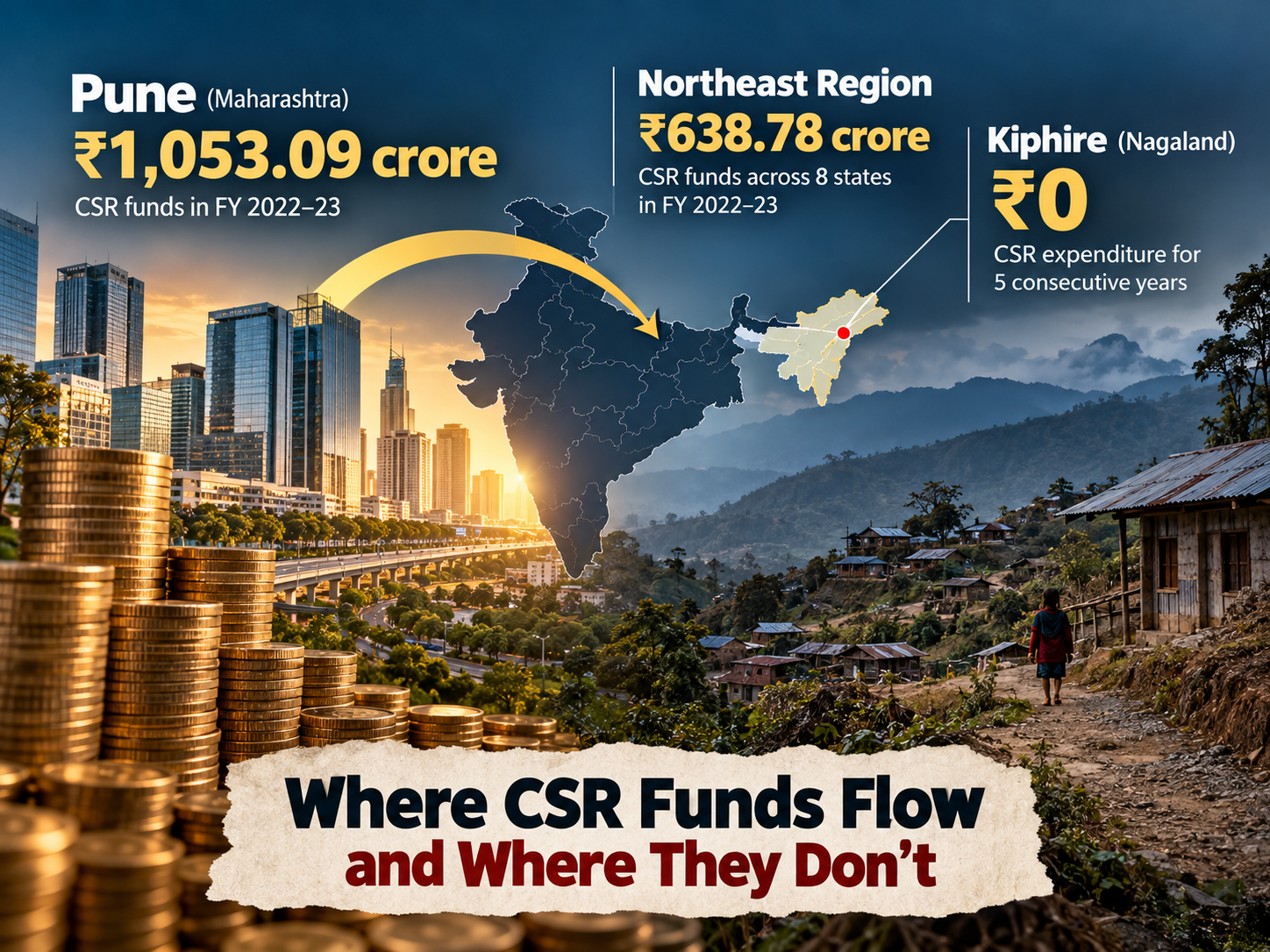
Kiphire, a district in the hill state of Nagaland, sits at the edge of India’s development map in more ways than one. With some of the country’s lowest human development indicators and virtually no industrial presence, it represents exactly the kind of place that India’s corporate social responsibility framework was designed to reach. And yet, for five consecutive financial years, Kiphire recorded zero CSR expenditure. Not a rupee.
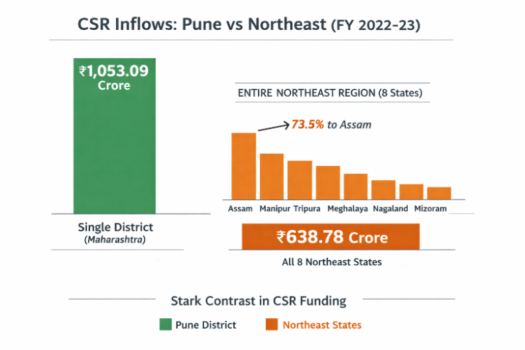
In FY 2022–23, Pune district in Maharashtra alone received ₹1,053.09 crore in CSR funds, more than the entire Northeast region combined, which received only ₹638.78 crore across eight states, according to the Ministry of Corporate Affairs CSR Portal. While Kiphire, with greater development need by almost every measure, received none. That is not a coincidence. This reflects an inherent feature of India’s CSR policy framework that channels corporate giving toward prosperity and away from poverty. This article examines disparities in CSR allocation across India’s backward regions, with a special focus on the Northeast.
The Geography of Corporate Giving
Section 135 of the Companies Act, 2013, mandates that eligible companies spend at least 2% of their average net profits on CSR activities. On paper, this represents one of the world’s most ambitious legislative attempts to harness private capital for public good. In practice, however, the distribution of these funds tells a different story.
According to a 2022 analysis by Prime Database, just five states, Maharashtra, Karnataka, Tamil Nadu, Andhra Pradesh, and Gujarat, absorb 65% of total CSR spending in India. By contrast, the eight northeastern states together received only ₹638.78 crore, about 2.8% of national CSR inflows in FY 2022–23. Of this, Assam captured more than 70%, leaving states like Nagaland, Mizoram, and Tripura with negligible allocations, according to the Ministry of Corporate Affairs CSR Portal.
India’s 115 Aspirational Districts, identified by NITI Aayog as the country’s most underdeveloped areas, home to over 15% of India’s population, received only about 2.15% of total CSR funds invested between 2014 and 2022, according to a January 2024 analysis by India Data Insights. Of these, aspirational districts in the northeastern states recorded among the lowest composite development scores in August 2023, yet continue to see the least CSR investment. The need is greatest where the money is least.
Three Structural Reasons the Money Goes Where It Is Not Most Needed
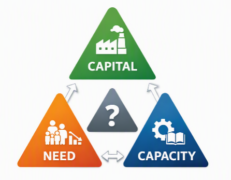
Understanding this disparity requires looking at three interlocking constraints, what might be called a Capital-Need-Capacity triangle.
First, the concentration of corporate operations.
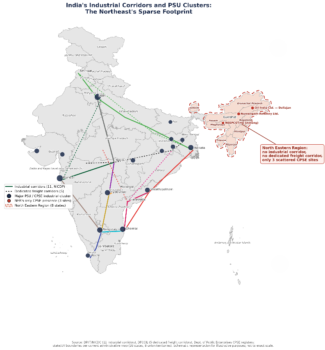
India’s largest companies, those with the highest CSR obligations, are concentrated in states with dense industrial and manufacturing activity: Maharashtra, Gujarat, Karnataka, and Delhi‑NCR. These states host the majority of India’s industrial corridors, manufacturing clusters, and PSU operational sites, according to the Department for Promotion of Industry and Internal Trade (DPIIT) and India Data Insights (2024). By contrast, the Northeast has relatively few large manufacturing units, mines, or major industrial corridors, and limited PSU footprints beyond Oil India Ltd. and Numaligarh Refinery Ltd. The Companies Act, 2013, includes a “local area preference” clause (Section 135, Schedule VII), directing companies to prioritise communities near their operations. The intent was accountability and proximity. The effect, however, is that CSR money gravitates back to states with the most operational presence, not necessarily those with the greatest developmental need. The Ministry of Corporate Affairs’ own FAQ Circular No. 14/2021 clarifies that this preference is “only directory and not mandatory in nature” and should be “balanced with national priorities.” This clarification gives companies considerable flexibility in determining where CSR resources are deployed. However, while the policy encourages such balancing, it does not specify institutional mechanisms, incentives or reporting requirements to ensure that geographically underserved regions receive adequate attention.
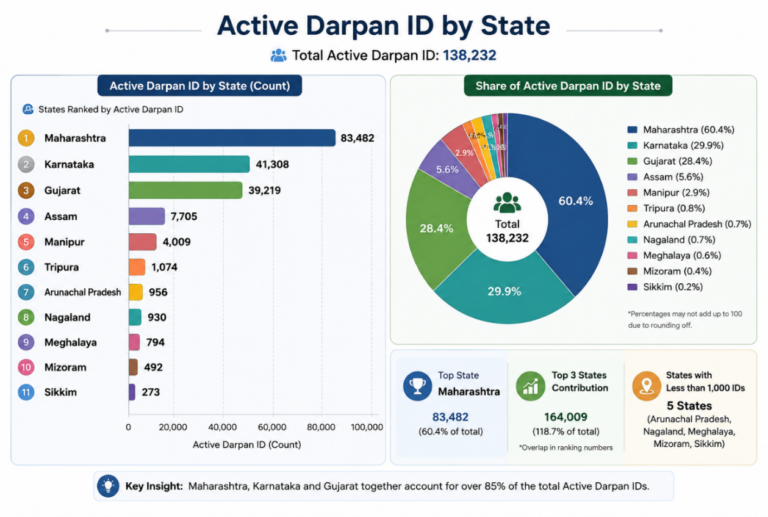
Second, the deficit of absorptive capacity. Even companies willing to invest in the Northeast often cannot. A well-functioning CSR project requires accredited implementing partners, NGOs registered under MCA’s NGO Darpan portal, capable of handling funds, reporting impact, and maintaining compliance. The data shows a striking gap: Maharashtra alone has 83,482 active NGO Darpan IDs, Gujarat 39,219, and Karnataka 41,308. By contrast, the entire Northeast eight states combined accounts for only 15,233 active Darpan IDs, led by Assam (7,705) at the top and Sikkim (273) at the bottom. Companies that encounter difficulty finding credible local partners tend to default to geographies they know. The result is a reinforcing cycle: where capacity is low, money does not flow; and where money does not flow, capacity does not grow.
Third, the invisibility of need. CSR allocation decisions are rarely driven by poverty indices alone. They are shaped by visibility, networks, ease of access, and reputational return. The Northeast, geographically remote and often perceived as logistically complex, tends to receive relatively less attention in CSR allocation patterns despite its developmental needs. High need does not automatically generate corporate attention. This is not conjecture: a 2021 study by the Indian Institute of Corporate Affairs (IICA) found that fewer than 5% of large Indian companies had any CSR project presence in the Northeast, despite the region’s high development need. The finding aligns with a scan of the annual reports of India’s top 50 CSR spenders (FY 2022–23), which shows that fewer than one in ten companies list a Northeast state among their primary project locations. The data confirm that high need does not automatically generate corporate attention, visibility, and proximity not deprivation that continue to shape India’s CSR geography.
Two Levers for Change: Company Policy and Government Direction
Correcting this imbalance requires action on two distinct fronts.
At the level of corporate CSR policy, companies can move beyond a purely proximity-based approach by adopting a diversified portfolio model for fund allocation. Rather than concentrating CSR spending primarily near corporate headquarters, a policy model proposed in a GRAAM policy brief recommends that manufacturing companies allocate approximately 40% of CSR funds to local communities, 25% to broader state-level needs, 25% to national priorities, including underserved regions, and reserve the remaining 10% for innovation and emergency response. For non-manufacturing firms, the allocation tilts further toward backward districts and national priorities. Critically, this model is voluntary; it does not wait for regulatory compulsion. HDFC Bank and ITC, while headquartered in industrial states, have maintained dedicated Northeast-focused CSR programmes through their rural livelihood and agri-extension initiatives. These examples show that geography need not be destiny — where the intent and the implementing partnerships exist, funds can reach the Northeast.
At the level of government policy, the responsibility shifts to creating enabling conditions rather than simply mandating compliance. Some state governments have already shown the way. The example below shows what this can look like in practice.
📋 GOVERNMENT IN ACTION: The Maharashtra Model Government Resolution No. HTED-11036(11)/2/2013-MHT-(TE-2) Issued by: Department of Higher & Technical Education, Government of Maharashtra Date: 30 January 2014 What it does: Establishes a State CSR Steering Committee and dedicated CSR Cell to facilitate, coordinate, and monitor CSR support for higher and technical education. All CSR proposals from companies are channelled through a central cell, matched with district-level institutional needs, and approved through a structured process. Companies seeking to invest in Maharashtra’s education sector are given a single-window interface — making it significantly easier to route CSR funds into the state’s institutions. The lesson for the Northeast: This is what proactive state-level facilitation looks like. No coercion — only coordination. |
The Maharashtra model is not just a policy document; it is a blueprint for how governments can become active intermediaries between corporate intent and social need. A dedicated CSR cell, district-level need mapping, and a structured matching process can reduce the friction that typically prevents companies from investing in unfamiliar geographies. The Ministry of Corporate Affairs could further accelerate this by introducing geographic disclosure requirements in annual CSR reporting: companies would be required to state what share of their expenditure reached aspirational districts or low-CSR regions like the Northeast. What gets measured gets managed.
Closing the Distance
India’s CSR mandate has, over the past decade, channelled hundreds of thousands of crores into social development. That is no small achievement. While the CSR legislation has successfully mobilized substantial private resources for public good, its current framework has not adequately addressed existing geographic disparities in CSR allocation.
The Northeast is not asking to be treated as a special case indefinitely. It is asking to be seen by corporate CSR planners, by state governments designing enabling frameworks, and by the Ministry of Corporate Affairs, which has the tools to make geographic equity a visible metric, not an afterthought.
Kiphire’s five years of zero expenditure are not inevitable. They are the product of structural choices that can be made differently. The first step is acknowledging that need, not proximity, must guide where the money goes.

Mentored by: Dr Ananya Samajdar, Deputy Director – Research, GRAAM.
All views are personal.
Damini B. Bhoge, GRAAM Embark India Development Fellow at the North Eastern Development Finance Corporation (NEDFi).
Damini B. Bhoge is a GRAAM Embark India Development Fellow placed at the North Eastern Development Finance Corporation (NEDFi), Guwahati, under the Department of Public Enterprises (DPE), Ministry of Finance, Government of India. Her fellowship research examines regional disparities in India's CSR fund allocation, with a focus on the structural and policy barriers that limit corporate social investment in the North Eastern Region.