
India’s aspiration to become a developed nation is closely intertwined with the larger goal of building a society in which growth is inclusive, sustainable and equitable. As businesses increasingly recognize that their long-term success is linked to the well-being of communities and the environment, responsible business is emerging as a defining pillar of India’s development journey.
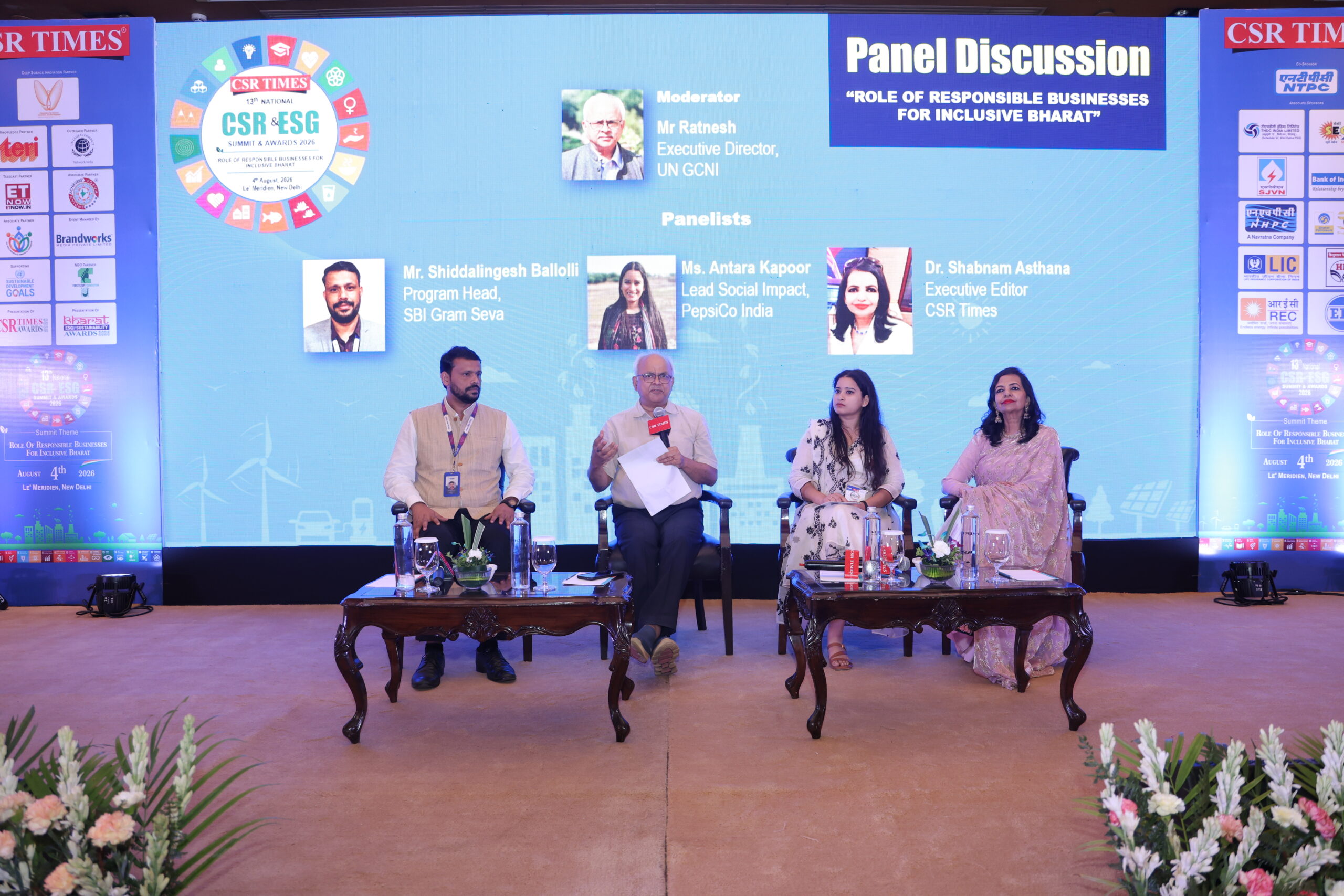
The panel discussion was held during the 13th CSR & ESG Summit 2026 on 4 August 2026 at Le Méridien, New Delhi. focused on – “Role of Responsible Businesses for Inclusive Bharat”, This meaningful discussion saw the participation of practitioners from the banking, corporate sustainability, social impact and development sectors to explore how businesses can move beyond conventional CSR and become genuine partners in nation-building.
The panel was moderated by Mr. Ratnesh, Executive Director, UN Global Compact Network India (UNGCNI). With more than three decades of experience in designing, financing, implementing and evaluating development interventions, Ratnesh brings extensive expertise in financial inclusion, enterprise development, poverty alleviation, women’s empowerment and inclusive growth. A strong development sector perspective was introduced to the conversation in keeping with his diverse experience, which spans national, state and district levels, including institutions including NITI Aayog, the Ministry of Finance and the Ministry of Rural Development.
The discussion began with Mr. Shiddalingesh Ballolli, Program Head, SBI Gram Seva, who shared his vast experience of working with rural communities. He shared valuable insights from the ground, and the realities, challenges and opportunities in rural development. With a professional profile incorporating more than 16 years of experience spanning financial services, community development and CSR, Ballolli has worked closely at the intersection of banking and social transformation. His position as the head of SBI Gram Seva, of the flagship rural development programme of SBI Foundation, includes work that focuses on rural livelihoods, community institutions and inclusive development. While voicing his perspective, what emerged as the highlight was the importance of creating self-reliant and resilient rural communities rather than limiting CSR interventions to short-term programmes.
Antara Kapoor, Lead – Social Impact, PepsiCo India, brought the corporate sustainability perspective to the discussion. Kapoor leads CSR and Foundation initiatives focused on sustainable and community-led development. Her experience encompasses water stewardship, plastic waste management, nutrition, digital literacy, women’s empowerment, disaster relief and Extended Producer Responsibility. Her work also reflects the growing importance of public-private partnerships in delivering social and environmental impact at scale.
Representing CSR Times, Dr. Shabnam Asthana, Executive Editor, introduced a perspective that stemmed from a fine blend of her experience in CSR, communications, social impact and responsible leadership to the conversation. She reiterated the emerging shift of responsible businesses from moving beyond just doing good, to communicating openly, engaging meaningfully with stakeholders and creating outcomes that could be seen and measured.
A pertinent point that was highlighted during the discussion was a growing expectation from businesses to focus on their core strategy and make environmental responsibility, social impact and ethical governance an integral part. CSR and ESG can no longer be viewed simply as compliance exercises or acts of charity. They need to be reflected in the way organizations make decisions, work with their stakeholders and create long-term value for both business and society.
The panel also emphasized the need to move from measuring activities to measuring outcomes. There was consensus that the amount spent on a CSR initiative or the number of beneficiaries reached can no doubt provide useful information, but they do not necessarily demonstrate lasting impact. The more important questions are whether communities have become economically stronger, whether livelihoods have improved, whether access to education and healthcare has increased, and whether interventions have created sustainable change.
For rural India in particular, this shift is crucial. Responsible businesses can play a crucial role in various ways. They can create a significant impact on various fronts such as focusing on strengthening local institutions, supporting livelihoods, building skills and empowering communities to be active participants in their own development. It is a proven fact that programs that focus on building local capacity and ownership are more likely to have a lasting effect than those that are entirely dependent on external support.
The panel further emphasized the importance of collaboration between corporates, government, NGOs and communities. India’s development challenges are too complex to be addressed by any one stakeholder. Businesses possess financial resources, technology, management expertise and innovation capabilities; governments provide scale and policy support; civil society organizations bring grassroots knowledge; and communities understand their own needs and aspirations. Combining these strengths effectively can result in favorable outcomes that can culminate in more effective and scalable solutions.
Technology and data can further strengthen this ecosystem by helping organizations identify needs, improve program delivery and monitor outcomes. But technology should still be driven to solve real problems, and improve people’s lives.
Transparency and governance was another important dimension. As ESG expectations increase, companies need to ensure that their sustainability commitments are backed by credible action, responsible disclosures and results that are measurable. Trust is becoming one of the most important assets for organizations and transparent communication is the key to building it.
Ultimately, the discussion reinforced a larger idea. Inclusive Bharat needs businesses to not see themselves as economic institutions but stakeholders in social progress.
The responsible business of the future will be one that understands that profitability and purpose don’t have to be competing goals. Businesses can create economic value, at the same time creating opportunities for communities, protecting the environment and strengthening social resilience.
The panel mentioned that the next phase of CSR in India has to be about partnership, participation, measurable impact and long-term commitment. Businesses can be powerful catalysts for inclusive growth when they pool their resources and innovation with community knowledge and public-sector collaboration.
As India moves toward its Viksit Bharat aspirations, responsible businesses have an opportunity – and a responsibility – to ensure that the benefits of development are available to a wider section of society. Ultimately, the path toward a developed India will be meaningful only when it is also a path toward a more inclusive, equitable and sustainable India.