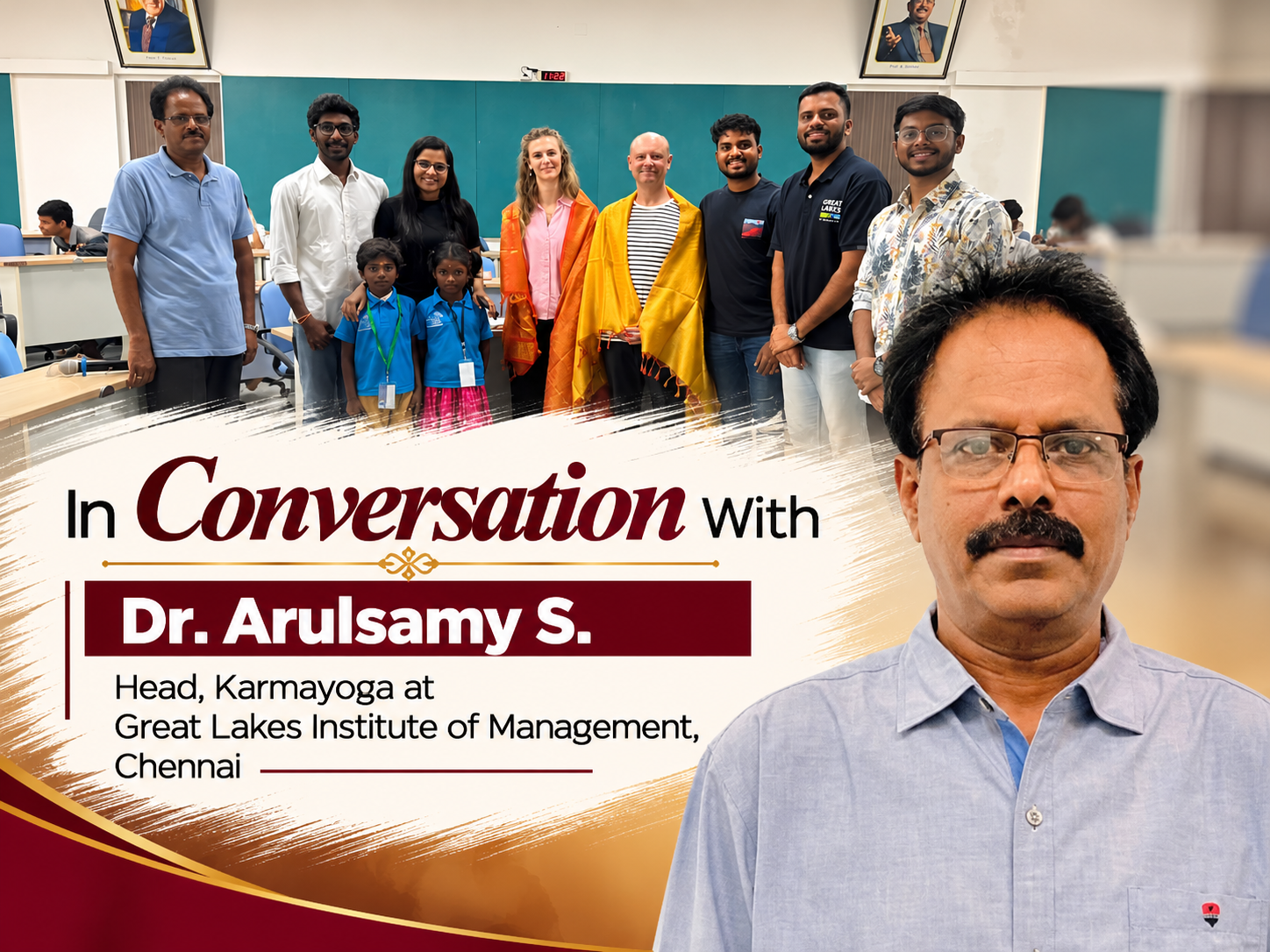
Dr. Arulsamy S., Head, Karmayoga at Great Lakes Institute of Management, Chennai, shares his perspectives on how Karmayoga at Great Lakes Institute of Management, Chennai, is redefining leadership education by taking learning beyond the classroom and into rural communities.
1.Karma Yoga is built around the idea that leadership cannot be fully learnt in a classroom and has to be experienced. What led Great Lakes Chennai to adopt this approach, and what gap in conventional management education were you looking to address?
The founder of Great Lakes Institute of Management, Dr Bala V. Balachandran, envisioned developing transformational leaders by integrating management education with experiential learning and community engagement. The establishment of the institution in proximity to rural communities reflected his conviction that management education should extend beyond classroom instruction and theoretical frameworks. He believed that meaningful learning occurs when students engage directly with real-world contexts, confront practical challenges, and apply their knowledge to address societal needs. While conventional management education equips students with analytical and managerial competencies, it may not always provide sufficient opportunities to understand ground realities and develop a deeper sense of social responsibility.
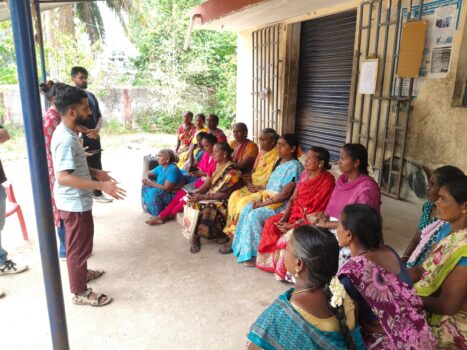
As part of this initiative, Great Lakes Institute of Management has established sustained engagement with 27 neighbouring villages that constitute its immediate community. Through regular field visits and community-based activities, students gain opportunities to apply classroom learning, understand local socioeconomic challenges, and develop practical solutions in collaboration with community members.
2.Why did you choose rural communities and villages as the setting for this leadership experience? What does a village environment teach students about leadership that a classroom, case study or business simulation may not?
Our neighbouring villagers are our immediate community, so serving them is both a responsibility and an opportunity for experiential learning. Great Lakes students undertake various participatory development projects involving farmers and fishermen, women’s self-help groups, tribal women and children, and community leaders. With the available resources and opportunities, students address issues in which plans may change according to the weather or a local festival, and they develop solutions that are practical and sustainable. Students learn to work through ambiguity and failure while remaining committed. Villages also teach humility and adaptability. These villages thus serve as living laboratories for experiential management education, fostering transformational leadership, social responsibility, and a deeper understanding of inclusive and sustainable development.
3.The programme spans education, healthcare, agriculture and livelihoods. How does working across such diverse challenges help students develop skills such as stakeholder management, empathy, negotiation and decision-making?
The developmental needs of different communities vary, and, with inclusivity as the driving force, our students try to address them within their own capacities. Each domain offers the possibility of identifying and promoting a business opportunity to generate more income for rural entrepreneurs, thereby strengthening the rural economy. The theoretical inputs gained in the classroom on running and managing a business are applied while working with new or existing entrepreneurs in the field. This presents a real challenge in helping them use the available resources and knowledge to become successful entrepreneurs.
4. The philosophy of Karma Yoga is closely linked to transformational leadership, creating capabilities rather than simply delivering solutions. How do you ensure that student interventions create sustainable change rather than becoming short-term acts of community service?
The link between Karma Yoga and transformational leadership offers a long-lasting solution for their followers when students engage with goals that empower the community. The bonding between students and communities over almost a decade paves the way for building trust, through which people develop confidence in the capabilities of our students. This trust is renewed year after year as students continue the good work in the field. Apart from short-term campaigns, such as cleanliness drives or health camps, strengthening the identified and ongoing initiatives to create more entrepreneurs and promote business ventures is the top priority.
Every project is designed to provide clear models and is structured to ensure continuity without losing the work already done, as it is carried forward by new batches of students. An intervention that passes this test reflects Karma Yoga’s spirit of selfless action and transformational leadership’s aim of developing others, leaving both the community and the students changed in lasting ways.
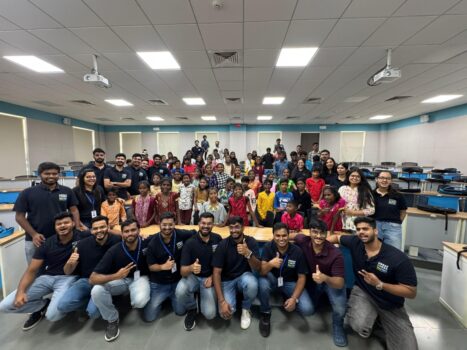
5.The programme now reaches 27 panchayat villages, 21+ schools and thousands of community members. As the initiative has grown, how have you balanced the scale of engagement with the need for meaningful, long-term relationships with communities?
As the programme has grown, we have prioritised depth before breadth, focusing on the major goal of blending classroom learning with the field-level need to create more business opportunities for people. As students of management studies, they can apply their classroom learning to identify aspiring entrepreneurs and existing enterprises within the communities and support them either in starting new businesses or in developing and scaling up their existing enterprises.
This approach would enable students to apply management concepts in real-life situations while simultaneously contributing to sustainable livelihood creation and economic development within the adopted villages. Structured handovers between cohorts, shared records, and annual review meetings with panchayat leaders preserve continuity and trust. Finally, we measure success by community-led outcomes rather than reach. The revised approach was introduced with the intention of making the Karma Yoga field projects more systematic, transparent, measurable, and results-oriented. It provides an opportunity to assess changes and development over a period of time, thereby contributing to the transformation of communities while enhancing students’ hands-on and experiential learning.
6.Looking ahead, as businesses increasingly operate in environments shaped by social complexity, sustainability and diverse stakeholders, what do you believe management education needs to do differently to prepare leaders—and what role can experiential programmes like Karma Yoga play in that future?
Management education must move towards creating future leaders who can navigate climate risk and inequality and address societal needs beyond the profit and loss of stakeholders. Their curriculum should be embedded in lived contexts rather than relying solely on case studies, community-based problem-solving rather than focusing only on individual achievement, and empathy, humility, and ethical judgement rather than analytical intelligence alone.
Experiential programmes like Karma Yoga make these shifts real. When students work alongside panchayat leaders, teachers, farmers, women’s groups, and entrepreneurs, they learn that complex problems rarely have clear-cut solutions, that listening precedes leading, and that legitimacy is earned through trust. They experience stakeholder management not as theory but as a relationship. Most importantly, Karma Yoga’s emphasis on purposeful action without attachment to personal reward cultivates leaders who measure success by the capabilities they build in others.