Most Indian cities do not plan for trees as infrastructure. Roads, flyovers, and buildings come first, and forests are mostly treated as decoration. But an urban forest cools a neighborhood, holds back air pollution, recharges groundwater, and gives people a place to relax. That is what the Government of India had in mind when it launched the Nagar Van Yojana in 2020, to build accessible city forests that boost biodiversity, cut heat islands, and get residents to feel ownership over green space.
During a survey with the Madhya Pradesh Forest Department, I spent time in two of those urban forests: Nagar Van Naulakhi in Ujjain and City Forest Nagar Van in Sagar. They sit more than 300 kilometers apart and reach the same lesson in different ways. Urban forestry works when it stops being a plantation and becomes a landscape people see themselves in.
Ujjain: a forest built around faith
Naulakhi, on Maxi Road at the edge of Ujjain, has turned an underused patch of land into a forest of more than 12,000 saplings covering roughly 180 to 200 native and medicinal species. What stands out is not the planting, it is the design.
Visitors walk through Ram Van marg, inspired by Lord Ram’s life story; Navgrah Vatika;
Nakshatra Vatika; Sapt Rishi Vatika; Smriti Van; and sections of medicinal plants. Each space gives people a reason to be there beyond a casual stroll, and a walk turns into a lesson in culture and ecology.
Unlike the fertile alluvial plains, Naulakhi sits on murrum soil, which holds little moisture and bakes through summer. The forest staff told me they mix imported black soil with vermicompost (kenchua khad), and neem cake (neem khali), to improve fertility and keep termites off the saplings. With replacement planting and heavy maintenance, they have kept an estimated 80 to 85 percent of the trees alive.
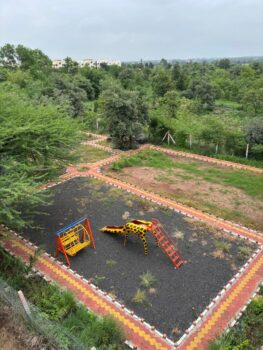
The place also works as an outdoor classroom. Each species has QR-coded signboards, while walking trails, play areas, open gym, bird habitats, and thematic gardens pull families and school groups into learning about faith & our culture around nature.
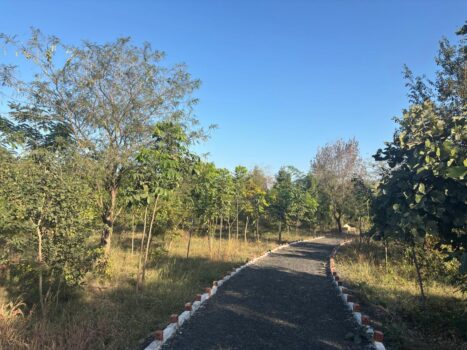 Visit Sagar: find your tree
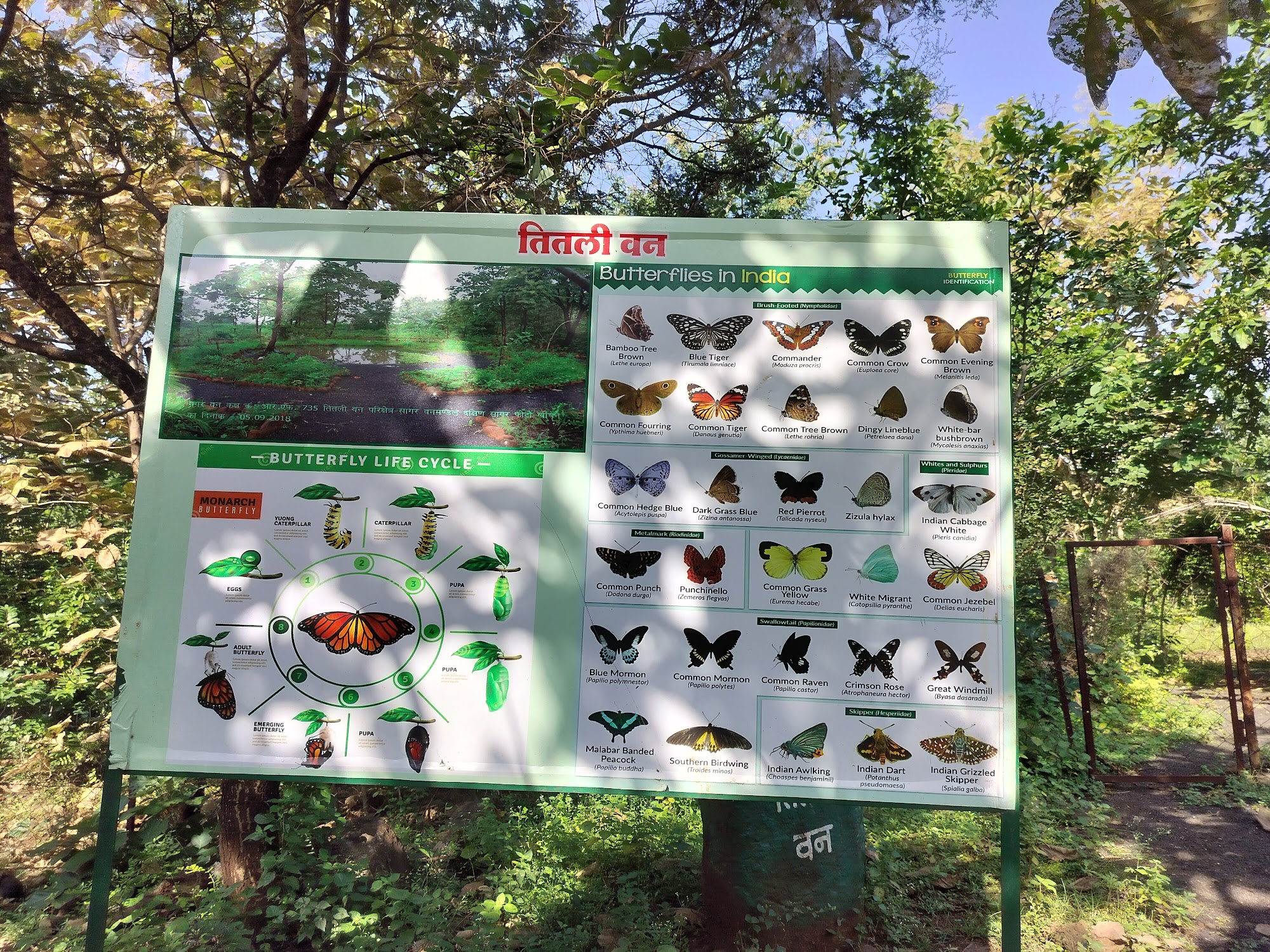
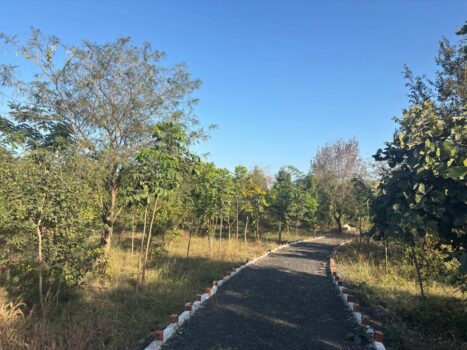
Spread over nearly 80 hectares, it runs a roughly three-kilometer walking trail that links a Rashi Van, a Nakshatra Vatika, a butterfly park, ponds, a watchtower, and open fitness areas. Many people arrive looking for the tree tied to their zodiac sign or birth constellation.
Forest staff report almost no vandalism or littering, because many visitors treat the space more like sacred ground than a city park. Families come from nearby villages, schoolchildren and morning walkers use it daily. It has become a shared community space, not just a government project.
Roughly 90 to 95 percent of planted saplings have survived here, that includes neem, shisham, karanj, arjun, amla, aloe vera, and other natives. Better habitat has also brought the wildlife back: peacocks, nilgai, wild boar, rabbits, foxes, porcupines, and several rare bird species, something you rarely see inside a city.
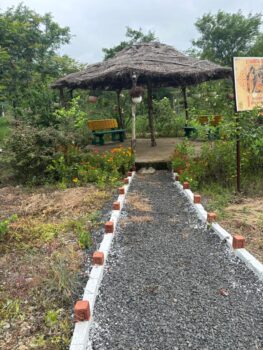
They have also kept the infrastructure deliberately simple: wooden benches, pagodas, ponds,
a watchtower and natural interpretation boards.
Beyond the plantation
The most useful lesson came from forest guards, as visitors keep asking where they can get the plants they see. Staff point them to nearby government nurseries, where saplings cost little. Often a family comes to identify its zodiac tree or a medicinal plant and leaves with a sapling for its own backyard.
Every tree planted in a home garden extends the urban forest into private space. Greenery stops being locked inside government land and starts spreading through the city. Both forests have also become centers of environmental education. Schools organize plantation drives, QR codes teach visitors about plants, and awareness campaigns push the ecological value of native species. This lines up with what the Nagar Van Yojana set out to do: raise green cover, conserve biodiversity, clean urban air, mitigate heat islands, and build community ownership.
The takeaway
The success of Ujjain and Sagar is not about planting more trees. It is all about giving people a reason to care. One forest connects visitors through mythology and memory and the other connects them through astrology and identity. Both turn ecological restoration into a shared cultural experience.
The strongest climate solutions are not always the most technical. Sometimes they start with a child finding the tree of their birth star, or a family taking home a sapling that will shade the next generation.